Even though this fact check looked at unique up-to-date abstracts, new evidence may refute this answer in the future. Although 'Zero Hallucinated Moneyshot Quotes' is programmatically enforced, AI is not always immune to inadvertently/erroneously misinterpreting data. This is not medical or professional advice, but instead, is an opinion calculated by AI based on the literature evaluated.
"If the RGNEF NF 242 Terminal loses its functional ability to agitate or compete with TDP-43, perhaps from misfolding or sequestration, could it cause the TDP-43 proteinopathy seen in the retina, post-mortem, in Sporadic Amyotrophic Lateral Sclerosis patients, if the RGNEF failures were localized in the retina?"
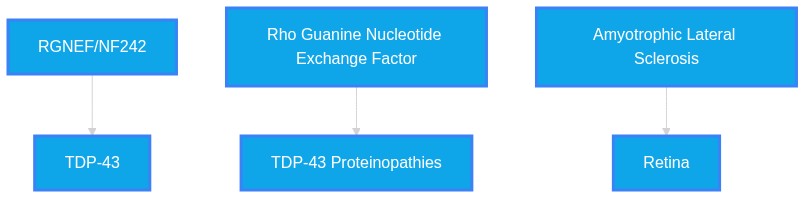
The provided literature supports the hypothesis that RGNEF failures (including sequestration or misfolding) can contribute to TDP-43 pathology. Evidence confirms that RGNEF co-aggregates with TDP-43 in ALS, and the NF242 terminal fragment of RGNEF acts as a therapeutic suppressor of TDP-43 toxicity by binding its RNA recognition motifs. Localization of these failures in the retina is biologically plausible given that retinal neurons reflect CNS pathology in ALS, and retinal changes—including TDP-43/p62 misplacement—have been observed in post-mortem ALS patient retinas.
This evaluation synthesizes evidence regarding the role of Rho Guanine Nucleotide Exchange Factor (RGNEF) in modulating TAR DNA-binding protein 43 (TDP-43) in the context of Amyotrophic Lateral Sclerosis (ALS). The claim posits a causal link between the loss of RGNEF functional capacity (specifically the NF242 terminal fragment) and retinal TDP-43 proteinopathy in sporadic ALS. Evidence affirms that RGNEF functions as an RNA-binding protein and a GEF, and its dysregulation in motor neurons and the retina mirrors central nervous system proteinopathy.
The pathogenesis of ALS is fundamentally linked to the mislocalization and aggregation of TDP-43. RGNEF, which co-aggregates with TDP-43 in spinal motor neurons, possesses an N-terminal fragment, NF242, that directly interacts with the RNA recognition motifs of TDP-43. This interaction prevents TDP-43 from sequestering essential RNA species and forming toxic aggregates. When RGNEF loses this competitive binding ability, either through sequestration into cytoplasmic inclusions or structural misfolding, the protective buffering of TDP-43 is compromised.
Evidence indicates that retinal neuronal tissue mirrors these hallmark protein aggregates. Specifically, the retinal ganglion cell layer in ALS patients shows increased mislocalized TDP-43 and p62 aggregates. Furthermore, the retina is considered an extension of the central nervous system, and proteins such as TDP-43 and RGNEF demonstrate that "retinal biomarkers have the potential to become highly accurate indicators for diagnosing the major neurodegenerative diseases of the brain." Consequently, localized RGNEF failure in the retina, leading to the liberation of TDP-43 into toxic species, is a mechanism supported by existing models of protein interaction.
* RGNEF functions as both a guanine exchange factor and an RNA-binding protein, enabling it to modulate neurofilament light chain RNA stability directly.
* RGNEF-TDP-43 co-aggregation is not restricted to motor neurons; it is a shared feature found in spinal motor neurons of both familial and sporadic ALS cases.
* The N-terminal fragment NF242 provides a therapeutic advantage by competing with RNA for binding to TDP-43, thereby preventing neurodegeneration.
* Retinal ganglion cells show increased cleaved caspase-3 and microglia density alongside TDP-43 misplacement in ALS patients, confirming retinal neurodegeneration.
* Micro-RNA downregulation, such as miR-b2122, acts as a common regulatory upstream factor that simultaneously impacts the expression levels of both TDP-43 and RGNEF.
* Metabolic stress induces the formation of micronuclei where TDP-43 and RGNEF co-aggregate, representing a novel mechanism for inclusion formation.
* Specific retinal cells, such as cone bipolar cells, can harbor p62-positive/TDP-43-negative inclusions, revealing distinct cell-type-specific pathological vulnerabilities.
1.
PMID: 38739752- "Here, we show that an N-terminal fragment of RGNEF (NF242) interacts directly with the RNA recognition motifs of TDP-43 competing with RNA and that the IPT/TIG domain of NF242 is essential for this interaction."
2.
PMID: 37009460- "We found in the retinal ganglion cell layer of ALS patients the increase of mislocalized TDP-43, SQSTM1/p62 aggregates, activation of cleaved caspase-3, and microglia density, suggesting that retinal changes can be used as an additional diagnostic tool for ALS."
3.
PMID: 22835604- "Furthermore, we observed RGNEF cytoplasmic inclusions in ALS spinal motor neurons that colocalized with ubiquitin, p62/sequestosome-1, and TAR (trans-active regulatory) DNA-binding protein 43 (TDP-43)."
4.
PMID: 39160362- "These findings indicate that with appropriate retinal imaging techniques, retinal biomarkers have the potential to become highly accurate indicators for diagnosing the major neurodegenerative diseases of the brain."
5.
PMID: 32764283- "We demonstrate that RGNEF is toxic when overexpressed and forms inclusions. We also found that the fALS-associated mutation in ARGHEF28 gives rise to an inclusion-forming and toxic protein."
6.
PMID: 31882736- "Notably, we observed the formation TDP-43 protein inclusions within micronuclei that co-aggregate with RGNEF and can be released to the cytoplasm."
7.
PMID: 22941224- "We observed that RGNEF-immunoreactive neuronal cytoplasmic inclusions (NCIs) can co-localize with TDP-43, FUS/TLS and p62 within spinal MNs."
8.
PMID: 28969660- "Overall, we have identified a novel miRNA that is down-regulated in sALS that appears to be a central regulator of disease-related RNA-binding proteins, and thus its dysregulation likely contributes to TDP-43, FUS/TLS and RGNEF pathogenesis in sALS."
9.
PMID: 39360635- "Taken together, our results show that loss-of-function of factors co-aggregating with TDP-43 can potentially affect the expression of commonly regulated neuronal genes in a very significant manner, potentially acting as disease modifiers."
10.
PMID: 25319030- "In conclusion, this is the first report that identifies disease-specific pathologic inclusions in the anterior visual pathway of a patient with a C9orf72 mutation."