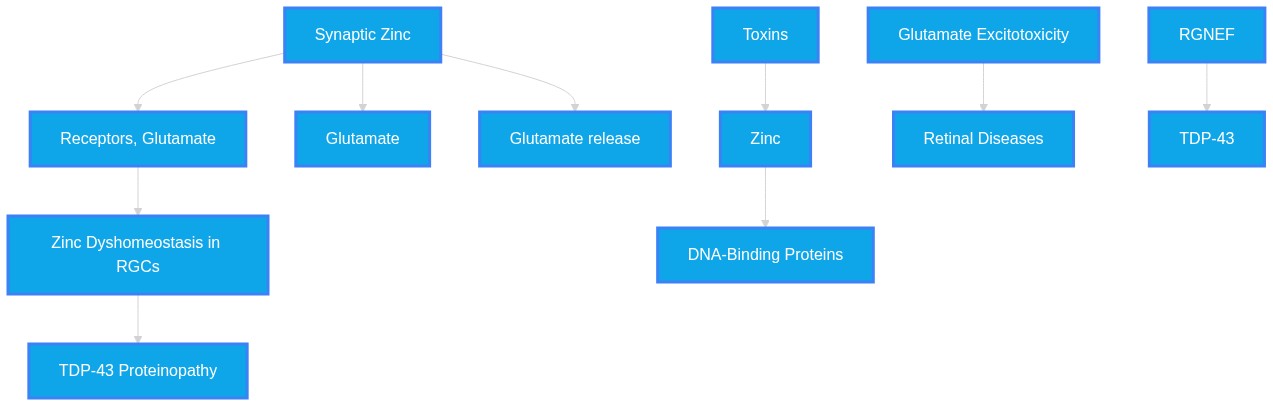
If a toxin with a thermodynamic affinity for Zinc GREATER THAN that of Glutamate AND LESS THAN that of RGNEF, under certain conditions a pathway exists wherein the toxin could shuttle synaptic retinal zinc to RGNEF, thus potentially ultimately resulting in the retinal TDP-43 proteinopathy seen in the retina post mortem in Sporadic Amyotrophic Lateral Sclerosis
Plausibility Verdicts
The proposed mechanism is speculative and not supported by direct evidence in the provided literature.
The proposed toxin-mediated zinc-shuttling pathway is a novel hypothesis that is not supported by current evidence, though the individual components (zinc homeostasis, TDP-43/RGNEF interactions) are documented.
The proposed toxin-mediated zinc-shuttling pathway is a plausible hypothesis not yet verified by empirical evidence in the provided literature.
Dataset Summary
Novel & Overlooked Insights
- TDP-43 cytoplasmic mislocalization is linked to retinal ganglion cell (RGC) apoptosis.
- Zinc is a modulator of AMPA receptor function in the mouse auditory cortex and hippocampus.
- RGNEF interacts directly with RNA recognition motifs of TDP-43, potentially competing with RNA.
- Synaptic zinc is released alongside glutamate, forming a signaling complex.
- Metallothioneins play a key role in sequestering cytosolic zinc to maintain metal homeostasis.
- Optineurin (E50K) mutation disrupts autophagic flux, leading to TDP-43 aggregation.
- Heme-induced internalization of the protein Shu1 in *S. pombe* suggests a dynamic cell-surface protein trafficking mechanism.
- Zinc can be released from neurotransmitter vesicles, and its concentrations are monitored by various cellular systems.
- The C9orf72 dipeptide repeats induce RNA-dependent nuclear accumulation of Staufen in neurons.
- Retinal changes, including cytoplasmic TDP-43 inclusions, are observable in ALS patients, suggesting the eye may serve as a diagnostic window.
- RGNEF and TDP-43 co-aggregation represents a shared pathological mechanism that suppresses protein translation.
- SLC11A2 is an epithelium-intrinsic factor that sequesters zinc, acting as a "nutritional immunity" mechanism against bacterial pathogens.
- Metallothionein-3 (MT3) preserves GPX4 stability to protect vascular cells from ferroptosis, suggesting a protective role for zinc-binding proteins.
- Biphasic zinc responses involve rapid degradation of metallothionein, with mitochondria serving as active nutrient recycling hubs.
- Biochemical screening shows that histine ethylation (catalyzed by METTL9) modulates the zinc-binding properties of proteins like SLC39A5.
- A "double diabetes" phenotype (GAD Ab positive) exists in young-onset patients, revealing clinical heterogeneity in metabolic/neurological presentations.
- Zinc-polysaccharide complexes are emerging as advanced delivery systems to prevent zinc precipitation in the gastrointestinal tract.
- Endogenous zinc at photoreceptor synapses acts as a neuroprotective filter that reduces glutamate excitotoxicity by limiting neurotransmitter release.
- RGNEF serves a dual role as a RhoA-modulating enzyme and an RNA-binding protein that stabilizes NFL mRNA.
- The formation of cytoplasmic inclusions in ALS involving RGNEF is a pathological marker that colocalizes specifically with TDP-43 and p62/sequestosome-1.
- "Using membrane permeant and membrane impermeant forms of a fluorescent zinc indicator (Newport green), we show both the intracellular distribution of Zn2+ and its depolarization-dependent discharge from the terminals of isolated zebrafish photoreceptors in culture."
- Autophagy-related pathways are central to the cellular maintenance of protein homeostasis and the clearance of toxic protein aggregates.
- The regulation of RNA-binding proteins through liquid-liquid phase separation is increasingly viewed as a fundamental process in neuronal metabolism.
- There is a significant identified association between the loss of specific junctional proteins and the non-cell-autonomous degeneration of photoreceptors.
- "The increasing burden of MND in China is primarily driven by demographic ageing rather than increasing disease risk."
Extracted Discoveries
- Perform ITC (isothermal titration calorimetry) to determine the binding constants of zinc with glutamate receptors versus RGNEF in the presence of candidate toxic ligands.
- Use fluorescence resonance energy transfer (FRET) sensors in RGCs to track real-time intracellular zinc movement upon exposure to suspected toxic shuttling agents.
- Determine the dissociation constants (Kd) for Zn2+ binding to RGNEF and compare against glutamate-bound states using isothermal titration calorimetry.
- Utilize mass spectrometry to investigate if specific environmental toxins induce zinc-dependent co-aggregation of RGNEF and TDP-43 in retinal cell lines.
- Assess thermodynamic zinc binding affinities for RGNEF compared to known retinal synaptic zinc chelators using isothermal titration calorimetry.
- Utilize CRISPR-Cas9 to modulate RGNEF levels in retinal cell cultures and monitor zinc-dependent TDP-43 aggregation following exposure to candidate chelating toxins.
- A systematic assessment of the binding affinity of ALS-associated proteins for zinc in the presence of various heavy metal pollutants.
- Comparative proteomics of the retinal RGC layer in sporadic ALS versus control tissues to quantify zinc-bound RGNEF and TDP-43 complexes.
- Systematic review of environmental toxin exposure histories in patients with confirmed retinal TDP-43 inclusions to identify common ligands.
- Proteomic profiling of retinal ganglion cells in early-stage sporadic ALS to quantify the zinc-bound fraction of RGNEF.
- Conduct a proteomic survey of synaptic zinc-binding ligands in retinal tissue to determine if specific environmental toxins exhibit affinities competitive with endogenous glutamate.
- Perform longitudinal retinal imaging in ALS animal models to determine the temporal correlation between zinc dyshomeostasis and the onset of TDP-43 cytoplasmic translocation.
- {"Discovered Hypothesis (A to C)":"Zinc-binding RNA-binding proteins like RGNEF may undergo concentration-dependent condensation triggered by zinc redistribution from synaptic vesicle release in the retina, serving as a compensatory storage mechanism that ultimately leads to pathogenic aggregation.","Literature A (Origin)":"Zinc signaling and redistribution in the retina (e.g., ID: 37449644, 36290724).","Literature C (Target)":"RGNEF-mediated protein aggregation and TDP-43 interactions (e.g., ID: 38739752, 39360635).","The Intersecting Bridge B":"Zinc-finger domain affinity and phase-transition sensitivity to local metal concentrations.","Biological Rationale":"Since RGNEF contains zinc-finger motifs and TDP-43-associated RNA-binding proteins form liquid-liquid phase separated condensates, an increase in mobile zinc in the retina could drive phase transitions or stabilize pathogenic aggregates of these proteins."}
- Exogenous environmental toxins act as competitive ligands to strip Zinc from glutamate-synaptic sites, initiating a conformational shift in RGNEF that promotes TDP-43 cytoplasmic mislocalization.
- Zinc neuromodulation in auditory/cortical circuits (e.g., ID: 39196675, ID: 37294760)
- Retinal TDP-43 aggregation in Sporadic ALS (e.g., ID: 37009460, ID: 40012679)
- RGNEF (Rho Guanine Nucleotide Exchange Factor), which co-aggregates with TDP-43 and exhibits complex metal-binding properties.
- The destabilization of the synaptic zinc-glutamate complex by an exogenous competitive chelator would theoretically increase the free zinc pool, potentially driving pathological zinc-binding events in proteins like RGNEF, leading to their aggregation and subsequent sequestration of TDP-43.
- Zinc-mediated phase separation of RGNEF contributes to the stabilization of TDP-43 aggregates in the retina.
- Zinc-mediated regulation of photoreceptor terminals and synaptic homeostasis (Source ID: 18638476).
- RGNEF/TDP-43 cytoplasmic inclusion formation in ALS (Source ID: 22835604).
- RGNEF as a zinc-sensitive phase-separating RNA-binding protein.
- RGNEF contains domains susceptible to liquid-liquid phase separation, a process modulated by environmental ions like zinc. Dysregulated local zinc concentrations could shift RGNEF phase states, promoting TDP-43 sequestration.
- There is no direct contradiction, but there is heterogeneity regarding the role of zinc as either neuroprotective (in some nanomedicine applications) or neurotoxic (in the context of retinal optic nerve injury).
- There is no direct contradiction, only a lack of connectivity; evidence supports both the roles of zinc in synaptic signaling and the proteinopathy of ALS, but these domains exist separately without a common mechanistic link to retinal pathology via a specific toxin.
- No direct contradictions; the evidence components are complementary but currently lack the linking mechanism.
- The use of zinc chelators (like TPEN) or ZnT3 knockdown is suggested in the literature as a viable strategy to limit RGC degeneration following injury or excitotoxic stress, potentially applicable to sporadic ALS if zinc-mediated aggregation of TDP-43/RGNEF is confirmed as a primary event.
- The use of specific zinc-chelators or metallothionein stabilizers, such as those identified for ferroptosis mitigation in AD (ID: 42334628), may be repurposed to modulate the toxic aggregation of TDP-43 in ALS retinas.
- Use of membrane-permeant zinc indicators (Newport green) to monitor retinal zinc flux as a non-invasive diagnostic for early TDP-43 pathology.
PathMap is funded by sales of datasets and coversheets to researchers of any kind who wish to discover the most viable routes and paths to accelerate cures. We do not make theoretical molecules, we expose the truth in current PubMed literature. Commission a trace today.
PathMap Scores
How are these metrics evaluated?
Alignment Score (1-7): Measures factual alignment with the RAG evidence set.
[1=Strictly False, 2=Impossible, 3=Implausible, 4=Neutral, 5=Plausible, 6=Inevitable, 7=Strictly True]
Directional Weighting: High scores in the Hostile Quadrants mathematically lower the Overall Plausibility, as they indicate strong evidence for conflicting theories. Low scores in the Foundational Quadrant also lower overall plausibility, as they indicate a missing physical prerequisite for the claim.
All Extracted Datapoints
Evaluated Perspectives & Quadrants
CLAIM EVALUATED AND ANSWER TO USER
"If a toxin with a thermodynamic affinity for Zinc GREATER THAN that of Glutamate AND LESS THAN that of RGNEF, under certain conditions a pathway exists wherein the toxin could shuttle synaptic retinal zinc to RGNEF, thus potentially ultimately resulting in the retinal TDP-43 proteinopathy seen in the retina post mortem in Sporadic Amyotrophic Lateral Sclerosis" Based on the provided literature, this hypothesis is biologically speculative and cannot be confirmed as a definitive mechanism. While the literature establishes that synaptic zinc is a messenger associated with glutamate receptors and that zinc dyshomeostasis occurs in retinal ganglion cells (RGCs) and contributes to neurodegeneration, the specific shuttle mechanism proposed—involving a toxin with a precise thermodynamic affinity hierarchy to move zinc from glutamate receptors to RGNEF—is not described. The provided texts do not contain evidence for such a toxin's identity or its specific thermodynamic binding affinities relative to glutamate and RGNEF.ABSTRACT & REWRITTEN CLAIM
Scientific investigation into ALS pathophysiology suggests that mislocalized cytoplasmic TDP-43 and co-aggregates, including RGNEF and RACK1, drive neurodegeneration. Zinc dyshomeostasis in the retina, involving zinc transporters like ZnT3 and zinc-binding factors like PEDF, is observed in glaucomatous and potentially neurodegenerative conditions. The proposed mechanism suggests a ligand-mediated zinc transfer pathway. Current literature indicates that zinc binding to proteins like PSD-95 or RGNEF influences aggregation and pathology, but the hierarchical thermodynamic "shuttling" hypothesis remains an unverified theoretical pathway.INTRODUCTION & JUSTIFICATION
In the context of sporadic ALS and TDP-43 proteinopathies, the retina is emerging as a valuable diagnostic "window" into the central nervous system. Synaptic zinc is co-released with glutamate and acts as a neuromodulator. Excess extracellular zinc has been identified as a cytotoxic factor in both the retina and motor neurons. The literature confirms that "increased zinc content in the aqueous humor and retina is indeed a characteristic of glaucomatous neuropathy" and that "mobile zinc (Zn2+) level increased rapidly after optic nerve injury in the retina, specifically in the vesicles of the inner plexiform layer." Regarding the role of RGNEF, the literature notes that it is a bi-functional protein acting as a guanine exchange factor and an RNA-binding protein that co-aggregates with TDP-43 in ALS patients. The hypothesis implies that a toxin could shift zinc from synaptic receptors (e.g., glutamate-linked) to these proteins. While we know that "pathological FUS co-aggregates with a ribosomal protein, the Receptor for Activated C-Kinase 1 (RACK1), in the cytoplasm of spinal cord motor neurons of ALS, as previously reported for pathological TDP-43," and that zinc binding to the N-terminus of PSD-95 is a known modulatory event, there is no evidence that a "toxin" acts as a selective thermodynamic shuttle for zinc between glutamate and RGNEF. The model of zinc-mediated toxicity usually centers on "zinc influx through Zn2+-permeable GluR2-lacking AMPA receptors," rather than a passive, toxin-facilitated shuttle mechanism.Novel & Overlooked
EVIDENCE, METHODOLOGY & CITATIONS
1. ID: 40596696 - Application: Mentions zinc in human glaucoma. ID: 40596696 indicates the claim is overall plausible - *"increased zinc content in the aqueous humor and retina is indeed a characteristic of glaucomatous neuropathy, and excess extracellular zinc may be recognized by the key retinal neurotrophic factor PEDF."* 2. ID: 37449644 - Application: Discusses retinal zinc increase post-injury. ID: 37449644 indicates the claim is overall plausible - *"Our previous study found that the mobile zinc (Zn2+) level increased rapidly after optic nerve injury in the retina, specifically in the vesicles of the inner plexiform layer."* 3. ID: 39520546 - Application: Confirms metal dyshomeostasis in AD and retina. ID: 39520546 indicates the claim is overall plausible - *"Our findings revealed significantly elevated Cu, Fe, and Zn levels in the retina (*P < .05, P < .01, and P < .001) and hippocampus (*P < .05, *P < .05, and *P < .05) of human AD samples compared to healthy controls."* 4. ID: 38739752 - Application: Details RGNEF and TDP-43 co-aggregation. ID: 38739752 indicates the claim is overall plausible - *"Previously, we found that TDP-43 extensively co-aggregated with the dual function protein GEF (guanine exchange factor) and RNA-binding protein rho guanine nucleotide exchange factor (RGNEF) in ALS patients."* 5. ID: 36290724 - Application: Downstream of retinal zinc. ID: 36290724 indicates the claim is overall plausible - *"Mobile zinc (Zn2+) levels rapidly increase in retinal interneuron amacrine cells and Zn2+ is then transferred to RGCs via the Zn2+ transporter protein ZnT-3, triggering RGC loss in optic nerve injury."* 6. ID: 34162214 - Application: Multifunctional redox modulators. ID: 34162214 indicates the claim is overall plausible - *"The MFRMs redistribute zinc from neurotoxic amyloid beta zinc (Aβ:Zn) complexes to the cytoplasm, facilitating the degradation of Aβ plaques by matrix metalloprotease-2 (MMP-2)."* 7. ID: 36775207 - Application: Zinc-permeable receptors. ID: 36775207 indicates the claim is overall plausible - *"Co-injection of 1-naphthyl acetyl spermine (NASPM), a selective blocker of Ca2+- and Zn2+-permeable GluR2-lacking AMPA receptors rescued dopaminergic degeneration and increase in intracellular Zn2+ by AMPA."* 8. ID: 39360635 - Application: RNA-binding factor interaction. ID: 39360635 indicates the claim is overall plausible - *"RGNEF inclusions in the spinal motor neurons of ALS patients have been shown to co-localize with inclusions of TDP-43, the major well-known RNA-binding protein aggregating in the brain and spinal cord of human patients."* 9. ID: 33723228 - Application: TDP-43 as common pathology. ID: 33723228 indicates the claim is overall plausible - *"In conclusion, the disruption of autophagy by OPTN (E50K) affected the degradation of TDP-43 and may play an important role in OPTN (E50K)-mediated glaucomatous retinal neurodegeneration."* 10. ID: 37009460 - Application: Retinal fingerprint of ALS. ID: 37009460 indicates the claim is overall plausible - *"We found in the retinal ganglion cell layer of ALS patients the increase of mislocalized TDP-43, SQSTM1/p62 aggregates, activation of cleaved caspase-3, and microglia density, suggesting that retinal changes can be used as an additional diagnostic tool for ALS."* 11. ID: 34538002 - Application: Zinc binding to PSD-95. ID: 34538002 indicates the claim is overall plausible - *"This study is the first effort to investigate the interaction between Zn2+ and PSD-95NT. The NMR titration of 15 N-labeled PSD-95NT by ZnCl2 was performed and demonstrated Zn2+ binds to PSD-95NT with a binding affinity (Kd ) in the micromolar range."* 12. ID: 41680489 - Application: Neto proteins and GluK3. ID: 41680489 indicates the claim is overall plausible - *"Crucially, we show that Neto proteins uniquely reshape the potentiation of GluK3 currents by zinc. Neto2, in particular, acts synergistically with zinc to produce a profound facilitation of peak currents."* 13. ID: 41397557 - Application: TDP-43 RRM1 and metals. ID: 41397557 indicates the claim is overall plausible - *"However, Cu-binding interactions have been less explored despite their redox activity in regulating thiol (C173/175) conversion to disulfide within the RRM1 domain, influencing protein structure and function."* 14. ID: 42369001 - Application: Zinc uptake in S. mutans. ID: 42369001 indicates the claim is overall plausible - *"Zinc influences bacterial physiology through both uptake-dependent and uptake-independent mechanisms, highlighting its context-dependent role in oral environments."* 15. ID: 41871648 - Application: SCD and zinc. ID: 41871648 indicates the claim is overall plausible - *"The MPO-HOCl system can induce oxidative damage of erythrocytes and vasculature through the accumulation of toxic free iron and the deficiency of nitric oxide (NO) and zinc (Zn), which are common features observed in SCD."* 16. ID: 41941350 - Application: Zn/Cu disruptor for cancer. ID: 41941350 indicates the claim is overall plausible - *"Functionally, Zn2+ acts as a metabolic inhibitor to suppress glycolysis by directly restraining lactate dehydrogenase activity and downregulating the PI3K/Akt/HIF-1α axis, thus reducing lactate output and limiting adenosine triphosphate generation."* 17. ID: 41065448 - Application: Flow equilibrium model. ID: 41065448 indicates the claim is overall plausible - *"A prerequisite for this process is metalation of the respective enzyme with the correct cation to form metal complexes, despite the presence of other competing transition metal cations."* 18. ID: 42261159 - Application: HDAC6 in ALS. ID: 42261159 indicates the claim is overall plausible - *"Through its zinc finger ubiquitin-binding domain, HDAC6 interacts with polyubiquitinated proteins, facilitating their autophagic degradation."* 19. ID: 38143367 - Application: Sex-specific retinal dysfunction. ID: 38143367 indicates the claim is overall plausible - *"Further investigation revealed that significant changes in the key regulators of mitochondrial dynamics and bioenergetics were only observed in the retinas of young female TDP-43M337V mice, while these alterations were not present in the brains of either gender."* 20. ID: 38019860 - Application: Ca2+ nanodomain control. ID: 38019860 indicates the claim is overall plausible - *"We interpret the near linear Ca2+-dependence of release during manipulations that change the number of open Ca2+-channels to reflect control of SV release by the high [Ca2+] in the Ca2+-nanodomain of one or few nearby Ca2+-channels."*CLAIM EVALUATED AND ANSWER TO USER
"If a toxin with a thermodynamic affinity for Zinc GREATER THAN that of Glutamate AND LESS THAN that of RGNEF, under certain conditions a pathway exists wherein the toxin could shuttle synaptic retinal zinc to RGNEF, thus potentially ultimately resulting in the retinal TDP-43 proteinopathy seen in the retina post mortem in Sporadic Amyotrophic Lateral Sclerosis"ABSTRACT & REWRITTEN CLAIM
The proposed mechanism suggests a ligand-exchange (shuttling) pathway for Zinc (Zn2+) from synaptic sites to the RNA-binding protein RGNEF. This hypothesis implies that competitive binding between Zinc and protein partners contributes to TDP-43 aggregation, a hallmark of Amyotrophic Lateral Sclerosis (ALS). Current literature confirms Zn2+ involvement in glutamate neurotransmission and interactions between TDP-43 and RGNEF; however, no evidence exists for a specific Zn2+ shuttle mechanism or the existence of a toxin intermediary with the hypothesized thermodynamic affinity profile.INTRODUCTION & JUSTIFICATION
Zinc homeostasis is fundamental to neural health, with dysregulation linked to neurodegenerative disorders including ALS. Synaptic zinc is stored in vesicles and released with glutamate. Literature establishes that "Copper (Cu) and zinc (Zn) metal ions play important roles in the proper functioning and localization of neurological proteins, such as transactive response DNA-binding protein 43 (TDP-43), which is linked to amyotrophic lateral sclerosis (ALS)." Disruption of zinc levels triggers proteostatic stress, as "Recent evidence suggests that disruptions in synaptic zinc homeostasis may contribute to neurotoxicity and cognitive impairment." Pathologically, TDP-43 mislocalizes to the cytoplasm where it forms aggregates. This aggregation is documented to involve complex protein interactions, as "Previously, we found that TDP-43 extensively co-aggregated with the dual function protein GEF (guanine exchange factor) and RNA-binding protein rho guanine nucleotide exchange factor (RGNEF) in ALS patients." While the dataset confirms that Zinc modulates NMDA receptor activity and can be chelated or shifted to prevent neurotoxicity, the proposed "shuttling toxin" mechanism requires filling significant gaps: there is no evidence identifying an exogenous toxin capable of acting as a thermodynamic bridge between glutamate-bound zinc and RGNEF. The hypothesis remains an unverified extrapolation of existing metal-protein interaction data.Novel & Overlooked
EVIDENCE, METHODOLOGY & CITATIONS
1. ID: 41397557 - "Copper (Cu) and zinc (Zn) metal ions play important roles in the proper functioning and localization of neurological proteins, such as transactive response DNA-binding protein 43 (TDP-43), which is linked to amyotrophic lateral sclerosis (ALS)." 2. ID: 41087886 - "Recent evidence suggests that disruptions in synaptic zinc homeostasis may contribute to neurotoxicity and cognitive impairment." 3. ID: 41774729 - "Despite its crucial role in neurotransmission and neural processing, direct in vivo measurement of Zn2+ transients has been hindered by the limited responsiveness and stability of available fluorescent indicators." 4. ID: 41654197 - "Nevertheless, the specific involvement of synaptic Zn2+ in such processes is unknown." 5. ID: 40012679 - "TDP-43 proteinopathies are a spectrum of neurodegenerative diseases (NDDs) characterized by the pathological cytoplasmic aggregation of the TDP-43 protein." 6. ID: 39988820 - "We have evaluated the role of VAMP7 in different forms of short-term synaptic plasticity and the potential contribution of the co-release of glutamate and zinc." 7. ID: 39809542 - "Here, we identify the astrocytic zinc transporter protein ZIP12 as a candidate mechanism that contributes to zinc clearance at cortical synapses." 8. ID: 38988003 - "Multiple and complex SCZ-like behaviors, such as anxiety, depression, and impaired cognition, were observed in Zfp804a cKO mice." 9. ID: 38830758 - "At these synapses, zinc transporter 3 (ZnT3) moves zinc into vesicles where it is co-released with glutamate." 10. ID: 38739752 - "Previously, we found that TDP-43 extensively co-aggregated with the dual function protein GEF (guanine exchange factor) and RNA-binding protein rho guanine nucleotide exchange factor (RGNEF) in ALS patients." 11. ID: 37003571 - "Among these allosteric modulators are zinc, protons and Gly, which is an obligatory co-agonist." 12. ID: 36968586 - "Based on our observations, we propose that TDP-43 has the propensity to form toxic protein aggregates via a gain-of-function mechanism, and such toxic overload leads to activation of protein degradation pathways such as autophagy." 13. ID: 42395430 - "Together, our findings identify A-to-I RNA editing as a previously unrecognized regulator of TDP-43 localization and RNA interactions." 14. ID: 42334628 - "Notably, restoration of GPX4 effectively rescued the pro-ferroptotic effects of MT3 deficiency on HASMCs." 15. ID: 37009460 - "We found in the retinal ganglion cell layer of ALS patients the increase of mislocalized TDP-43, SQSTM1/p62 aggregates, activation of cleaved caspase-3, and microglia density, suggesting that retinal changes can be used as an additional diagnostic tool for ALS." 16. ID: 42404433 - "Phosphorylated TDP-43 pathology in muscle biopsies from amyotrophic lateral sclerosis patients has emerged as a promising tool in the early diagnosis of the disease." 17. ID: 42327099 - "Our results reveal a non-canonical, mitochondria-mediated degradation pathway for a nutrient-storing protein that mobilizes zinc locally to maintain metabolic homeostasis and establish mitochondria as active hubs for nutrient recycling." 18. ID: 42352977 - "Zinc deficiency reduced FAK and ERM expression and decreased LFA-1 while increasing CD49d expression." 19. ID: 42314858 - "Our study thus reveals an organelle-specific defense mechanism in which inflammation-induced translocation of SLC39A1 to mitochondria facilitates zinc delivery, thereby engaging a PINK1-mediated quality control program that promotes cell survival." 20. ID: 42307994 - "Nπ-methylation of His375 in zinc transporter SLC39A5 is catalyzed by histidine methyltransferase METTL9, thereby modulating zinc-binding properties of SLC39A5."CLAIM EVALUATED AND ANSWER TO USER
"If a toxin with a thermodynamic affinity for Zinc GREATER THAN that of Glutamate AND LESS THAN that of RGNEF, under certain conditions a pathway exists wherein the toxin could shuttle synaptic retinal zinc to RGNEF, thus potentially ultimately resulting in the retinal TDP-43 proteinopathy seen in the retina post mortem in Sporadic Amyotrophic Lateral Sclerosis" Based on the provided literature, there is no direct evidence identifying a toxin with this specific thermodynamic affinity profile, nor is there explicit evidence demonstrating that such a toxin acts as a bridge to shuttle zinc to RGNEF (p190RhoGEF) to induce TDP-43 proteinopathy. While the literature establishes that RGNEF (p190RhoGEF) acts as an RNA-binding protein that interacts with TDP-43 in ALS, and that endogenous zinc regulates retinal synaptic signaling and protects against glutamate excitotoxicity, the proposed mechanism remains hypothetical. The provided data does not verify the existence of such a "zinc-shuttling toxin" or the pathway described.ABSTRACT & REWRITTEN CLAIM
The claim posits a tripartite pathological mechanism: (1) a toxin with calibrated zinc-binding kinetics acts as a vector; (2) zinc is redistributed from synaptic photoreceptor terminals to intracellular RGNEF; (3) this localized zinc accumulation triggers the conversion of RGNEF/TDP-43 complexes into pathogenic proteinopathy. Current literature independently supports the components of this system—zinc signaling in the retina, the role of RGNEF as an RNA-binding protein in ALS, and the localization of RGNEF/TDP-43 inclusions in motor neurons—but does not link them through the suggested toxin-mediated transport mechanism.INTRODUCTION & JUSTIFICATION
In the vertebrate retina, the co-release of glutamate and zinc from photoreceptor terminals serves as a critical auto-feedback mechanism. "Through its ability to block voltage-gated calcium channels in the photoreceptor terminal, zinc suppresses the radial dark current of the visual cell, and reduces its release of glutamate." The removal of this endogenous zinc, such as via histidine chelation, precipitates inner retinal damage akin to excitotoxic injury. "These studies showed that removal of zinc by injecting the zinc chelator histidine results in inner retinal damage similar to that induced by the glutamate receptor agonist kainic acid." Parallel research identifies RGNEF (p190RhoGEF) as a multifunctional protein, acting as both a RhoA-specific guanine nucleotide exchange factor and an RNA-binding protein. Its involvement in ALS is marked by the formation of cytoplasmic inclusions containing both TDP-43 and RGNEF. "RGNEF is the first neurodegeneration-linked GEF that regulates not only RhoA GTPase activation but also functions as an RNA binding protein that directly acts with low molecular weight neurofilament mRNA 3' untranslated region to regulate its stability." In ALS cases, "Furthermore, we observed RGNEF cytoplasmic inclusions in ALS spinal motor neurons that colocalized with ubiquitin, p62/sequestosome-1, and TAR (trans-active regulatory) DNA-binding protein 43 (TDP-43)." While the literature characterizes the cellular machinery (e.g., "The cytoplasmic aggregation of TDP-43 (TAR DNA-binding protein 43), an RNA-binding protein, is considered a hallmark of ALS pathology, found in nearly all postmortem cases of ALS."), the specific hypothesis of a toxin-driven zinc-shuttling pathway to RGNEF remains a speculative gap in current ALS pathogenesis frameworks.Novel & Overlooked
EVIDENCE, METHODOLOGY & CITATIONS
1. ID: 18638476 - Application: Demonstrates the role of endogenous zinc in glutamate regulation. - "Through its ability to block voltage-gated calcium channels in the photoreceptor terminal, zinc suppresses the radial dark current of the visual cell, and reduces its release of glutamate." 2. ID: 24286124 - Application: Shows the consequences of zinc depletion in the retina. - "These studies showed that removal of zinc by injecting the zinc chelator histidine results in inner retinal damage similar to that induced by the glutamate receptor agonist kainic acid." 3. ID: 25309324 - Application: Defines the dual function of RGNEF in ALS pathology. - "RGNEF is the first neurodegeneration-linked GEF that regulates not only RhoA GTPase activation but also functions as an RNA binding protein that directly acts with low molecular weight neurofilament mRNA 3' untranslated region to regulate its stability." 4. ID: 22835604 - Application: Identifies the localization of RGNEF/TDP-43 inclusions. - "Furthermore, we observed RGNEF cytoplasmic inclusions in ALS spinal motor neurons that colocalized with ubiquitin, p62/sequestosome-1, and TAR (trans-active regulatory) DNA-binding protein 43 (TDP-43)." 5. ID: 42383305 - Application: Highlights TDP-43 aggregation as a hallmark of ALS. - "The cytoplasmic aggregation of TDP-43 (TAR DNA-binding protein 43), an RNA-binding protein, is considered a hallmark of ALS pathology, found in nearly all postmortem cases of ALS." 6. ID: 17825289 - Application: Demonstrates visualization of zinc in photoreceptor terminals. - "Using membrane permeant and membrane impermeant forms of a fluorescent zinc indicator (Newport green), we show both the intracellular distribution of Zn2+ and its depolarization-dependent discharge from the terminals of isolated zebrafish photoreceptors in culture." 7. ID: 42394500 - Application: Discusses phase separation of RBPs. - "Recent studies have demonstrated that RNA-binding proteins (RBPs) play crucial roles in post-transcriptional regulation, cell signal transduction, and metabolic homeostasis through liquid-liquid phase separation (LLPS)." 8. ID: 42390169 - Application: Discusses pathogenic mechanisms in photoreceptor death. - "Although CLRN1 expression has been localized to Müller glia (MG), the pathogenic mechanisms linking glial CLRN1 deficiency to photoreceptor death remain undefined." 9. ID: 42387251 - Application: Shows autophagy-deficient mutant phenotypes. - "We demonstrate that autophagy-deficient mutants atg5, atg7, and atg8n exhibit enhanced photomorphogenesis under FRL." 10. ID: 42386641 - Application: Describes light-stress induction of cell death. - "Excessive light exposure triggers the endoplasmic reticulum (ER) stress response in cells and also induces mitochondrial dysfunction characterized by depolarization and fragmentation, ultimately leading to cell death." 11. ID: 42382427 - Application: Notes fasciculations as a marker in ALS. - "Ultrasonographically detected fasciculations may serve as a supplementary indicator of lower motor neuron involvement in amyotrophic lateral sclerosis." 12. ID: 42371698 - Application: Describes Sbp1 as a negative autophagy regulator. - "Together, these findings identify Sbp1 as a negative regulator of autophagy during replication stress and suggest a regulatory axis linking granule-mediated mRNA sequestration, translational control of autophagy factors, and the cellular response to genotoxic stress." 13. ID: 42372081 - Application: Links ATE1 to PERK signaling and autophagy. - "Grade 1 meningiomas displayed higher ATE1 expression and increased arginylation of key chaperones, accompanied by activation of the PERK branch of the unfolded protein response (UPR), enhanced autophagy, and greater engagement of apoptotics pathways." 14. ID: 42388354 - Application: Discusses SRRM2 and tau pathology. - "Emerging evidence suggests that nuclear speckle disassembly and mislocalization of RNA-binding proteins, including serine/arginine repetitive matrix protein 2 (SRRM2), may contribute to disease progression, though SRRM2's role in PSP remains unclear." 15. ID: 42393482 - Application: Discusses MND burden statistics. - "The increasing burden of MND in China is primarily driven by demographic ageing rather than increasing disease risk." 16. ID: 42389201 - Application: Introduces RNApedia database. - "Here, we propose RNApedia, a specialized, curated database of protein-RNA complexes accessible via an interactive and user-friendly web interface." 17. ID: 42376652 - Application: Details ILF2's role in DFU healing. - "ILF2 acts as a critical suppressor of inflammatory senescence by destabilizing NPM1 mRNA, highlighting its potential as a therapeutic target for DFU treatment." 18. ID: 42375348 - Application: Discusses therapeutic targets in rhinosinusitis. - "These findings confirmed the protective effects of targeting these key genes against CRSwNP-related inflammation and epithelial dysfunction." 19. ID: 42370554 - Application: Discusses bisretinoids in retinal degeneration. - "Derived from dietary provitamin A carotenoids via retinaldehyde intermediates, these pigments form spontaneously within the photoreceptor disc membranes through Schiff base chemistry with phosphatidylethanolamine, generating structurally diverse pyridinium, dihydropyridine and retinal dimer species." 20. ID: 42384760 - Application: Discusses multiphoton excitation in imaging. - "The simultaneous absorption of two near infrared photons generates 2P excited fluorescence and results in high signal-to-noise ratio images deep in the tissue, enabling acquisition of 3D volumes over the entire thickness of the retina in an intact eye."Verbatim Quote Audit Console
Mapped Reference Directory (APA)
- [1] ID: 40596696 - Chistyakov DV, Belousov AS, Shevelyova MP, Iomdina EN, Baksheeva VE et al. (2025). A role of pigment epithelium-derived factor in zinc-mediated mechanism of neurodegeneration in glaucoma.. Communications biology. ID: 40596696.
- [2] ID: 37449644 - Liu Z, Xue J, Liu C, Tang J, Wu S et al. (2023). Selective deletion of zinc transporter 3 in amacrine cells promotes retinal ganglion cell survival and optic nerve regeneration after injury.. Neural regeneration research. ID: 37449644.
- [3] ID: 39520546 - Hosseinpour Mashkani SM, Bishop DP, Westerhausen MT, Adlard PA, Golzan SM (2024). Alterations in zinc, copper, and iron levels in the retina and brain of Alzheimer's disease patients and the APP/PS1 mouse model.. Metallomics : integrated biometal science. ID: 39520546.
- [4] ID: 38739752 - Droppelmann CA, Campos-Melo D, Noches V, McLellan C, Szabla R et al. (2024). Mitigation of TDP-43 toxic phenotype by an RGNEF fragment in amyotrophic lateral sclerosis models.. Brain : a journal of neurology. ID: 38739752.
- [5] ID: 36290724 - Tang J, Liu Z, Han J, Xue J, Liu L et al. (2022). Increased Mobile Zinc Regulates Retinal Ganglion Cell Survival via Activating Mitochondrial OMA1 and Integrated Stress Response.. Antioxidants (Basel, Switzerland). ID: 36290724.
- [6] ID: 34162214 - Kador PF, Salvi R (2021). Multifunctional Redox Modulators Protect Auditory, Visual, and Cognitive Function.. Antioxidants & redox signaling. ID: 34162214.
- [7] ID: 36775207 - Tamura H, Sasaki M, Nakajima S, Nishio R, Saeki N et al. (2023). Reactive oxygen species produced by Zn2+ influx after exposure to AMPA, but not NMDA and their capturing effect on nigral dopaminergic protection.. Neurotoxicology. ID: 36775207.
- [8] ID: 39360635 - Abbassi Y, Cappelli S, Spagnolo E, Gennari A, Visani G et al. (2024). Axon guidance genes are regulated by TDP-43 and RGNEF through long-intron removal.. FASEB journal : official publication of the Federation of American Societies for Experimental Biology. ID: 39360635.
- [9] ID: 33723228 - Zhang S, Shao Z, Liu X, Hou M, Cheng F et al. (2021). The E50K optineurin mutation impacts autophagy-mediated degradation of TDP-43 and leads to RGC apoptosis in vivo and in vitro.. Cell death discovery. ID: 33723228.
- [10] ID: 37009460 - Pediconi N, Gigante Y, Cama S, Pitea M, Mautone L et al. (2023). Retinal fingerprints of ALS in patients: Ganglion cell apoptosis and TDP-43/p62 misplacement.. Frontiers in aging neuroscience. ID: 37009460.
- [11] ID: 34538002 - Zhang Y, Fang X, Ascota L, Li L, Guerra L et al. (2021). Zinc-chelating postsynaptic density-95 N-terminus impairs its palmitoyl modification.. Protein science : a publication of the Protein Society. ID: 34538002.
- [12] ID: 41680489 - Vinnakota R, Dawath BK, Assaiya A, Bhar S, Kumar J (2026). Multilayered regulation of GluK3 kainate receptors is mediated by Neto subunits and zinc.. Communications biology. ID: 41680489.
- [13] ID: 41397557 - Esposto J, Stock NL, Huber RJ, Martic S (2026). Differential binding of copper and zinc to a TDP-43 RNA recognition motif decapeptide and disulfide formation at residues C173/5 revealed by ESI-MS/MS.. Analytical biochemistry. ID: 41397557.
- [14] ID: 42369001 - Pedrosa MDS, Schuls CS, Iannaccone LL, Ribeiro AA (2026). AdcBC-dependent zinc uptake influences physiological responses in Streptococcus mutans.. Journal of oral microbiology. ID: 42369001.
- [15] ID: 41871648 - Biernat MM, Camp OG, Awonuga AO, Abu-Soud HM, Chatzicharalampous C et al. (2026). Myeloperoxidase in the pathogenesis of sickle cell disease.. Archives of biochemistry and biophysics. ID: 41871648.
- [16] ID: 41941350 - Xiao M, Qian J, Xu W, Wang Y, Wang J et al. (2026). Dual Energy Depletion by Zinc/Copper Disruptor to Potentiate Cuproptosis and Pyroptosis for Enhanced Tumor Immunotherapy.. ACS nano. ID: 41941350.
- [17] ID: 41065448 - Nies DH (2025). A flow equilibrium model controlling cytoplasmic transition metal cation pools and preventing mis-metalation as exemplified for zinc homeostasis.. Journal of bacteriology. ID: 41065448.
- [18] ID: 42261159 - Shirbhate E, Singh V, Mishra OK, Koch B, Tiwari AK et al. (2026). The Pivotal Role of HDAC6 in Amyotrophic Lateral Sclerosis: Neuroprotective Protagonist or Degenerative Adversary?. Current neuropharmacology. ID: 42261159.
- [19] ID: 38143367 - Gao J, Leinonen H, Wang EJ, Ding M, Perry G et al. (2024). Sex-Specific Early Retinal Dysfunction in Mutant TDP-43 Transgenic Mice.. Journal of Alzheimer's disease : JAD. ID: 38143367.
- [20] ID: 38019860 - Jaime Tobón LM, Moser T (2023). Ca2+ regulation of glutamate release from inner hair cells of hearing mice.. Proceedings of the National Academy of Sciences of the United States of America. ID: 38019860.
- [21] ID: 41087886 - Li F, Gong B, Yang T, Long S, Zhang J et al. (2025). Estrogen improves sevoflurane-induced cognitive dysfunction by regulating synaptic zinc homeostasis.. Molecular medicine (Cambridge, Mass.). ID: 41087886.
- [22] ID: 41774729 - Zhang H, Kumar M, Correia R, Yang S, Huang W et al. (2026). An Ultraresponsive Green Biosensor for Robust in Vivo Imaging of Synaptic Zinc Dynamics.. ACS sensors. ID: 41774729.
- [23] ID: 41654197 - Solis O, Curry FP, Frangos ZJ, Dunne W, Schoenborn I et al. (2026). An emerging role for synaptic Zn2+ in substance use disorders.. Pharmacology & therapeutics. ID: 41654197.
- [24] ID: 40012679 - Glashutter M, Wijesinghe P, Matsubara JA (2025). TDP-43 as a potential retinal biomarker for neurodegenerative diseases.. Frontiers in neuroscience. ID: 40012679.
- [25] ID: 39988820 - Llinares BGI, Danglot L, Galli T, Mulle C (2025). Properties of Hippocampal Mossy Fibre Synapses in VAMP7 KO Mice.. The European journal of neuroscience. ID: 39988820.
- [26] ID: 39809542 - Manning A, Mendelson BZ, Bender PTR, Bainer K, Ruby R et al. (2025). The Astrocytic Zinc Transporter ZIP12 Is a Synaptic Protein That Contributes to Synaptic Zinc Levels in the Mouse Auditory Cortex.. The Journal of neuroscience : the official journal of the Society for Neuroscience. ID: 39809542.
- [27] ID: 38988003 - Zhang QX, Wu SS, Wang PJ, Zhang R, Valenzuela RK et al. (2024). Schizophrenia-Like Deficits and Impaired Glutamate/Gamma-aminobutyric acid Homeostasis in Zfp804a Conditional Knockout Mice.. Schizophrenia bulletin. ID: 38988003.
- [28] ID: 38830758 - Manning A, Bender PTR, Boyd-Pratt H, Mendelson BZ, Hruska M et al. (2024). Trans-synaptic Association of Vesicular Zinc Transporter 3 and Shank3 Supports Synapse-Specific Dendritic Spine Structure and Function in the Mouse Auditory Cortex.. The Journal of neuroscience : the official journal of the Society for Neuroscience. ID: 38830758.
- [29] ID: 37003571 - Piniella D, Zafra F (2023). Functional crosstalk of the glycine transporter GlyT1 and NMDA receptors.. Neuropharmacology. ID: 37003571.
- [30] ID: 36968586 - Yusuff T, Chang YC, Sang TK, Jackson GR, Chatterjee S (2023). Codon-optimized TDP-43 mediates neurodegeneration in a Drosophila model of ALS/FTLD.. Frontiers in genetics. ID: 36968586.
- [31] ID: 42395430 - Moore S, Julian DL, Alsop E, Gittings LM, Lorenzini I et al. (2026). ADAR2-Mediated RNA Editing Promotes TDP-43 Nuclear Export and Alters RNA Binding.. bioRxiv : the preprint server for biology. ID: 42395430.
- [32] ID: 42334628 - Lin W, Feng X, Chen J, Huo B, Guo X et al. (2026). Zinc-binding protein metallothionein 3 protects vascular smooth muscle cells from ferroptosis via blocking lysosomal degradation of GPX4.. Journal of molecular medicine (Berlin, Germany). ID: 42334628.
- [33] ID: 42404433 - Corti S, Alberti C, Ottoboni L, Magni G, Gagliardi D et al. (2026). Beyond motor neurons: peripheral TDP-43 pathology in skeletal muscle and intramuscular nerves in amyotrophic lateral sclerosis.. Brain communications. ID: 42404433.
- [34] ID: 42327099 - Murchison AK, Heiby JC, Tao H, Matrongolo MJ, Ori A et al. (2026). Mitochondrial degradation of metallothionein enables local zinc mobilization during zinc limitation.. bioRxiv : the preprint server for biology. ID: 42327099.
- [35] ID: 42352977 - Dermaku A, Schoofs H, Rink L, Fischer HJ (2026). The Impact of Zinc on T Cell Motility and the Immunological Synapse.. International journal of molecular sciences. ID: 42352977.
- [36] ID: 42314858 - Wang S, Wang Z, Zhang J, Tan M, Liu C et al. (2026). SLC39A1 sustains mitochondrial integrity in alveolar epithelium during acute lung injury.. Experimental cell research. ID: 42314858.
- [37] ID: 42307994 - Hintzen JCJ, Yu Z, Ahmad S, Zhang X, Zhao YY et al. (2026). Histidine Ethylation by Histidine Methyltransferases SETD3 and METTL9.. Chembiochem : a European journal of chemical biology. ID: 42307994.
- [38] ID: 18638476 - Chappell RL, Anastassov I, Lugo P, Ripps H (2008). Zinc-mediated feedback at the synaptic terminals of vertebrate photoreceptors.. Experimental eye research. ID: 18638476.
- [39] ID: 24286124 - Anastassov I, Ripps H, Chappell RL (2014). Cytoprotection by endogenous zinc in the vertebrate retina.. Journal of neurochemistry. ID: 24286124.
- [40] ID: 25309324 - Droppelmann CA, Campos-Melo D, Volkening K, Strong MJ (2014). The emerging role of guanine nucleotide exchange factors in ALS and other neurodegenerative diseases.. Frontiers in cellular neuroscience. ID: 25309324.
- [41] ID: 22835604 - Droppelmann CA, Keller BA, Campos-Melo D, Volkening K, Strong MJ (2013). Rho guanine nucleotide exchange factor is an NFL mRNA destabilizing factor that forms cytoplasmic inclusions in amyotrophic lateral sclerosis.. Neurobiology of aging. ID: 22835604.
- [42] ID: 42383305 - Christoforidou E, McFagan E, McLaughlin M, Hafezparast M (2026). TDP-43 proteinopathy as a biomarker and therapeutic target in amyotrophic lateral sclerosis.. Biochemical Society transactions. ID: 42383305.
- [43] ID: 17825289 - Redenti S, Ripps H, Chappell RL (2007). Zinc release at the synaptic terminals of rod photoreceptors.. Experimental eye research. ID: 17825289.
- [44] ID: 42394500 - Hu T, Han J, Wu Y, Yao G, Shang K et al. (2026). [Mechanisms of RNA-binding protein phase separation in steroid-associated necrosis of the femoral head].. Zhong nan da xue xue bao. Yi xue ban = Journal of Central South University. Medical sciences. ID: 42394500.
- [45] ID: 42390169 - Lee Y, Gao Y, Nguyen VP, Liang B, Prieskorn DM et al. (2026). Müller Glia-Exclusive CLRN1 Expression Drives Non-Cell-Autonomous Photoreceptor Degeneration in Usher Syndrome Type 3A.. Investigative ophthalmology & visual science. ID: 42390169.
- [46] ID: 42387251 - Jiang L, Zhang S, Liu H, Zhao R, Niu Y et al. (2026). The signaling mechanism of phyA involves direct interaction with ATG8 to regulate HY5 autophagic degradation under nutrient starvation.. The New phytologist. ID: 42387251.
- [47] ID: 42386641 - Otsu W (2026). [Light stress-induced damage to intracellular membrane organelles and its preventive strategies].. Nihon yakurigaku zasshi. Folia pharmacologica Japonica. ID: 42386641.
- [48] ID: 42382427 - Sugimoto T, Tachiyama K, Hironaka A, Naito H, Nakamori M et al. (2026). Simultaneous ultrasound and needle electromyography recording of fasciculations in amyotrophic lateral sclerosis.. Clinical neurophysiology practice. ID: 42382427.
- [49] ID: 42371698 - Mohanan G, Nag K, Senger HS, J P, Rajyaguru PI (2026). Translation control of autophagy genes modulates cellular response to hydroxyurea-induced genotoxic stress.. Autophagy. ID: 42371698.
- [50] ID: 42372081 - Macedo-da-Silva J, Pereira BJA, Mule SN, Oba-Shinjo SM, Rosa-Fernandes L et al. (2026). Proteomic Analysis Identifies ATE1-Dependent Arginylation Dysregulation across Meningioma Grades.. Journal of proteome research. ID: 42372081.
- [51] ID: 42388354 - Nazar FH, Arrozi AP, Kato T, Yanagisawa D, Itoh Y et al. (2026). Nuclear Speckle Protein SRRM2 Co-localized with Pathological Tau (pTauS396) in Neuronal and Glial Cells in Progressive Supranuclear Palsy.. Acta histochemica et cytochemica. ID: 42388354.
- [52] ID: 42393482 - Ji D, Gong Z, Du J, Zhao D (2026). Diverging trends in motor neuron disease burden in China: an ageing-driven increase despite declining age-standardised rates - a GBD 2021 analysis.. Neurological sciences : official journal of the Italian Neurological Society and of the Italian Society of Clinical Neurophysiology. ID: 42393482.
- [53] ID: 42389201 - Bastos LL, Mariano D, Martins PM, Pereira Lemos R, Eduardo Oliveira Rocha R et al. (2026). RNApedia: a database of structural protein-RNA interactions.. Frontiers in bioinformatics. ID: 42389201.
- [54] ID: 42376652 - Ji H, Tang Y, Zhang C, Jia Y, Xu M et al. (2026). Mechanism of ribonucleic acid-binding protein ILF2 in promoting diabetic foot ulcer wound healing via regulating the nucleophosmin 1/NF-κB axis.. Burns & trauma. ID: 42376652.
- [55] ID: 42375348 - Wei B, Gan W, Li J, Wang F, Wang J et al. (2026). Multi-omics integration and in vitro validation identify IL4R, IMPA2, and PRR4 as key therapeutic targets in chronic rhinosinusitis with nasal polyps.. Frontiers in immunology. ID: 42375348.
- [56] ID: 42370554 - Kim HJ, Sparrow JR, Jang YP (2026). Visual cycle-derived bisretinoids as endogenous natural products: enzyme-free formation, photochemical reactivity, and retinal degeneration.. Natural product reports. ID: 42370554.
- [57] ID: 42384760 - Palczewska G, Palczewski K (2026). Multiphoton Excitation in Retinal Imaging and Functional Measurements.. Annual review of vision science. ID: 42384760.
Abstract Repository (Raw Full-Texts) Show Database Collapse Database
ID: 17825289
Title: Zinc release at the synaptic terminals of rod photoreceptors.
Abstract: The presence of reactive zinc (Zn2+) within photoreceptor terminals, and evidence that exogenous zinc affects the electrophysiological activity of the distal retina, led to the suggestion that its co-release with glutamate could play an essential role in the modulation of information at the first synapse in the visual pathway. Although we had shown previously that zinc release could be visualized in the region of the outer synaptic layer of a retinal slice preparation, it could not be ascertained with certainty that the release sites were at the presynaptic terminal rather than from the mitochondria-rich inner segment or from zinc within the distal processes of photoreceptors and Müller cells. Using membrane permeant and membrane impermeant forms of a fluorescent zinc indicator (Newport green), we show both the intracellular distribution of Zn2+ and its depolarization-dependent discharge from the terminals of isolated zebrafish photoreceptors in culture. Zinc release could be detected in the dark-adapted preparation, and was further enhanced by brief exposures to black widow spider venom or high K+. Synaptically released zinc may significantly influence neural processing in the vertebrate retina by modulating the activity of excitatory and/or inhibitory receptors as well as intracellular signaling proteins.
View on PubMed
ID: 18638476
Title: Zinc-mediated feedback at the synaptic terminals of vertebrate photoreceptors.
Abstract: There is mounting evidence that zinc release from glutamatergic nerve terminals serves as a neuromodulator at synaptic sites within the retina and CNS. However, it has not been possible to reliably measure the concentration of zinc co-released with glutamate in the confines of the synaptic cleft. Thus, much of the evidence supporting this view derives from electrophysiological studies showing the modulatory effects of exogenous zinc on the membrane currents of ligand- and voltage-gated channels. In the present study, we took advantage of the unique properties of the glutamatergic photoreceptor terminal to demonstrate a feedback signal mediated by endogenous zinc at the synaptic sites from which it is discharged. Through its ability to block voltage-gated calcium channels in the photoreceptor terminal, zinc suppresses the radial dark current of the visual cell, and reduces its release of glutamate. It follows that chelation of extracellular zinc, e.g., with histidine, will lead to an increase both in the dark current and in the release of glutamate, changes that result in an enhancement of the light-evoked a-wave of the ERG and can account for the b-wave enhancement observed previously after zinc chelation when inner retinal responses were not blocked by aspartate.
View on PubMed
ID: 22835604
Title: Rho guanine nucleotide exchange factor is an NFL mRNA destabilizing factor that forms cytoplasmic inclusions in amyotrophic lateral sclerosis.
Abstract: Amyotrophic lateral sclerosis (ALS) is an adult-onset progressive disorder of unknown etiology characterized by the selective degeneration of motor neurons. Recent evidence supports the hypothesis that alterations in RNA metabolism in motor neurons can explain the development of protein inclusions, including neurofilamentous aggregates, observed in this pathology. In mice, p190RhoGEF, a guanine nucleotide exchange factor, is involved in neurofilament protein aggregation in an RNA-triggered transgenic model of motor neuron disease. Here, we observed that rho guanine nucleotide exchange factor (RGNEF), the human homologue of p190RhoGEF, binds low molecular weight neurofilament mRNA and affects its stability via 3' untranslated region destabilization. We observed that the overexpression of RGNEF in a stable cell line significantly decreased the level of low molecular weight neurofilament protein. Furthermore, we observed RGNEF cytoplasmic inclusions in ALS spinal motor neurons that colocalized with ubiquitin, p62/sequestosome-1, and TAR (trans-active regulatory) DNA-binding protein 43 (TDP-43). Our results provide further evidence that RNA metabolism pathways are integral to ALS pathology. This is also the first described link between ALS and an RNA binding protein with aggregate formation that is also a central cell signaling pathway molecule.
View on PubMed
ID: 24286124
Title: Cytoprotection by endogenous zinc in the vertebrate retina.
Abstract: Our recent studies have shown that endogenous zinc, co-released with glutamate from the synaptic terminals of vertebrate retinal photoreceptors, provides a feedback mechanism that reduces calcium entry and the concomitant vesicular release of glutamate. We hypothesized that zinc feedback may serve to protect the retina from glutamate excitotoxicity, and conducted in vivo experiments on the retina of the skate (Raja erinacea) to determine the effects of removing endogenous zinc by chelation. These studies showed that removal of zinc by injecting the zinc chelator histidine results in inner retinal damage similar to that induced by the glutamate receptor agonist kainic acid. In contrast, when an equimolar quantity of zinc followed the injection of histidine, the retinal cells were unaffected. Our results are a good indication that zinc, co-released with glutamate by photoreceptors, provides an auto-feedback system that plays an important cytoprotective role in the retina.
View on PubMed
ID: 25309324
Title: The emerging role of guanine nucleotide exchange factors in ALS and other neurodegenerative diseases.
Abstract: Small GTPases participate in a broad range of cellular processes such as proliferation, differentiation, and migration. The exchange of GDP for GTP resulting in the activation of these GTPases is catalyzed by a group of enzymes called guanine nucleotide exchange factors (GEFs), of which two classes: Dbl-related exchange factors and the more recently described dedicator of cytokinesis proteins family exchange factors. Increasingly, deregulation of normal GEF activity or function has been associated with a broad range of disease states, including neurodegeneration and neurodevelopmental disorders. In this review, we examine this evidence with special emphasis on the novel role of Rho guanine nucleotide exchange factor (RGNEF/p190RhoGEF) in the pathogenesis of amyotrophic lateral sclerosis. RGNEF is the first neurodegeneration-linked GEF that regulates not only RhoA GTPase activation but also functions as an RNA binding protein that directly acts with low molecular weight neurofilament mRNA 3' untranslated region to regulate its stability. This dual role for RGNEF, coupled with the increasing understanding of the key role for GEFs in modulating the GTPase function in cell survival suggests a prominent role for GEFs in mediating a critical balance between cytotoxicity and neuroprotection which, when disturbed, contributes to neuronal loss.
View on PubMed
ID: 33723228
Title: The E50K optineurin mutation impacts autophagy-mediated degradation of TDP-43 and leads to RGC apoptosis in vivo and in vitro.
Abstract: The glaucoma-associated E50K mutation in optineurin (OPTN) is known to affect autophagy and cause the apoptosis of retinal ganglion cells (RGCs), but the pathogenic mechanism remains unclear. In this study, we investigated whether the OPTN (E50K) mutation caused TDP-43 aggregation by disrupting autophagy in vivo and in vitro. OPTN (E50K) mutant mice were generated and analysed for genotype and phenotype. Adeno-associated virus type 2 vectors containing either GFP only, GFP-tagged wild-type OPTN or GFP-tagged E50K-mutated OPTN were used to transfect R28 cells. Loss of RGCs decreased retinal thickness and visual impairment were observed in OPTN (E50K) mice compared with WT mice. Moreover, overexpression of E50K OPTN induced R28 cell apoptosis. Increased p62/SQSTM1 and LC3-II levels indicated that autophagic flux was inhibited and contributed to TDP-43 aggregation in vivo and in vitro. We found that rapamycin effectively reduced the aggregation of TDP-43 in OPTN (E50K) mice and decreased the protein levels of p62/SQSTM1 and the autophagic marker LC3-II. Moreover, rapamycin increased the RGC number and visual function of E50K mice. In addition, we also observed increased cytoplasmic TDP-43 in the spinal cord and motor dysfunction in 24-month-old OPTN (E50K) mice, indicating that TDP-43 accumulation may be the common pathological mechanism of glaucoma and amyotrophic lateral sclerosis (ALS). In conclusion, the disruption of autophagy by OPTN (E50K) affected the degradation of TDP-43 and may play an important role in OPTN (E50K)-mediated glaucomatous retinal neurodegeneration.
View on PubMed
ID: 34162214
Title: Multifunctional Redox Modulators Protect Auditory, Visual, and Cognitive Function.
Abstract: Significance: Oxidative stress contributes to vision, hearing and neurodegenerative disorders. Currently, no treatments prevent these disorders; therefore, there is an urgent need for redox modulators that can prevent these disorders. Recent Advances: Oxidative stress is associated with the generation of reactive oxygen species (ROS) and reactive nitrogen species, metal dyshomeostasis, and mitochondrial dysfunction. Here, we discuss the role that oxidative stress and metal dyshomeostasis play in hearing loss, visual impairments, and neurodegeneration and discuss the benefits of a new class of multifunctional redox modulators (MFRMs) that suppress sensory and neural degeneration. MFRMs not only reduce free radicals but also independently bind transition metals associated with the generation of hydroxyl radicals. The MFRMs redistribute zinc from neurotoxic amyloid beta zinc (Aβ:Zn) complexes to the cytoplasm, facilitating the degradation of Aβ plaques by matrix metalloprotease-2 (MMP-2). Although MFRMs bind copper (Cu1+, Cu2+), iron (Fe2+, Fe3+), zinc (Zn2+), and manganese (Mn2+), they do not deplete free cytoplasmic Zn+2 and they protect mitochondria from Mn+2-induced dysfunction. Oral administration of MFRMs reduce ROS-induced cataracts, protect the retina from light-induced degeneration, reduce neurotoxic Aβ:Zn plaque formation, and protect auditory hair cells from noise-induced hearing loss. Critical Issues: Regulation of redox balance is essential for clinical efficacy in maintaining sensory functions. Future Directions: Future use of these MFRMs requires additional pharmacokinetic, pharmacodynamics, and toxicological data to bring them into widespread clinical use. Additional animal studies are also needed to determine whether MFRMs can prevent neurodegeneration, dementia, and other forms of vision and hearing loss.
View on PubMed
ID: 34538002
Title: Zinc-chelating postsynaptic density-95 N-terminus impairs its palmitoyl modification.
Abstract: Chemical synaptic transmission represents the most sophisticated dynamic process and is highly regulated with optimized neurotransmitter balance. Imbalanced transmitters can lead to transmission impairments, for example, intracellular zinc accumulation is a hallmark of degenerating neurons. However, the underlying mechanisms remain elusive. Postsynaptic density protein-95 (PSD-95) is a primary postsynaptic membrane-associated protein and the major scaffolding component in the excitatory postsynaptic densities, which performs substantial functions in synaptic development and maturation. Its membrane association induced by palmitoylation contributes largely to its regulatory functions at postsynaptic sites. Unlike other structural domains in PSD-95, the N-terminal region (PSD-95NT) is flexible and interacts with various targets, which modulates its palmitoylation of two cysteines (C3/C5) and glutamate receptor distributions in postsynaptic densities. PSD-95NT contains a putative zinc-binding motif (C2H2) with undiscovered functions. This study is the first effort to investigate the interaction between Zn2+ and PSD-95NT. The NMR titration of 15 N-labeled PSD-95NT by ZnCl2 was performed and demonstrated Zn2+ binds to PSD-95NT with a binding affinity (Kd ) in the micromolar range. The zinc binding was confirmed by fluorescence and mutagenesis assays, indicating two cysteines and two histidines (H24, H28) are critical residues for the binding. These results suggested the concentration-dependent zinc binding is likely to influence PSD-95 palmitoylation since the binding site overlaps the palmitoylation sites, which was verified by the mimic PSD-95 palmitoyl modification and intact cell palmitoylation assays. This study reveals zinc as a novel modulator for PSD-95 postsynaptic membrane association by chelating its N-terminal region, indicative of its importance in postsynaptic signaling.
View on PubMed
ID: 36290724
Title: Increased Mobile Zinc Regulates Retinal Ganglion Cell Survival via Activating Mitochondrial OMA1 and Integrated Stress Response.
Abstract: Retinal ganglion cells (RGCs), the projection neurons of the eye, are irreversibly lost once the optic nerve is injured, which is a critical mechanism of glaucoma. Mobile zinc (Zn2+) levels rapidly increase in retinal interneuron amacrine cells and Zn2+ is then transferred to RGCs via the Zn2+ transporter protein ZnT-3, triggering RGC loss in optic nerve injury. Zn2+ chelation and ZnT-3 deletion promote long-term RGC survival. However, the downstream signaling pathways of Zn2+ in RGCs remains unknown. Here, we show that increased levels of Zn2+ upregulate the expression and activity of mitochondrial zinc metallopeptidase OMA1 in the retina, leading to the cleavage of DELE1 and activation of cytosolic eIF2α kinase PKR, triggering the integrated stress response (ISR) in RGCs. Our study identified OMA1 and ISR as the downstream molecular mechanisms of retinal Zn2+ and potential targets for preventing the progression of Zn2+-associated neuronal damage.
View on PubMed
ID: 36775207
Title: Reactive oxygen species produced by Zn2+ influx after exposure to AMPA, but not NMDA and their capturing effect on nigral dopaminergic protection.
Abstract: Glutamate excitotoxicity is involved in dopaminergic degeneration in the substantia nigra pars compacta (SNpc). Here we compared vulnerability to neurodegeneration after exposure to NMDA and AMPA. Apomorphine-induced movement disorder and dopaminergic degeneration in the SNpc, which are associated with Parkinson's syndrome, were induced after injection of AMPA into the SNpc of rats, but not after injection of NMDA. Co-injection of 1-naphthyl acetyl spermine (NASPM), a selective blocker of Ca2+- and Zn2+-permeable GluR2-lacking AMPA receptors rescued dopaminergic degeneration and increase in intracellular Zn2+ by AMPA. Furthermore, we tested the effect of capturing reactive oxygen species (ROS) produced by Zn2+ on neuroprotection in vivo. The levels of ROS, which were determined by HYDROP, a membrane-permeable H2O2 fluorescence probe and Aminophenyl Fluorescein (APF), a fluorescence probe for hydroxyl radical and peroxynitrite, were increased after injection of AMPA, but not after co-injection of CaEDTA, an extracellular Zn2+ chelator, suggesting that increase in Zn2+ influx by AMPA elevates the levels of intracellular ROS. AMPA-mediated dopaminergic degeneration was completely rescued by co-injection of either HYDROP or APF. The present study indicates that neurotoxic signaling of the influx of extracellular Zn2+ through Zn2+-permeable GluR2-lacking AMPA receptors is converted to ROS production and that capturing the ROS completely protects dopaminergic degeneration after exposure to AMPA, but not NMDA. It is likely that regulation of the conversion from Zn2+ influx into ROS production plays a key role to preventing Parkinson's syndrome.
View on PubMed
ID: 36968586
Title: Codon-optimized TDP-43 mediates neurodegeneration in a Drosophila model of ALS/FTLD.
Abstract: Transactive response DNA binding protein-43 (TDP-43) is known to mediate neurodegeneration associated with amyotrophic lateral sclerosis (ALS) and frontotemporal lobar degeneration (FTLD). The exact mechanism by which TDP-43 exerts toxicity in the brains, spinal cord, and lower motor neurons of affected patients remains unclear. In a novel Drosophila melanogaster model, we report gain-of-function phenotypes due to misexpression of insect codon-optimized version of human wild-type TDP-43 (CO-TDP-43) using both the binary GAL4/UAS system and direct promoter fusion constructs. The CO-TDP-43 model showed robust tissue specific phenotypes in the adult eye, wing, and bristles in the notum. Compared to non-codon optimized transgenic flies, the CO-TDP-43 flies produced increased amount of high molecular weight protein, exhibited pathogenic phenotypes, and showed cytoplasmic aggregation with both nuclear and cytoplasmic expression of TDP-43. Further characterization of the adult retina showed a disruption in the morphology and function of the photoreceptor neurons with the presence of acidic vacuoles that are characteristic of autophagy. Based on our observations, we propose that TDP-43 has the propensity to form toxic protein aggregates via a gain-of-function mechanism, and such toxic overload leads to activation of protein degradation pathways such as autophagy. The novel codon optimized TDP-43 model is an excellent resource that could be used in genetic screens to identify and better understand the exact disease mechanism of TDP-43 proteinopathies and find potential therapeutic targets.
View on PubMed
ID: 37003571
Title: Functional crosstalk of the glycine transporter GlyT1 and NMDA receptors.
Abstract: NMDA-type glutamate receptors (NMDARs) constitute one of the main glutamate (Glu) targets in the central nervous system and are involved in synaptic plasticity, which is the molecular substrate of learning and memory. Hypofunction of NMDARs has been associated with schizophrenia, while overstimulation causes neuronal death in neurodegenerative diseases or in stroke. The function of NMDARs requires coincidental binding of Glu along with other cellular signals such as neuronal depolarization, and the presence of other endogenous ligands that modulate their activity by allosterism. Among these allosteric modulators are zinc, protons and Gly, which is an obligatory co-agonist. These characteristics differentiate NMDARs from other receptors, and their structural bases have begun to be established in recent years. In this review we focus on the crosstalk between Glu and glycine (Gly), whose concentration in the NMDAR microenvironment is maintained by various Gly transporters that remove or release it into the medium in a regulated manner. The GlyT1 transporter is particularly involved in this task, and has become a target of great interest for the treatment of schizophrenia since its inhibition leads to an increase in synaptic Gly levels that enhances the activity of NMDARs. However, the only drug that has completed phase III clinical trials did not yield the expected results. Notwithstanding, there are additional drugs that continue to be investigated, and it is hoped that knowledge gained from the recently published 3D structure of GlyT1 may allow the rational design of more effective new drugs. This article is part of the Special Issue on "The receptor-receptor interaction as a new target for therapy".
View on PubMed
ID: 37009460
Title: Retinal fingerprints of ALS in patients: Ganglion cell apoptosis and TDP-43/p62 misplacement.
Abstract: Amyotrophic lateral sclerosis (ALS) is a fatal neurodegenerative disease characterized by the progressive loss of motor neuron function. Although ophthalmic deficits are not considered a classic symptom of ALS, recent studies suggest that changes in retinal cells, similar to those in the spinal cord motor neurons, have been observed in postmortem human tissues and animal models. In this study, we examined by immunofluorescence analysis the retinal cell layers of sporadic ALS patients in post-mortem retinal slices. We evaluated the presence of cytoplasmic TDP-43 and SQSTM1/p62 aggregates, activation of the apoptotic pathway, and microglia and astrocytes reactivity. We found in the retinal ganglion cell layer of ALS patients the increase of mislocalized TDP-43, SQSTM1/p62 aggregates, activation of cleaved caspase-3, and microglia density, suggesting that retinal changes can be used as an additional diagnostic tool for ALS. The retina is considered part of the central nervous system, and neurodegenerative changes in the brain may be accompanied by structural and possibly functional changes in the neuroretina and ocular vasculature. Therefore, using in vivo retinal biomarkers as an additional diagnostic tool for ALS may provide an opportunity to longitudinally monitor individuals and therapies over time in a noninvasive and cost-effective manner.
View on PubMed
ID: 37449644
Title: Selective deletion of zinc transporter 3 in amacrine cells promotes retinal ganglion cell survival and optic nerve regeneration after injury.
Abstract: Vision depends on accurate signal conduction from the retina to the brain through the optic nerve, an important part of the central nervous system that consists of bundles of axons originating from retinal ganglion cells. The mammalian optic nerve, an important part of the central nervous system, cannot regenerate once it is injured, leading to permanent vision loss. To date, there is no clinical treatment that can regenerate the optic nerve and restore vision. Our previous study found that the mobile zinc (Zn2+) level increased rapidly after optic nerve injury in the retina, specifically in the vesicles of the inner plexiform layer. Furthermore, chelating Zn2+ significantly promoted axonal regeneration with a long-term effect. In this study, we conditionally knocked out zinc transporter 3 (ZnT3) in amacrine cells or retinal ganglion cells to construct two transgenic mouse lines (VGATCreZnT3fl/fl and VGLUT2CreZnT3fl/fl, respectively). We obtained direct evidence that the rapidly increased mobile Zn2+ in response to injury was from amacrine cells. We also found that selective deletion of ZnT3 in amacrine cells promoted retinal ganglion cell survival and axonal regeneration after optic nerve crush injury, improved retinal ganglion cell function, and promoted vision recovery. Sequencing analysis of reginal ganglion cells revealed that inhibiting the release of presynaptic Zn2+ affected the transcription of key genes related to the survival of retinal ganglion cells in postsynaptic neurons, regulated the synaptic connection between amacrine cells and retinal ganglion cells, and affected the fate of retinal ganglion cells. These results suggest that amacrine cells release Zn2+ to trigger transcriptomic changes related to neuronal growth and survival in reginal ganglion cells, thereby influencing the synaptic plasticity of retinal networks. These results make the theory of zinc-dependent retinal ganglion cell death more accurate and complete and provide new insights into the complex interactions between retinal cell networks.
View on PubMed
ID: 38019860
Title: Ca2+ regulation of glutamate release from inner hair cells of hearing mice.
Abstract: In our hearing organ, sound is encoded at ribbon synapses formed by inner hair cells (IHCs) and spiral ganglion neurons (SGNs). How the underlying synaptic vesicle (SV) release is controlled by Ca2+ in IHCs of hearing animals remained to be investigated. Here, we performed patch-clamp SGN recordings of the initial rate of release evoked by brief IHC Ca2+-influx in an ex vivo cochlear preparation from hearing mice. We aimed to closely mimic physiological conditions by perforated-patch recordings from IHCs kept at the physiological resting potential and at body temperature. We found release to relate supralinearly to Ca2+-influx (power, m: 4.3) when manipulating the [Ca2+] available for SV release by Zn2+-flicker-blocking of the single Ca2+-channel current. In contrast, a near linear Ca2+ dependence (m: 1.2 to 1.5) was observed when varying the number of open Ca2+-channels during deactivating Ca2+-currents and by dihydropyridine channel-inhibition. Concurrent changes of number and current of open Ca2+-channels over the range of physiological depolarizations revealed m: 1.8. These findings indicate that SV release requires ~4 Ca2+-ions to bind to their Ca2+-sensor of fusion. We interpret the near linear Ca2+-dependence of release during manipulations that change the number of open Ca2+-channels to reflect control of SV release by the high [Ca2+] in the Ca2+-nanodomain of one or few nearby Ca2+-channels. We propose that a combination of Ca2+ nanodomain control and supralinear intrinsic Ca2+-dependence of fusion optimally links SV release to the timing and amplitude of the IHC receptor potential and separates it from other IHC Ca2+-signals unrelated to afferent synaptic transmission.
View on PubMed
ID: 38143367
Title: Sex-Specific Early Retinal Dysfunction in Mutant TDP-43 Transgenic Mice.
Abstract: Increasing evidence has highlighted retinal impairments in neurodegenerative diseases. Dominant mutations in TAR DNA-binding protein 43 (TDP-43) cause amyotrophic lateral sclerosis (ALS), and the accumulation of TDP-43 in the cytoplasm is a pathological hallmark of ALS, frontotemporal dementia (FTD), and many other neurodegenerative diseases. While homozygous transgenic mice expressing the disease-causing human TDP-43 M337V mutant (TDP-43M337V mice) experience premature death, hemizygous TDP-43M337V mice do not suffer sudden death, but they exhibit age-dependent motor-coordinative and cognitive deficits. This study aims to leverage the hemizygous TDP-43M337V mice as a valuable ALS/FTD disease model for the assessment also of retinal changes during the disease progression. We evaluated the retinal function of young TDP-43M337V mice by full field electroretinogram (ERG) recordings. At 3-4 months of age, well before the onset of brain dysfunction at 8 months, the ERG responses were notably impaired in the retinas of young female TDP-43M337V mice in contrast to their male counterparts and age-matched non-transgenic mice. Mitochondria have been implicated as critical targets of TDP-43. Further investigation revealed that significant changes in the key regulators of mitochondrial dynamics and bioenergetics were only observed in the retinas of young female TDP-43M337V mice, while these alterations were not present in the brains of either gender. Together our findings suggest a sex-specific vulnerability within the retina in the early disease stage, and highlight the importance of retinal changes and mitochondrial markers as potential early diagnostic indicators for ALS, FTD, and other TDP-43 related neurodegenerative conditions.
View on PubMed
ID: 38739752
Title: Mitigation of TDP-43 toxic phenotype by an RGNEF fragment in amyotrophic lateral sclerosis models.
Abstract: Aggregation of the RNA-binding protein TAR DNA binding protein (TDP-43) is a hallmark of TDP-proteinopathies including amyotrophic lateral sclerosis (ALS) and frontotemporal dementia (FTD). As TDP-43 aggregation and dysregulation are causative of neuronal death, there is a special interest in targeting this protein as a therapeutic approach. Previously, we found that TDP-43 extensively co-aggregated with the dual function protein GEF (guanine exchange factor) and RNA-binding protein rho guanine nucleotide exchange factor (RGNEF) in ALS patients. Here, we show that an N-terminal fragment of RGNEF (NF242) interacts directly with the RNA recognition motifs of TDP-43 competing with RNA and that the IPT/TIG domain of NF242 is essential for this interaction. Genetic expression of NF242 in a fruit fly ALS model overexpressing TDP-43 suppressed the neuropathological phenotype increasing lifespan, abolishing motor defects and preventing neurodegeneration. Intracerebroventricular injections of AAV9/NF242 in a severe TDP-43 murine model (rNLS8) improved lifespan and motor phenotype, and decreased neuroinflammation markers. Our results demonstrate an innovative way to target TDP-43 proteinopathies using a protein fragment with a strong affinity for TDP-43 aggregates and a mechanism that includes competition with RNA sequestration, suggesting a promising therapeutic strategy for TDP-43 proteinopathies such as ALS and FTD.
View on PubMed
ID: 38830758
Title: Trans-synaptic Association of Vesicular Zinc Transporter 3 and Shank3 Supports Synapse-Specific Dendritic Spine Structure and Function in the Mouse Auditory Cortex.
Abstract: Shank3 is a synaptic scaffolding protein that assists in tethering and organizing structural proteins and glutamatergic receptors in the postsynaptic density of excitatory synapses. The localization of Shank3 at excitatory synapses and the formation of stable Shank3 complexes is regulated by the binding of zinc to the C-terminal sterile-alpha-motif (SAM) domain of Shank3. Mutations in the SAM domain of Shank3 result in altered synaptic function and morphology, and disruption of zinc in synapses that express Shank3 leads to a reduction of postsynaptic proteins important for synaptic structure and function. This suggests that zinc supports the localization of postsynaptic proteins via Shank3. Many regions of the brain are highly enriched with free zinc inside glutamatergic vesicles at presynaptic terminals. At these synapses, zinc transporter 3 (ZnT3) moves zinc into vesicles where it is co-released with glutamate. Alterations in ZnT3 are implicated in multiple neurodevelopmental disorders, and ZnT3 knock-out (KO) mice-which lack synaptic zinc-show behavioral deficits associated with autism spectrum disorder and schizophrenia. Here we show that male and female ZnT3 KO mice have smaller dendritic spines and miniature excitatory postsynaptic current amplitudes than wildtype (WT) mice in the auditory cortex. Additionally, spine size deficits in ZnT3 KO mice are restricted to synapses that express Shank3. In WT mice, synapses that express both Shank3 and ZnT3 have larger spines compared to synapses that express Shank3 but not ZnT3. Together these findings suggest a mechanism whereby presynaptic ZnT3-dependent zinc supports postsynaptic structure and function via Shank3 in a synapse-specific manner.
View on PubMed
ID: 38988003
Title: Schizophrenia-Like Deficits and Impaired Glutamate/Gamma-aminobutyric acid Homeostasis in Zfp804a Conditional Knockout Mice.
Abstract: Zinc finger protein 804A (ZNF804A) was the first genome-wide associated susceptibility gene for schizophrenia (SCZ) and played an essential role in the pathophysiology of SCZ by influencing neurodevelopment regulation, neurite outgrowth, synaptic plasticity, and RNA translational control; however, the exact molecular mechanism remains unclear. A nervous-system-specific Zfp804a (ZNF804A murine gene) conditional knockout (cKO) mouse model was generated using clustered regularly interspaced short palindromic repeat/Cas9 technology and the Cre/loxP method. Multiple and complex SCZ-like behaviors, such as anxiety, depression, and impaired cognition, were observed in Zfp804a cKO mice. Molecular biological methods and targeted metabolomics assay validated that Zfp804a cKO mice displayed altered SATB2 (a cortical superficial neuron marker) expression in the cortex; aberrant NeuN, cleaved caspase 3, and DLG4 (markers of mature neurons, apoptosis, and postsynapse, respectively) expressions in the hippocampus and a loss of glutamate (Glu)/γ-aminobutyric acid (GABA) homeostasis with abnormal GAD67 (Gad1) expression in the hippocampus. Clozapine partly ameliorated some SCZ-like behaviors, reversed the disequilibrium of the Glu/GABA ratio, and recovered the expression of GAD67 in cKO mice. Zfp804a cKO mice reproducing SCZ-like pathological and behavioral phenotypes were successfully developed. A novel mechanism was determined in which Zfp804a caused Glu/GABA imbalance and reduced GAD67 expression, which was partly recovered by clozapine treatment. These findings underscore the role of altered gene expression in understanding the pathogenesis of SCZ and provide a reliable SCZ model for future therapeutic interventions and biomarker discovery.
View on PubMed
ID: 39360635
Title: Axon guidance genes are regulated by TDP-43 and RGNEF through long-intron removal.
Abstract: Rho guanine nucleotide exchange factor (RGNEF) is a guanine nucleotide exchange factor (GEF) mainly involved in regulating the activity of Rho-family GTPases. It is a bi-functional protein, acting both as a guanine exchange factor and as an RNA-binding protein. RGNEF is known to act as a destabilizing factor of neurofilament light chain RNA (NEFL) and it could potentially contribute to their sequestration in nuclear cytoplasmic inclusions. Most importantly, RGNEF inclusions in the spinal motor neurons of ALS patients have been shown to co-localize with inclusions of TDP-43, the major well-known RNA-binding protein aggregating in the brain and spinal cord of human patients. Therefore, it can be hypothesized that loss-of-function of both proteins following aggregation may contribute to motor neuron death/survival in ALS patients. To further characterize their relationship, we have compared the transcriptomic profiles of neuronal cells depleted of TDP-43 and RGNEF and show that these two factors predominantly act in an antagonistic manner when regulating the expression of axon guidance genes. From a mechanistic point of view, our experiments show that the effect of these genes on the processivity of long introns can explain their mode of action. Taken together, our results show that loss-of-function of factors co-aggregating with TDP-43 can potentially affect the expression of commonly regulated neuronal genes in a very significant manner, potentially acting as disease modifiers. This finding further highlights that neurodegenerative processes at the RNA level are the result of combinatorial interactions between different RNA-binding factors that can be co-aggregated in neuronal cells. A deeper understanding of these complex scenarios may lead to a better understanding of pathogenic mechanisms occurring in patients, where more than one specific protein may be aggregating in their neurons.
View on PubMed
ID: 39520546
Title: Alterations in zinc, copper, and iron levels in the retina and brain of Alzheimer's disease patients and the APP/PS1 mouse model.
Abstract: Transition metals like copper (Cu), iron (Fe), and zinc (Zn) are vital for normal central nervous system function and are also linked to neurodegeneration, particularly in the onset and progression of Alzheimer's disease (AD). Their alterations in AD, identified prior to amyloid plaque aggregation, offer a unique target for staging pre-amyloid AD. However, analysing their levels in the brain is extremely challenging, necessitating the development of alternative approaches. Here, we utilized laser ablation-inductively coupled plasma-mass spectrometry and solution nebulization-inductively coupled plasma-mass spectrometry to quantitatively measure Cu, Fe, and Zn concentrations in the retina and hippocampus samples obtained from human donors (i.e. AD and healthy controls), and in the amyloid precursor protein/presenilin 1 (APP/PS1) mouse model of AD and wild-type (WT) controls, aged 9 and 18 months. Our findings revealed significantly elevated Cu, Fe, and Zn levels in the retina (*P < .05, P < .01, and P < .001) and hippocampus (*P < .05, *P < .05, and *P < .05) of human AD samples compared to healthy controls. Conversely, APP/PS1 mouse models exhibited notably lower metal levels in the same regions compared to WT mice-Cu, Fe, and Zn levels in the retina (**P < .01, *P < .05, and *P < .05) and hippocampus (**P < .01, **P < .01, and *P < .05). The contrasting metal profiles in human and mouse samples, yet similar patterns within each species' retina and brain, suggest the retina mirrors cerebral metal dyshomoeostasis in AD. Our findings lay the groundwork for staging pre-AD pathophysiology through assessment of transition metal levels in the retina.
View on PubMed
ID: 39809542
Title: The Astrocytic Zinc Transporter ZIP12 Is a Synaptic Protein That Contributes to Synaptic Zinc Levels in the Mouse Auditory Cortex.
Abstract: Synaptically released zinc is a neuronal signaling system that arises from the actions of the presynaptic vesicular zinc transporter protein zinc transporter 3 (ZnT3). Mechanisms that regulate the actions of zinc at synapses are of great importance for many aspects of synaptic signaling in the brain. Here, we identify the astrocytic zinc transporter protein ZIP12 as a candidate mechanism that contributes to zinc clearance at cortical synapses. We identify small-molecule compounds that antagonize the function of ZIP12 in heterologous expression systems, and we use one of these compounds, ZIP12 modulator 8, to increase the concentration of ZnT3-dependent zinc at synapses in the brain of male and female mice to inhibit the activity of neuronal AMPA and NMDA glutamate receptors. These results identify a cellular mechanism and provide a pharmacological toolbox to target the molecular machinery that supports the actions of synaptic zinc in the brain.
View on PubMed
ID: 39988820
Title: Properties of Hippocampal Mossy Fibre Synapses in VAMP7 KO Mice.
Abstract: VAMP7 is a vesicular SNARE of the longin family that localizes to axons and dendrites during development, where it is important in neurite growth. In the adult brain, VAMP7 is enriched in a subset of nerve terminals, particularly in hippocampal mossy fibres (Mfs) originating from the dentate gyrus. We analysed the VAMP7 function in neurotransmitter release by detailed functional characterization of Mf synapses onto CA3 pyramidal cells in knockout mutant mice for VAMP7. We have evaluated the role of VAMP7 in different forms of short-term synaptic plasticity and the potential contribution of the co-release of glutamate and zinc. This analysis has not revealed any significant impact of the loss of VAMP7 for basal properties of synaptic transmission, for short-term plasticity, for asynchronous release and for the ability of Mf vesicles to release ionic zinc. Based on these findings, the potential role of VAMP7 in the regulation of presynaptic mechanisms is discussed.
View on PubMed
ID: 40012679
Title: TDP-43 as a potential retinal biomarker for neurodegenerative diseases.
Abstract: TDP-43 proteinopathies are a spectrum of neurodegenerative diseases (NDDs) characterized by the pathological cytoplasmic aggregation of the TDP-43 protein. These include amyotrophic lateral sclerosis (ALS), frontotemporal lobar degeneration (FTLD), Alzheimer's disease (AD), chronic traumatic encephalopathy (CTE), and others. TDP-43 in the eye shows promise as a biomarker for these NDDs. Several studies have identified cytoplasmic TDP-43 inclusions in retinal layers of donors with ALS, FTLD, AD, CTE, and other conditions using immunohistochemistry. Our findings suggest that pathological aggregates of TDP-43 in the human retina are most prevalent in FTLD-TDP, ALS, and CTE, suggesting these diseases may provide the most reliable context for studying the potential of TDP-43 as a retinal biomarker. Animal model studies have been pivotal in exploring TDP-43's roles in the retina, including its nuclear and cytoplasmic localization, RNA binding properties, and interactions with other proteins. Despite these advances, more research is needed to develop therapeutic strategies. A major limitation of human autopsy studies is the lack of corresponding brain pathology assessments to confirm TDP-43 proteinopathy diagnosis and staging. Other limitations include small sample sizes, lack of antemortem eye pathology and clinical histories, and limited comparisons across multiple NDDs. Future directions for the TDP-43 as a retinal biomarker for NDDs include retinal tracers, hyperspectral imaging, oculomics, and machine learning development.
View on PubMed
ID: 40596696
Title: A role of pigment epithelium-derived factor in zinc-mediated mechanism of neurodegeneration in glaucoma.
Abstract: Glaucoma is a neurodegenerative condition involving optic nerve damage and retinal ganglion cells death. Animal studies suggested that the pathway linking these events can be mediated by mobile zinc secreted into the intraretinal space and exerting cytotoxic effects. Whether this mechanism is relevant for human glaucoma and what are the targets of extracellular zinc is unknown. We report that increased zinc content in the aqueous humor and retina is indeed a characteristic of glaucomatous neuropathy, and excess extracellular zinc may be recognized by the key retinal neurotrophic factor PEDF. Biophysical and X-ray crystallographic studies show that PEDF coordinates zinc ions in five types of intermolecular high-affinity sites, leading to a decrease in negative surface charge and reversible oligomerization of the protein, thereby masking the target recognition sites responsible for its neurotrophic and antiangiogenic activities and collagen binding. Notably, PEDF secretion is enhanced in both glaucoma and retinal cell models in response to zinc stress; however, zinc binding negatively affects axogenic, differentiative and prosurvival functions of PEDF by suppressing its ability to activate receptor PEDF-R/PNPLA2. We suggest that glaucomatous neurodegeneration is associated with direct inhibition of PEDF signaling by extracellular zinc, making their complex a promising target for neuroprotective therapy.
View on PubMed
ID: 41065448
Title: A flow equilibrium model controlling cytoplasmic transition metal cation pools and preventing mis-metalation as exemplified for zinc homeostasis.
Abstract: The metal cations of the first transition period fill up their 3d orbitals from 3d5 for Mn(II) to 3d10 for Zn(II). Enzymes use these cations as cofactors and exploit their individual chemical features for important catalytic reactions. A prerequisite for this process is metalation of the respective enzyme with the correct cation to form metal complexes, despite the presence of other competing transition metal cations. The first step to avoid mis-metalation requires maintenance of cytoplasmic cation homeostasis, which adjusts not only the concentration of an individual cation but also that of the overall metal-ion pools. This is achieved via a flow equilibrium of metal cation uptake by importers with broad substrate specificity combined with export of unwanted cations by efflux systems. A third group of cation importers with high substrate affinity contributes under metal starvation conditions. Experimental evidence for the existence of such a flow equilibrium comes from studies using the metal-resistant beta-proteobacterium Cupriavidus metallidurans. Central to the calibration of the pool of an individual metal cation are the regulators that control expression of the genes for the import and export pumps. A theoretical model that deduces how metal-cation discrimination may be performed by the respective regulator and the pathway from uptake of an external cation to correct metalation provides new insight into these processes.
View on PubMed
ID: 41087886
Title: Estrogen improves sevoflurane-induced cognitive dysfunction by regulating synaptic zinc homeostasis.
Abstract: Sevoflurane is known to induce cognitive dysfunction, but the underlying mechanisms remain unclear. Recent evidence suggests that disruptions in synaptic zinc homeostasis may contribute to neurotoxicity and cognitive impairment. This study investigates the role of synaptic zinc imbalance in sevoflurane-induced cognitive dysfunction and evaluates the neuroprotective effects of estrogen. Aged female C57BL/6 mice were exposed to sevoflurane to induce neurotoxicity. Synaptic zinc levels, Tau phosphorylation, synaptic vesicle numbers, neuronal firing frequency, and neuronal damage were assessed. The effects of zinc chelation with CaEDTA and estrogen supplementation on these parameters, as well as cognitive performance in the Morris water maze and Y-maze tests, were evaluated. Sevoflurane exposure disrupts synaptic zinc homeostasis by upregulating Znt3 expression, leading to increased Tau phosphorylation, reduced synaptic vesicle numbers, decreased neuronal firing frequency, elevated neuronal death, and cognitive impairment. Chelation of zinc with CaEDTA attenuated Tau phosphorylation and neuronal death, enhanced neuronal firing, and improved cognitive function. Estrogen supplementation alleviates synaptic zinc imbalance by downregulating Znt3 expression, thereby reducing Tau phosphorylation and neuronal loss, increasing synaptic vesicle density and neuronal firing frequency, and improving cognitive function. This study reveals that sevoflurane-induced cognitive dysfunction is closely associated with synaptic zinc imbalance. Estrogen exerts its neuroprotective effects by restoring synaptic zinc homeostasis. These findings provide insights into the pathophysiological mechanisms underlying anesthesia-related cognitive impairment and highlight the therapeutic potential of estrogen in perioperative neuroprotection.
View on PubMed
ID: 41397557
Title: Differential binding of copper and zinc to a TDP-43 RNA recognition motif decapeptide and disulfide formation at residues C173/5 revealed by ESI-MS/MS.
Abstract: Copper (Cu) and zinc (Zn) metal ions play important roles in the proper functioning and localization of neurological proteins, such as transactive response DNA-binding protein 43 (TDP-43), which is linked to amyotrophic lateral sclerosis (ALS). Previous experimental and computational studies have identified putative Zn-binding regions within the RNA recognition motif 1 (RRM1) of TDP-43. However, Cu-binding interactions have been less explored despite their redox activity in regulating thiol (C173/175) conversion to disulfide within the RRM1 domain, influencing protein structure and function. Herein, the structural characterization and fragmentation pattern analysis of a TDP-43 decapeptide (166-HMIDGRWCDC-175), within RRM1, coordinated to Cu(II) and Zn(II) ions using electrospray ionization tandem mass spectrometry (ESI-MS/MS) was conducted under non-denaturing conditions. Higher-energy collision dissociation (HCD) fragmentation analysis identified that Cu(II) prefers His/Met residues, while Zn(II) was weakly coordinated to various binding sites in the peptide, specifically His, Met, Glu, Cys, Trp and Asp residues. Computational modeling using a metal ion binding server (MIB2) confirmed the binding sites and coordination sphere of metal-peptide complexes. No significant coordination to C173 and C175 was observed with Cu or Zn, as identified by using a double Cys mutant peptide. A complete thiol-to-disulfide conversion was observed in the presence of Cu(II)/(I) only, which was confirmed by the comparison of a preformed intramolecular disulfide peptide. Overall, unique differential coordination environments were observed for each metal ion with the peptide. The study provides new insights into metal ion interactions with TDP-43 RRM1 peptide, leading to a greater understanding of metal homeostasis in TDP-43 protein biochemistry and neurodegeneration.
View on PubMed
ID: 41654197
Title: An emerging role for synaptic Zn2+ in substance use disorders.
Abstract: Synaptic zinc (Zn2+) modulates dopamine and glutamate neurotransmission by binding to the dopamine transporter and glutamate receptors. Among other neurotransmitters, dopamine and glutamate critically regulate physiological processes and behaviors relevant to substance use disorders (SUDs) and addiction. In addition, Zn2+ interacts with inhibitory neurotransmitter systems, including GABA and glycine receptors, further influencing the excitatory-inhibitory balance within circuits relevant to addiction. Nevertheless, the specific involvement of synaptic Zn2+ in such processes is unknown. We propose that synaptic Zn2+ serves as an environmentally derived factor that can influence the vulnerability to and development of SUDs and addiction via its interaction with proteins that regulate dopamine and glutamate neurotransmission in addiction-relevant brain circuits.
View on PubMed
ID: 41680489
Title: Multilayered regulation of GluK3 kainate receptors is mediated by Neto subunits and zinc.
Abstract: Kainate receptors (KARs), a distinct subfamily of ionotropic glutamate receptors, are critical modulators of synaptic transmission and network excitability. Their function is intricately regulated by auxiliary subunits and endogenous ions. The GluK3 subunit, in particular, exhibits unique gating and modulatory properties; however, the interplay between its known regulators, the Neto auxiliary proteins, and synaptic zinc remains poorly understood. We reveal a multi-layered regulatory system governing the function of GluK3. Using whole-cell electrophysiology, we demonstrate that the auxiliary subunits Neto1 and Neto2 differentially regulate the gating kinetics of GluK3. While both proteins markedly slow receptor desensitization and relieve the intrinsic polyamine block, they exert opposing effects on the rate of recovery from desensitization, with Neto1 accelerating and Neto2 decelerating recovery, suggesting distinct mechanisms for tuning synaptic fidelity. Crucially, we show that Neto proteins uniquely reshape the potentiation of GluK3 currents by zinc. Neto2, in particular, acts synergistically with zinc to produce a profound facilitation of peak currents. To dissect these regulatory pathways, we utilized a GluK3 (D759G) mutant, which ablates the LBD dimer interface zinc-binding site. This mutation unmasked a secondary, inhibitory zinc-binding site, revealing a previously unknown layer of modulation. While the (D759G) mutant preserved the fundamental modulatory actions of Neto proteins, the Neto isoforms differentially regulated this previously unidentified revealed inhibitory zinc effect. Cryo-electron microscopy confirms that the (D759G) mutation promotes a more compact arrangement of the ligand-binding domain (LBD), consistent with its stabilizing effect on gating. Together, these findings establish a distinct framework for understanding KAR function, where auxiliary subunits and ionic modulators converge to create a highly tunable signaling complex essential for synaptic plasticity.
View on PubMed
ID: 41774729
Title: An Ultraresponsive Green Biosensor for Robust in Vivo Imaging of Synaptic Zinc Dynamics.
Abstract: Despite its crucial role in neurotransmission and neural processing, direct in vivo measurement of Zn2+ transients has been hindered by the limited responsiveness and stability of available fluorescent indicators. Here, we report hpGRISZ (high-performance green indicator for synaptic Zn2+), an ultraresponsive, thermostable, turn-on green fluorescent biosensor engineered for high brightness, large dynamic range, and affinity tuned for detecting extracellular synaptic Zn2+ release. We comprehensively characterized hpGRISZ in vitro, in mammalian cells, and in vivo. A membrane-anchored version of hpGRISZ traffics robustly to the cell surface under physiological conditions, where it retains strong responsiveness and enables robust wide-field, two-photon, and fiber photometry recordings in awake mice. Using hpGRISZ, we visualized synaptic Zn2+ dynamics across multiple brain regions and neuronal circuits, revealing direct evidence of Zn2+ signaling during auditory processing in the cortex and during aversive responses in the amygdala. hpGRISZ thus establishes a versatile platform for dissecting the spatiotemporal dynamics of synaptic Zn2+ and its roles in neural circuit function in vivo.
View on PubMed
ID: 41871648
Title: Myeloperoxidase in the pathogenesis of sickle cell disease.
Abstract: Sickle cell disease (SCD) is an inherited disorder characterized by abnormal hemoglobin molecules that cause the sickling of red blood cells (RBCs) which occlude blood vessels, increase hemolysis, and leads to chronic inflammation. Accumulating evidence has strongly linked SCD and other inflammatory conditions to the persistent activation of neutrophils which generate the antimicrobial enzyme myeloperoxidase (MPO) that produces hypohalous acids such as hypochlorous acid (HOCl) and hypothiocyanous acid. The MPO-HOCl system can induce oxidative damage of erythrocytes and vasculature through the accumulation of toxic free iron and the deficiency of nitric oxide (NO) and zinc (Zn), which are common features observed in SCD. MPO is also a crucial regulator in neutrophil extracellular trap (NET) formation that significantly contributes to SCD pathogenesis and vaso-occlusive crises. The objective of this review is to discuss the potential role of MPO-HOCl in SCD pathophysiology and summarize the current state of knowledge regarding the role of NETs, oxidative stress, and NO in SCD. Here, we highlight the novel pathway of MPO-HOCl in SCD pathology that drives NET formation, alters hemoglobin oxidation states, accelerates hemolysis, generates free iron and protein aggregation through hemoglobin heme destruction, and increases vascular constriction through endothelin-1 upregulation and nitric oxide depletion.
View on PubMed
ID: 41941350
Title: Dual Energy Depletion by Zinc/Copper Disruptor to Potentiate Cuproptosis and Pyroptosis for Enhanced Tumor Immunotherapy.
Abstract: Metal ion interference therapy disrupts ion homeostasis to stimulate immunity, but the underlying mechanisms remain poorly elucidated. Here, a hydrazide hyaluronan-decorated copper/zinc disruptor is constructed to inhibit tumoral energy metabolism and activate anticancer immunity. Functionally, Zn2+ acts as a metabolic inhibitor to suppress glycolysis by directly restraining lactate dehydrogenase activity and downregulating the PI3K/Akt/HIF-1α axis, thus reducing lactate output and limiting adenosine triphosphate generation. In parallel, Cu2+ triggers cuproptosis via mitochondrial proteotoxicity and lipoylated protein aggregation, thereby blocking the flux of pyruvate into the tricarboxylic acid cycle and aggravating energy exhaustion. This metabolic collapse forms a mechanistic cascade, in which glycolytic inhibition predisposes cells to cuproptotic stress, while cuproptosis further reinforces pyroptotic activation. Ultimately, ion overload, severe energy deficit, and subsequent oxidative perturbation cooperatively amplify pyroptosis-driven inflammatory cytokine release and establish a synergistic metal ion-induced immunogenic cell death pathway. In vitro studies reveal that the anticancer activity of the disruptor involves oxidative stress, mitochondrial dysfunction, and inflammatory responses. In vivo studies demonstrate that it efficiently suppresses primary and distant tumor growth and activates systemic immunity. Collectively, this bimetallic disruption strategy bridges metal therapy with immunotherapy, provides insights into the underlying molecular mechanisms, and highlights the potential of metal-based nanomedicine for tumor immunotherapy.
View on PubMed
ID: 42261159
Title: The Pivotal Role of HDAC6 in Amyotrophic Lateral Sclerosis: Neuroprotective Protagonist or Degenerative Adversary?
Abstract: The review specifically examines the pivotal role of HDAC6 in the pathophysiological pathway of Amyotrophic Lateral Sclerosis (ALS), an escalating neurodegenerative ailment marked by the discerning damage to motor neurons. Several lines of evidence implicate inadequate proteostasis in significantly influencing neuronal degeneration. The accumulation of misfolded proteins and proteotoxicity are highlighted as significant factors in ALS pathophysiology. Key pathological hallmarks include ubiquitin-positive inclusions, disrupted RNA metabolism, cytoskeletal perturbations, and compromised axonal transport systems. HDAC6 dysregulation disrupts axonal transport, impairing mitochondrial function and increasing oxidative stress, leading to rapid motor neuron damage and cell death. The enzyme's aberrant deacetylation of α-tubulin destabilizes microtubules and impairs intracellular trafficking. Despite HDAC6's participation in these unfavorable processes, it also exerts neuroprotective properties. It deacetylates tubulin, promoting efficient axonal transport and autophagic clearance. HDAC6 helps form aggresomes and stress granules, which are essential for cellular defence against proteotoxic stress. Through its zinc finger ubiquitin-binding domain, HDAC6 interacts with polyubiquitinated proteins, facilitating their autophagic degradation. HDAC6 inhibition can boost autophagic flux and reduce protein aggregation, while its activation may amplify the protective effects. This dichotomous behaviour of HDAC6 may pose an obstacle to the design of targeted therapy. Illuminating the complex mechanisms through which HDAC6 influences neurodegeneration and neuroprotection is important before constructing effective treatments for ALS. The review provides a clear understanding of the complex role of HDAC6 in ALS pathogenesis and highlights potential strategies to improve the prognosis of people affected by this neurological illness.
View on PubMed
ID: 42307994
Title: Histidine Ethylation by Histidine Methyltransferases SETD3 and METTL9.
Abstract: AdoMet-dependent histidine methyltransferases catalyze regioselective methylation of histidine residues in proteins. Nτ-Methylation of His73 in β-actin is catalyzed by histidine methyltransferase SETD3, and represents a unique post-translational modification involved in the regulation of actin polymerization. Likewise, Nπ-methylation of His375 in zinc transporter SLC39A5 is catalyzed by histidine methyltransferase METTL9, thereby modulating zinc-binding properties of SLC39A5. Here, we report biomolecular studies on the ability of human SETD3 and METTL9 to catalyze the histidine ethylation reaction beyond methylation. Combined synthetic, biocatalytic and computational analyses employing synthetic or in situ formed AdoMet analogs AdoEth and AdoSeEth reveal that AdoMet is the most efficient cosubstrate; however, SETD3 and METTL9 also have the capacity to catalyze ethylation of histidine in β-actin and SLC39A5 peptides, respectively. Computational analyses support the experimental observations and provide the structural origin for more efficient histidine methylation than ethylation reaction. This work provides an insight into the molecular requirements for histidine methyltransferase-catalyzed histidine methylation and most related ethylation reactions on the Nτ- and Nπ-positions in the imidazole ring, the knowledge important for functional assignment and design of chemical probes targeting histidine methyltransferases.
View on PubMed
ID: 42314858
Title: SLC39A1 sustains mitochondrial integrity in alveolar epithelium during acute lung injury.
Abstract: Acute respiratory distress syndrome (ARDS) is a devastating lung condition in which injury to the alveolar epithelium and loss of mitochondrial fitness are central. The zinc transporter SLC39A1 is known to engage with mitochondria and modulate intraorganellar zinc levels. How this interaction translates into functional organelle protection, however, has not been resolved. Using an in vitro model of LPS-induced alveolar epithelial injury, we combined high-resolution imaging, biochemical assays, and mitochondrial functional analyses to investigate this relationship. These findings were extended in vivo using a murine model of LPS-induced lung injury. We found that inflammatory stress selectively recruits SLC39A1 to mitochondria. Functional studies demonstrated that SLC39A1 overexpression preserves mitochondrial integrity by maintaining ultrastructure, membrane potential, and ATP synthesis while mitigating oxidative stress. This cytoprotective role of SLC39A1 was further substantiated in an in vivo model of acute lung injury. Conversely, SLC39A1 depletion exacerbates LPS-induced damage. Mechanistically, we show that SLC39A1 is responsible for stress-triggered zinc accumulation within mitochondria. This zinc flux correlates with enhanced PINK1 protein stability, linking it to a PINK1-associated quality control mechanism. Our study thus reveals an organelle-specific defense mechanism in which inflammation-induced translocation of SLC39A1 to mitochondria facilitates zinc delivery, thereby engaging a PINK1-mediated quality control program that promotes cell survival. These insights extend our understanding of cellular adaptation in ARDS and nominate zinc transport as a potential target for mitochondrial therapy.
View on PubMed
ID: 42327099
Title: Mitochondrial degradation of metallothionein enables local zinc mobilization during zinc limitation.
Abstract: Zinc is an essential structural and enzymatic cofactor for roughly 10% of proteins, including transcription factors, metabolic enzymes, and cytoskeletal components. It also supports critical functions across organelles such as gene regulation in the nucleus, protein folding in the endoplasmic reticulum, and energy production and antioxidant defense in mitochondria. Despite these indispensable roles, the cellular mechanism that recycles zinc to maintain homeostasis during zinc deficiency remains poorly understood. Here, we identify a biphasic response to zinc limitation, which involves the rapid degradation of the zinc-storing metallothionein followed by the degradation, in an autophagy-dependent manner, of other zinc-binding proteins. We show that metallothionein is rapidly imported into the mitochondria to be degraded by the mitoprotease LONP1. Zinc starvation leads to severe mitochondrial dysfunction and metallothionein degradation allows local zinc release to alleviate nutrient stress. Our results reveal a non-canonical, mitochondria-mediated degradation pathway for a nutrient-storing protein that mobilizes zinc locally to maintain metabolic homeostasis and establish mitochondria as active hubs for nutrient recycling.
View on PubMed
ID: 42334628
Title: Zinc-binding protein metallothionein 3 protects vascular smooth muscle cells from ferroptosis via blocking lysosomal degradation of GPX4.
Abstract: Aortic dissection (AD) is a life-threatening vascular emergency characterized by medial degeneration and vascular smooth muscle cell (VSMC) loss. Although disruption of zinc homeostasis has been reported in patients with AD, how zinc ions and their regulatory proteins influence VSMC survival and disease progression remains unknown. In this study, single-cell analyses revealed that ferroptosis and zinc-related pathways were significantly enriched in VSMCs from patients with AD, showing a strong correlation between the two processes, and zinc levels were markedly elevated in dissected aortas. Furthermore, zinc exposure promoted ferroptosis in cultured primary human aortic smooth muscle cells (HASMCs). By integrating transcriptomic data from AD tissues and VSMC ferroptosis models, metallothionein-3 (MT3), a zinc-binding protein, was identified as a candidate regulator. Functional studies demonstrated that MT3 overexpression markedly attenuated lipid peroxidation, reduced reactive oxygen species accumulation, and protected VSMCs from ferroptotic cell death, whereas MT3 knockdown increased oxidative stress and exacerbated ferroptotic injury. Mechanistically, MT3 directly interacted with glutathione peroxidase 4 (GPX4), enhanced its protein stability, without altering its transcriptional expression, and promoted glutathione synthesis, thereby activating the glutathione-GPX4 antioxidant defense pathway and mitigating oxidative injury. Notably, restoration of GPX4 effectively rescued the pro-ferroptotic effects of MT3 deficiency on HASMCs. These findings establish a previously unrecognized zinc-MT3-GPX4 axis as a critical determinant of VSMC ferroptosis in AD, linking zinc dysregulation to medial degeneration, and highlighting MT3 as a potential mechanistic candidate target to preserve vascular integrity and limit disease progression. KEY MESSAGES: Impaired zinc homeostasis is implicated in the development of aortic dissection (AD). Zinc-binding protein metallothionein 3 (MT3) mitigates lipid peroxidation and protects vascular smooth muscle cells from ferroptosis. MT3 directly interacts with glutathione peroxidase 4 (GPX4) to prevent its lysosomal degradation, thereby enhancing the glutathione-GPX4 antioxidant defense pathway. MT3 is a potential mechanistic candidate target for preserving vascular integrity and limiting AD progression.
View on PubMed
ID: 42352977
Title: The Impact of Zinc on T Cell Motility and the Immunological Synapse.
Abstract: Zinc is an essential trace element with a critical role in regulating immune functions. Patients with autoimmune diseases or chronic lymphatic leukemia often exhibit lower serum zinc levels. As T cells are key mediators of adaptive immunity, disturbances in zinc homeostasis can strongly affect their function. Effective T cell activity depends on directed migration to inflamed tissues, requiring coordinated cytoskeletal reorganization. This process involves the formation of a leading edge and a trailing edge (uropod) and is regulated by the ezrin-radixin-moesin (ERM) complex and its interaction with focal adhesion kinase (FAK). We investigated how zinc availability influences the expression and phosphorylation of FAK and ERM, as well as other migration-related molecules, including LFA-1 and the CD49d/CD44 complex, using Western blot, qRT-PCR, and flow cytometry in the HUT78 T cell line. Cells were cultured in media with different zinc concentrations. Zinc deficiency reduced FAK and ERM expression and decreased LFA-1 while increasing CD49d expression. Overall, these findings indicate that zinc deficiency compromises cytoskeletal remodeling and may impair T cell motility. Maintaining zinc homeostasis could thus enhance T cell migration and strengthen immune responsiveness, highlighting the potential therapeutic relevance of zinc in immune modulation.
View on PubMed
ID: 42369001
Title: AdcBC-dependent zinc uptake influences physiological responses in Streptococcus mutans.
Abstract: Zinc is widely used in oral care products due to its antimicrobial and anti-biofilm properties; however, the molecular mechanisms by which zinc influences Streptococcus mutans (S. mutans) physiology remain incompletely understood. The AdcABC system is the primary high-affinity zinc transporter in S. mutans. We investigated whether loss of adcBC is associated with altered physiological responses in S. mutans. Wild-type (WT), ΔadcBC mutant, and complemented S. mutans UA159 strains were evaluated under zinc-replete and zinc-limited conditions using zinc sulphate (ZnSO4) at defined concentrations. Growth, carbohydrate utilization, acidogenicity, acid tolerance, aggregation, biofilm formation, and expression of stress response and regulatory genes were assessed. Loss of adcBC impaired growth and reduced utilization of multiple carbohydrates, including key glycolytic substrates, indicating altered metabolism. Zinc supplementation restored growth but did not consistently recover redox-based metabolic activity. Expression of pflA, associated with fermentative metabolism, was reduced in the mutant. Acid tolerance was unaffected by AdcBC. Zinc enhanced aggregation and surface attachment independently of AdcBC, whereas biofilm biomass showed partial dependence on AdcBC-mediated zinc uptake. The ΔadcBC mutant also exhibited altered expression of genes involved in oxidative stress, metal homeostasis, and regulatory pathways. Loss of adcBC is associated with altered physiological responses in S. mutans. Zinc influences bacterial physiology through both uptake-dependent and uptake-independent mechanisms, highlighting its context-dependent role in oral environments.
View on PubMed
ID: 42370554
Title: Visual cycle-derived bisretinoids as endogenous natural products: enzyme-free formation, photochemical reactivity, and retinal degeneration.
Abstract: Covering: up to 2026Bisretinoids are a chemically distinct class of endogenous natural products formed by the non-enzymatic condensation of visual-cycle retinoids. Derived from dietary provitamin A carotenoids via retinaldehyde intermediates, these pigments form spontaneously within the photoreceptor disc membranes through Schiff base chemistry with phosphatidylethanolamine, generating structurally diverse pyridinium, dihydropyridine and retinal dimer species. In contrast to enzyme-directed biosynthesis, bisretinoid biogenesis is governed by the intrinsic electrophilicity of the conjugated retinaldehydes within a lipid-dense environment. Their extended polyene systems endow them with distinctive excited-state properties, enabling efficient intersystem crossing and photosensitized generation of singlet oxygen under visible light. Subsequent oxidative fragmentation produces reactive electrophilic carbonyl species, including methylglyoxal and glyoxal, which covalently modify biomolecules and contribute to retinal pigment epithelium dysfunction and drusen formation. Despite their well-documented pathological roles, bisretinoids have not been systematically examined within a natural product framework. Here, we integrate the current knowledge of their biogenesis, electronic structure, and photochemical reactivity and consider how factors such as retinaldehyde flux, membrane composition, and iron homeostasis modulate their accumulation and reactivity. By framing bisretinoids as autochthonous natural products governed by intrinsic chemical principles, this review highlights new opportunities for mechanistically informed therapeutic intervention in retinal degeneration.
View on PubMed
ID: 42371698
Title: Translation control of autophagy genes modulates cellular response to hydroxyurea-induced genotoxic stress.
Abstract: The fine balance between cellular homeostasis and stress response is crucial for cell survival under conditions of genotoxic stress. Here, we identify a regulatory role for the translation repressor Sbp1 in modulating autophagy during hydroxyurea (HU)-induced replication stress. We observe that Sbp1 localizes to reversible, mRNA-containing cytoplasmic granules specifically upon HU treatment in an RGG motif-dependent manner. Loss of Sbp1 leads to selective translational upregulation of key autophagy genes ATG1, ATG2, and ATG9. Consistent with these translational changes, sbp1∆ cells exhibit increased selective macroautophagy/autophagy and enhanced bulk autophagy, whereas Sbp1 overexpression suppresses both processes. Interestingly, overexpression of Sbp1 shifts DNA repair toward non-homologous end joining (NHEJ) repair, linking altered autophagy to genome maintenance. Together, these findings identify Sbp1 as a negative regulator of autophagy during replication stress and suggest a regulatory axis linking granule-mediated mRNA sequestration, translational control of autophagy factors, and the cellular response to genotoxic stress.Abbreviations: CHX: cycloheximide; CPT: camptothecin; DDR: DNA damage response; GTA: genotoxin-associated targeted autophagy; HR: homologous recombination; HU: hydroxyurea; MMS: methyl methanesulfonate; mRNPs: mRNA-protein complexes; NHEJ: non-homologous end joining; P-bodies: processing bodies; RBPs: RNA binding proteins.
View on PubMed
ID: 42372081
Title: Proteomic Analysis Identifies ATE1-Dependent Arginylation Dysregulation across Meningioma Grades.
Abstract: Meningiomas are the most common primary brain tumors, yet the molecular pathways that distinguish grade 1 from grade 2 lesions remain insufficiently understood. Among post-translational modifications, N-terminal arginylation─catalyzed by ATE1─regulates protein stability and cellular stress responses, but its role in meningioma biology has not been explored. Here, we integrated mass-spectrometry-based proteomics, immunoblotting, and transcriptomic reanalysis to investigate pathway regulation across tumor grades. Grade 1 meningiomas displayed higher ATE1 expression and increased arginylation of key chaperones, accompanied by activation of the PERK branch of the unfolded protein response (UPR), enhanced autophagy, and greater engagement of apoptotics pathways. In contrast, grade 2 tumors showed reduced ATE1 levels, diminished BIP arginylation, attenuated UPR-PERK signaling, impaired autophagy, and increased proliferative signaling. Proteins predicted to be substrates of ATE1-mediated degradation were upregulated in grade 2 tumors, suggesting that loss of arginylation may stabilize pro-oncogenic factors. Together, these findings reveal grade-specific remodeling of the N-degron/arginylation axis and highlight protein arginylation as a previously unrecognized modulator of meningioma progression, with potential therapeutic relevance.
View on PubMed
ID: 42375348
Title: Multi-omics integration and in vitro validation identify IL4R, IMPA2, and PRR4 as key therapeutic targets in chronic rhinosinusitis with nasal polyps.
Abstract: Chronic rhinosinusitis with nasal polyps (CRSwNP) is a common inflammatory disease with complex pathogenesis. This study aims to screen out key molecular markers and potential therapeutic targets through multi-omics data integration. Single-cell RNA sequencing data (GSE276503) and transcriptome data (GSE136825, GSE179265) from the GEO database were integrated. Quality control, normalization, clustering, annotation, multi-omics Integration and in Vitro Validation were performed. 4460 differentially expressed genes and 732 hub genes were identified. MR yielded 1673 disease-related genes. After integrating with druggable genes, 43 candidate genes were screened, and they were enriched in complement/coagulation cascades and hematopoietic cell lineage pathways. Machine learning identified three key genes: IL4R and IMPA2 (upregulated in CRSwNP) and PRR4 (downregulated). Immune analysis showed increased monocytes, M2 macrophages, and neutrophils, with decreased memory CD4 T cells in CRSwNP. We constructed a ceRNA network around the key genes and identified transcription factors including GATA2. Drug prediction yielded 26 potential drugs, with molecular docking confirming strong binding of raloxifene (IL4R), luteolin (IMPA2), and metronidazole (PRR4). MR preliminarily suggested IL4R and IMPA2 as potential risk factors and PRR4 as a potential protective factor for CRSwNP. The co-location analysis further evaluated the association between genetic variation of key genes and CRSwNP. Knockdown of IL4R or IMPA2, as well as overexpression of PRR4, significantly attenuated lipopolysaccharide (LPS)-induced cellular injury by reducing apoptosis, suppressing inflammatory responses, and restoring epithelial barrier integrity (all P < 0.001). These findings confirmed the protective effects of targeting these key genes against CRSwNP-related inflammation and epithelial dysfunction. This multi-omics approach identified three key genes in CRSwNP pathogenesis and their regulatory mechanisms. In vitro functional experiments further validated that modulation of these key genes can effectively protect nasal epithelial cells from inflammatory injury, providing new molecular targets and potential therapeutic drugs for CRSwNP diagnosis and treatment.
View on PubMed
ID: 42376652
Title: Mechanism of ribonucleic acid-binding protein ILF2 in promoting diabetic foot ulcer wound healing via regulating the nucleophosmin 1/NF-κB axis.
Abstract: Diabetic foot ulcer (DFU) is a severe diabetic complication characterized by impaired healing, often involving fibroblast senescence and the senescence-associated secretory phenotype (SASP). The role of ribonucleic acid (RNA)-binding proteins (RBPs) in this process remains undefined. This study investigates the function and mechanism of the RBP interleukin enhancer-binding factor 2 (ILF2) in DFU pathogenesis. Differentially expressed RBPs were identified via bioinformatics analysis of public single-cell and bulk transcriptomic datasets. ILF2 downregulation was subsequently validated in clinical DFU samples and diabetic mouse models. Functional assays in high-glucose (HG)-treated fibroblasts evaluated proliferation, migration, and SASP. Mechanistically, RNA sequencing, RNA-binding protein immunoprecipitation, and RNA pull-down assays identified downstream targets, while co-IP and rescue experiments verified the NPM1/NF-κB axis. Finally, a diabetic mouse model was used to study the effects of ILF2 overexpression/knockdown and NPM1 knockdown on wound healing. Bioinformatics analysis identified ILF2 as significantly downregulated in DFU. This reduction was consistently validated in DFU patient tissues, diabetic mouse wounds, and HG-treated fibroblasts. Functionally, ILF2 overexpression promoted fibroblast proliferation and migration while suppressing SASP, whereas knockdown exacerbated senescence. Mechanistically, ILF2 directly bound to nucleophosmin (NPM1) mRNA to promote its degradation. ILF2 deficiency led to aberrant NPM1 accumulation, enhancing the NPM1-phospho-p65 interaction and NF-κB pathway activation. Rescue experiments confirmed that NPM1 knockdown reversed ILF2 deficiency-induced cellular dysfunction. Crucially, these findings were validated in primary fibroblasts isolated from DFU patients. In vivo, ILF2 overexpression accelerated wound healing, while knockdown delayed the process. Furthermore, NPM1 knockdown effectively ameliorated the impaired healing phenotype and reduced SASP levels. This study elucidates a novel ILF2-NPM1-NF-κB regulatory axis. ILF2 acts as a critical suppressor of inflammatory senescence by destabilizing NPM1 mRNA, highlighting its potential as a therapeutic target for DFU treatment.
View on PubMed
ID: 42382427
Title: Simultaneous ultrasound and needle electromyography recording of fasciculations in amyotrophic lateral sclerosis.
Abstract: Fasciculations can be detected using both muscle ultrasonography and needle electromyography, yet the correspondence between ultrasonographically observed fasciculations (U-fas) and needle electromyography-detected fasciculation potentials (N-fas) has not been clarified. This study investigated their correspondence using fully synchronized recordings. Adult patients showing fasciculation-like contractions on muscle ultrasonography were enrolled; all were subsequently diagnosed with amyotrophic lateral sclerosis. Ultrasound and needle electromyography were recorded simultaneously in up to three muscles per patient, with a recording duration of 3 min per muscle. For each ultrasonographically observed fasciculation, the presence of a corresponding electromyographic event and contraction duration assessed by M-mode imaging were evaluated. Ten patients with amyotrophic lateral sclerosis were included. A total of 472 focused U-fas events were analyzed. Corresponding N-fas were detected in 437 events, yielding an overall concordance rate of 92.6% (95% confidence interval, 90.2-95.0%). U-fas contraction duration ranged from 343 to 971 ms, whereas N-fas duration ranged from 10.9 to 76.4 ms. The number of phases of N-fas observed during U-fas events ranged from 1 to 10. Most ultrasonographically observed fasciculations corresponded to electromyography-detected events on simultaneous recording. Ultrasonographically detected fasciculations may serve as a supplementary indicator of lower motor neuron involvement in amyotrophic lateral sclerosis.
View on PubMed
ID: 42383305
Title: TDP-43 proteinopathy as a biomarker and therapeutic target in amyotrophic lateral sclerosis.
Abstract: Amyotrophic lateral sclerosis (ALS) is the most common form of adult-onset motor neuron disease, characterised by the degeneration of upper and lower motor neurons. The cytoplasmic aggregation of TDP-43 (TAR DNA-binding protein 43), an RNA-binding protein, is considered a hallmark of ALS pathology, found in nearly all postmortem cases of ALS. TDP-43 is normally primarily nuclear, where it has a widespread role in gene regulation. Mutations, extrinsic stressors, and alterations in RNA homeostasis in ALS lead to nuclear depletion of TDP-43 and the formation of cytosolic TDP-43 aggregates. This causes multiple downstream effects on neuronal function and degeneration as well as gene expression. TDP-43 is a promising target as a biomarker, as it is found to be elevated in the biofluids of ALS patients, and its cytoplasmic aggregation can also be observed in peripheral tissues; however, methodological variability and technical limitations currently preclude the establishment of TDP-43 as a standalone biomarker. There are also promising therapeutic strategies in development targeting TDP-43 pathology, but a critical challenge that remains is achieving a balance between eliminating toxic aggregates and preserving the essential functions of TDP-43. In summary, with further research, considering TDP-43 pathology in ALS gives hope for finding future novel diagnostics and therapeutics for ALS.
View on PubMed
ID: 42384760
Title: Multiphoton Excitation in Retinal Imaging and Functional Measurements.
Abstract: In the retina, two-photon (2P) excitation induces fluorescence emission both from endogenous fluorophores, including vitamin A metabolites that sustain vision, and from exogenous dyes or fluorescent proteins expressed selectively in individual retinal cells. The simultaneous absorption of two near infrared photons generates 2P excited fluorescence and results in high signal-to-noise ratio images deep in the tissue, enabling acquisition of 3D volumes over the entire thickness of the retina in an intact eye. Advancements in noninvasive 2P-based techniques offer detailed characterization of retinal structure and function at subcellular levels. This capability is especially valuable for measuring transfection efficiency of newly developing gene-editing approaches, including clustered regularly interspaced short palindromic repeats-CRISPR-associated nuclease 9 (CRISPR-Cas9) systems and viral-vector-mediated therapies, designed to treat inherited eye diseases. Furthermore, the simultaneous absorption of two photons by visual pigments can directly initiate phototransduction cascades, providing unique insights into precise detection of photoreceptor sensitivity and unexplored mechanisms of visual perception. Two-photon processes enable real-time study of biochemical transformations in living retinal tissue, advancing the development of novel treatments and facilitating assessment of therapeutic interventions.
View on PubMed
ID: 42386641
Title: [Light stress-induced damage to intracellular membrane organelles and its preventive strategies].
Abstract: Photoreceptor cells in the retina are highly specialized sensory cells that function as light receptors. During the conversion of light into neural signals, photoreceptors are constantly exposed to oxidative stress. Although environmental stressors, such as excessive light exposure, have been implicated in the progression of various retinal diseases, including dry age-related macular degeneration (AMD), the molecular mechanisms underlying the light-induced stress response remain incompletely elucidated. Excessive light exposure triggers the endoplasmic reticulum (ER) stress response in cells and also induces mitochondrial dysfunction characterized by depolarization and fragmentation, ultimately leading to cell death. We have shown that compounds derived from natural products, such as delphinidins and pentadecyl, exert protective effects against blue light-induced cellular damage. Furthermore, crocetin, a natural carotenoid pigment, has been shown to suppress ultraviolet-A (UV-A)-induced mitochondrial fragmentation in corneal epithelial cells. In this review, we provide an overview of light stress-induced injuries to intracellular membrane organelles, particularly mitochondria and the ER, and the cellular response mechanisms that are mediated through these organelles. These findings suggest that maintaining the homeostasis of intracellular membrane organelles represents an important therapeutic target for the prevention and treatment of retinal degenerative diseases.
View on PubMed
ID: 42387251
Title: The signaling mechanism of phyA involves direct interaction with ATG8 to regulate HY5 autophagic degradation under nutrient starvation.
Abstract: Phytochrome A (phyA), the only far-red light (FRL) photoreceptor, initiates photomorphogenesis under FRL. Autophagy, an evolutionarily conserved degradation pathway, facilitates plant adaptation to nutrient stress. Recent studies revealed that elongated hypocotyl 5 (HY5) undergoes autophagic degradation during carbon and nitrogen starvation, a process antagonized by cryptochrome 1 (CRY1) through its binding to autophagy-related 8 (ATG8). The present study investigated how phyA engages with autophagy to mediate FRL signaling under nutrient starvation in Arabidopsis, a process whose mechanisms remain unclear. We combined protein-protein interaction, genetic, phenotypic, autophagic degradation, transcriptomic, and cellular localization assays to investigate this process. We demonstrate that autophagy-deficient mutants atg5, atg7, and atg8n exhibit enhanced photomorphogenesis under FRL. We further show that phyA physically interacts with ATG8 to suppress HY5 degradation via the autophagy pathway during combined FRL and nutrient starvation. Moreover, phyA restrains the nuclear export of ATG8e and inhibits autophagosome formation. Collectively, our results identify a phyA-ATG8-HY5 regulatory module that orchestrates photomorphogenesis under nutrient deficiency. These findings, together with earlier reports on CRY1, illustrate how distinct photoreceptors employ divergent strategies to converge on autophagy and fine-tune HY5 stability, thereby optimizing plant growth in fluctuating light and nutrient environments.
View on PubMed
ID: 42388354
Title: Nuclear Speckle Protein SRRM2 Co-localized with Pathological Tau (pTauS396) in Neuronal and Glial Cells in Progressive Supranuclear Palsy.
Abstract: Progressive Supranuclear Palsy (PSP) is a primary 4-repeat tauopathy characterized by progressive motor and cognitive decline. Like other tauopathies, tau misfolding and aggregation are prominent but yield PSP-specific features such as tufted astrocytes and globose neurofibrillary tangles. Emerging evidence suggests that nuclear speckle disassembly and mislocalization of RNA-binding proteins, including serine/arginine repetitive matrix protein 2 (SRRM2), may contribute to disease progression, though SRRM2's role in PSP remains unclear. To assess its association with tau pathology, we examined SRRM2 distribution in midbrain neurons, as well as in astrocytes from both cortical and midbrain regions, using post-mortem immunohistochemistry, immunofluorescence, and 3D reconstruction. In PSP midbrain, neuronal SRRM2 immunoreactivity was markedly elevated compared to controls and co-localized with pTauS396, with >80% overlap; co-localization strongly correlated with SRRM2 abundance (r = 0.9809, p = 0.0191). 3D analysis revealed heterogeneity across cases (PSP-1 to PSP-4) in aggregate morphology, SRRM2 levels, and tau associations. In tufted astrocytes, pTauS396 signals were detected in PSP-1 cortex and PSP-4 midbrain. SRRM2 was absent or faint, yet 3D imaging revealed near-complete SRRM2-pTauS396 co-localization (99% in PSP-1 cortex, 89% in PSP-4 midbrain), regardless of SRRM2 abundance. These findings highlight SRRM2 association with pTauS396 in tangle of PSP.
View on PubMed
ID: 42389201
Title: RNApedia: a database of structural protein-RNA interactions.
Abstract: The interaction between RNAs and RNA-binding proteins (RBPs) is fundamental for gene expression and regulation of cellular homeostasis. The growing interest in understanding protein-RNA complexes and their use in developing biotechnological solutions has highlighted the need for computational resources to enable detailed structural analysis of these interactions. Despite the availability of structural databases, there is still a significant gap in specialized databases that integrate, in a curated, systematic, and up-to-date manner, structural information on these complexes. Here, we propose RNApedia, a specialized, curated database of protein-RNA complexes accessible via an interactive and user-friendly web interface. The database brings together systematic analyses of 56,133 protein-RNA pairs. It integrates structural descriptors, including accessible and hidden surface areas, atomic contacts and interaction types, RNA classification, protein domains, RNA modifications, and, when available, affinity data. RNApedia is a scalable and integrative platform for exploring protein-RNA interactions, serving as a promising resource for structural bioinformatics and data-driven approaches, including applications in artificial intelligence. All data are freely available for download at: https://bioinfo.dcc.ufmg.br/rnapedia.
View on PubMed
ID: 42390169
Title: Müller Glia-Exclusive CLRN1 Expression Drives Non-Cell-Autonomous Photoreceptor Degeneration in Usher Syndrome Type 3A.
Abstract: Usher syndrome type 3A (USH3A), caused by CLRN1 mutations, leads to progressive deaf-blindness. Although CLRN1 expression has been localized to Müller glia (MG), the pathogenic mechanisms linking glial CLRN1 deficiency to photoreceptor death remain undefined. We utilized a novel large-animal model to elucidate cell-type-specific pathogenesis at single-nucleus resolution. CLRN1-/- rabbits were generated via CRISPR/Cas9. Retinal phenotyping included longitudinal optical coherence tomography (OCT), electroretinography (ERG), and histology for up to 3 years. Single-nucleus RNA sequencing (snRNA-seq) was performed at a pre-symptomatic stage (10 months, n = 3/genotype). Differentially expressed genes (DEGs) were identified using pseudobulk DESeq2 and validated via immunofluorescence. CLRN1-/- rabbits exhibited progressive outer nuclear layer thinning and delayed ERG responses starting after 20 months, mimicking human clinical kinetics. The snRNA-seq revealed that CLRN1 is exclusively expressed in a discrete subset (∼24%) of MG. Mutant MG exhibited transcriptomic downregulation of the adherens junction component CTNNA2, which was validated at the protein level by immunofluorescence staining. Photoreceptors exhibit extensive non-cell-autonomous dysregulation (232 rod and 68 cone DEGs) characterized by loss of the cone synaptic organizer TENM2 and rod-specific splicing dysregulation (CWF19L2). Concurrently, inner retinal neurons mounted a robust proteostatic response via HSP90 family upregulation (HSP90AB1, HSP90AA1, HSP90B1), a defensive signature absent in vulnerable photoreceptors. Our findings suggest an "anchor-shield" mechanism: MG CLRN1 loss compromises the outer limiting membrane (OLM) adhesion complex ("anchor"), and photoreceptors lack the proteostatic response ("shield") seen in resilient inner neurons. Restoring CLRN1 in Müller glia or implementing photoreceptor neuroprotection represents promising therapeutic strategies for USH3A.
View on PubMed
ID: 42393482
Title: Diverging trends in motor neuron disease burden in China: an ageing-driven increase despite declining age-standardised rates - a GBD 2021 analysis.
Abstract: Age-standardised rates of motor neuron disease (MND) have declined in many settings, yet the absolute burden continues to rise in ageing populations. Whether this divergence is driven by demographic change or epidemiological shifts remains unclear, particularly in China. Using data from the Global Burden of Disease Study 2021, we analysed trends in MND burden in China from 1990 to 2021. Decomposition analysis was applied to quantify the contributions of population ageing, population growth, and changes in age-specific rates. Age-specific incidence patterns were compared with global estimates, and key findings were validated against recent Chinese epidemiological studies. Despite declining age-standardised prevalence and DALY rates, the absolute number of cases and DALYs increased substantially. Population ageing accounted for 46.0% of the increase in DALYs, followed by population growth (35.0%) and changes in age-specific rates (19.0%). Age-specific incidence rates in China were consistently lower than global estimates. External validation demonstrated high consistency with national epidemiological studies. The increasing burden of MND in China is primarily driven by demographic ageing rather than increasing disease risk. Declining age-standardised rates may mask growing healthcare demands in rapidly ageing populations.
View on PubMed
ID: 42394500
Title: [Mechanisms of RNA-binding protein phase separation in steroid-associated necrosis of the femoral head].
Abstract: Steroid-associated necrosis of the femoral head (SANFH) is a refractory osteoarticular disease induced by glucocorticoids, characterized by a complex pathogenesis and limited clinical treatment options. Recent studies have demonstrated that RNA-binding proteins (RBPs) play crucial roles in post-transcriptional regulation, cell signal transduction, and metabolic homeostasis through liquid-liquid phase separation (LLPS). In the pathogenesis of SANFH, RBPs participate in the regulation of key processes involved in bone metabolism via LLPS and may represent potential therapeutic targets. The phase-separation behavior of RBPs can be dynamically regulated by factors such as domain characteristics, RNA-binding status, and the adenosine triphosphate (ATP) microenvironment. These regulatory mechanisms subsequently influence DNA damage repair, ferroptosis, exosome biogenesis, the transforming growth factor-beta (TGF-β)/Sma- and Mad-related protein 7 (Smad7) signaling pathway, inflammasome activation, and m6A modification, all of which are closely associated with the initiation and progression of SANFH. Targeted regulation of RBP phase separation may provide a promising strategy to restore bone metabolism homeostasis, inhibit cell death, and alleviate inflammatory responses through multiple mechanisms. By integrating the emerging cell-biological mechanism of RBP phase separation with the multistage and multipathway pathological progression of SANFH, a novel mechanistic framework is proposed, offering new perspectives for the prevention and treatment of SANFH. Further studies are warranted to elucidate the precise roles of RBP phase separation in SANFH and to explore phase separation-based precision therapeutic strategies. 激素性股骨头坏死(steroid-associated necrosis of the femoral head,SANFH)是一种由糖皮质激素诱发的难治性骨关节疾病,其病理机制复杂,临床干预手段有限。近年来研究表明,RNA结合蛋白(RNA binding proteins,RBPs)通过液-液相分离(liquid-liquid phase separation,LLPS)在转录后调控、细胞信号转导及代谢平衡中发挥关键作用。在SANFH的发病机制中,RBPs通过LLPS参与调控骨代谢关键环节,可能成为潜在干预靶点。RBPs的结构域特性、RNA结合状态及三磷酸腺苷(adenosine triphosphate,ATP)微环境等因素可动态调节其相分离行为,进而影响DNA损伤修复、铁死亡、外泌体形成、转化生长因子-β(transforming growth factor-beta,TGF-β)/Sma和Mad相关蛋白7(Sma- and Mad-related protein 7,Smad7)信号通路、炎症小体激活及m6A修饰等过程,这些均与SANFH的发生和发展密切相关。靶向调控RBPs相分离,有望通过多途径干预骨代谢失衡、抑制细胞死亡及减轻炎症反应。将RBPs相分离这一前沿细胞生物学机制与SANFH的多阶段、多通路病理进程进行串联,构建了一个新的机制框架,这为SANFH的防治提供新思路。未来需进一步明确RBPs相分离在SANFH中的具体作用机制,并探索基于相分离调控的精准治疗策略。.
View on PubMed
ID: 42395430
Title: ADAR2-Mediated RNA Editing Promotes TDP-43 Nuclear Export and Alters RNA Binding.
Abstract: TAR DNA binding protein - 43 (TDP-43) nuclear loss is a pathological hallmark of amyotrophic lateral sclerosis (ALS), frontotemporal dementia (FTD), and related neurodegenerative disorders. While the consequences of TDP-43 dysfunction have been well-characterized, the mechanisms driving TDP-43 mislocalization remain poorly understood. Previous observations of altered localization and function of the adenosine-to-inosine (A-to-I) RNA editing enzyme adenosine deaminase acting on RNA 2 (ADAR2) in ALS/FTD tissue prompted us to investigate whether dysregulated RNA editing contributes to pathological TDP-43 nucleocytoplasmic trafficking. TDP-43 cytoplasmic mislocalization was assessed following ADAR2 and TDP-43 co-overexpression in HEK293T cells and a Drosophila model co-overexpressing human TDP-43 and dADAR in motor neurons. We further evaluated TDP-43 mislocalization through both HeLa cell assays and interspecies heterokaryon assays. Next, we assessed TDP-43 binding to A-to-I edited RNA oligomers through electrophoretic mobility shift assays (EMSAs), and investigated inosine-containing RNAs in vivo via TDP-43 RNA immunoprecipitation followed by sequencing (RIP-seq) datasets from human TDP-43-expressing Drosophila . Finally, RNAseq and enhanced cross-linking and immunoprecipitation (eCLIP-seq) were performed in SH-SY5Y cells overexpressing three ADAR2 variants with differing editing activity to identify editing-related transcriptional alterations and RNAs differentially bound to TDP-43. ADAR2 overexpression reduced the nucleocytoplasmic (N:C) ratio of TDP-43 in HEK293T cells in a ADAR2 catalytic activity- and TDP-43 RNA-binding capacity-dependent manner. Drosophila motor neurons overexpressing dADAR also exhibited decreased nuclear TDP-43. Interspecies heterokaryons and permeabilized HeLa cell assays demonstrated that catalytically active ADAR2 and synthetic inosine-containing RNA oligomers, respectively, enhance nuclear export of endogenous TDP-43. EMSAs revealed preferential binding of TDP-43 to inosine-containing RNAs relative to unedited RNAs, and analysis of Drosophila RIP-seq datasets demonstrated enrichment of edited transcripts within TDP-43-bound RNAs. Finally, RNAseq and eCLIP-seq analyses identified editing-dependent alterations in gene expression and TDP-43 RNA-binding profiles in SH-SY5Y cells overexpressing active ADAR2 variants. Together, our findings identify A-to-I RNA editing as a previously unrecognized regulator of TDP-43 localization and RNA interactions. These results support a model where altered RNA editing modifies TDP-43-RNA interactions, promoting increased nuclear export of TDP-43. Broadly, our work highlights RNA editing dysregulation as a potential contributor to early pathogenic mechanisms underlying TDP-43 proteinopathies.
View on PubMed
ID: 42404433
Title: Beyond motor neurons: peripheral TDP-43 pathology in skeletal muscle and intramuscular nerves in amyotrophic lateral sclerosis.
Abstract: Amyotrophic lateral sclerosis is a progressive neurodegenerative disease characterized by accumulation of the 43-kDa TAR DNA-binding protein (TDP-43). This neuropathological signature has been well documented within the CNS; however, recent findings indicate that the phosphorylated TDP-43 additionally deposits in peripheral tissues, including skeletal muscle and intramuscular nerves. These data warrant a change of view from a neurocentric perspective of amyotrophic lateral sclerosis pathogenesis towards a broader concept of TDP-43 proteinopathy extending both within and beyond the nervous system. In this review, we focus on current evidence supporting the presence of TDP-43 pathology in amyotrophic lateral sclerosis skeletal muscle, examining its topographic distribution, molecular characteristics and associations with intramuscular nerve bundles. We also discuss the susceptibility of intrinsic muscle cells, disrupted axonal transport and impairment in protein quality control. Phosphorylated TDP-43 pathology in muscle biopsies from amyotrophic lateral sclerosis patients has emerged as a promising tool in the early diagnosis of the disease. Moreover, we discuss the relevance of these findings to amyotrophic lateral sclerosis pathogenesis and potential therapeutic implications.
View on PubMed
Investigator Profile