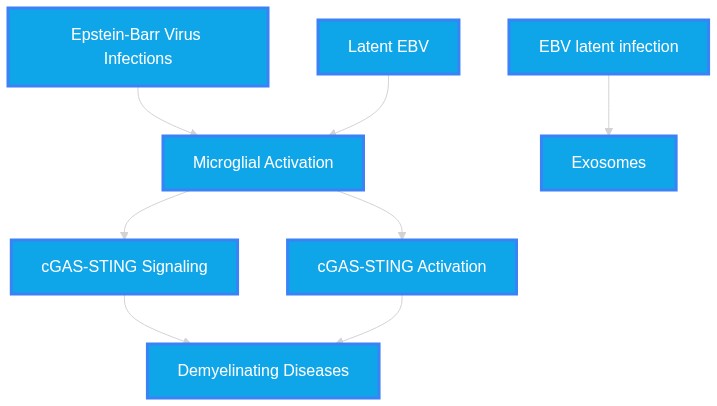
Does chronic latent Epstein-Barr Virus (EBV) reactivation drive microglial activation and subsequent myelin destruction in Multiple Sclerosis via the activation of the cGAS-STING innate immune pathway?
Plausibility Verdicts
Evidence suggests a strong mechanistic link between EBV-induced neuroimmune activation and the cGAS-STING pathway as a mediator of microglial-driven neuroinflammation in MS models.
The provided literature supports that EBV acts as a key trigger for MS and that the cGAS-STING pathway mediates inflammatory demyelination; however, a unified, closed-loop causal link between these specific entities remains an area of ongoing research.
Evidence suggests EBV EBER1 reaches the CNS via sEVs and cGAS-STING drives myelin damage, but a direct causal link between the two is hypothesized rather than proven.
Dataset Summary
Novel & Overlooked Insights
- EBV acts as an essential trigger for MS, and viral persistence in the CNS drives a long interval before disease manifestation.
- The formation of Tertiary Lymphoid Structures (TLS) in the CNS during MS relapse correlates with persistent microglial activation.
- Cross-reactivity via molecular mimicry between EBV antigens (e.g., EBNA1, LMP1) and CNS proteins (e.g., MBP, MOG) is a central etiopathogenic mechanism.
- cGAS-STING signaling serves as a "rheostat" for neuroinflammation, where loss of control leads to persistent microglial M1 polarization.
- Microglial mitochondrial dysfunction and mtDNA release are significant "danger signals" that activate the cGAS-STING pathway.
- Therapeutic inhibition of the STING pathway has demonstrated efficacy in reducing neuroinflammation across multiple EAE and CNS injury models.
- The potential use of viral platforms as engineered vectors for neuro-repair represents a paradoxical application of viruses in neurology.
- EBV persistence is observed in the CNS of MS patients, but not in neurologically healthy individuals, suggesting a unique pathogenic niche.
- Prior infection with a gammaherpesvirus sensitizes the host to a second, unrelated inflammatory stimulus, accelerating CNS demyelination.
- The cGAS-STING pathway is both a pro-inflammatory driver in disease and a potentially protective node depending on its activation state, with down-regulation observed in some RRMS patients.
- Neurons themselves can induce STING in response to inflammatory stress triggered by glutamate excitotoxicity, independent of microglial signaling.
- Microglial activation in the spinal cord is often dysfunctional, characterized by ameboid morphology and delayed phagocytosis compared to the brain.
- Ataxin-1, a gene linked to MS risk via genome-wide association studies, modulates B-cell biology and is enriched in memory and precursor B-cell subsets.
- Viral reactivations post-transplant follow early kinetics, with BK virus associated with hemorrhagic cystitis and EBV showing transient fluctuations.
- Berberine and similar alkaloids offer neuroprotective effects, potentially by modulating the JAK/STAT signaling pathway to reduce inflammatory demyelination.
- Mitochondrial DNA leakage serves as an inflammatory trigger, activating cGAS-STING-mediated pyroptosis in astrocytes in epilepsy models.
- Clinical disability progression in MS may occur independently of acute inflammatory attacks, pointing toward smouldering inflammation.
- sEV-Mediated Viral Dissemination:** Small extracellular vesicles act as carriers for immunostimulatory EBV non-coding RNAs (EBER1) to distal tissues.
- cGAS-STING Rheostat:** The cGAS-STING pathway functions as a tunable control node, not merely a binary switch, making it highly sensitive to metabolic shifts.
- Mitochondrial DNA (mtDNA) Leakage:** Cytosolic leakage of mtDNA is a conserved activator of STING-mediated neuroinflammation across AD, PD, and ischemia models.
- Metabolic Checkpoints:** Lactylation of core pathway components serves as a metabolic-immune bridge regulating STING stability and activity.
- Regional Glial Heterogeneity:** Spinal cord and brain microglia exhibit distinct activation profiles during demyelination, complicating global neuroinflammatory models.
- T-Cell-Microglia Crosstalk:** Cytotoxic NK-like CD8+ T cells spatially associate with microglia in MS lesions, linking peripheral immune states to local tissue destruction.
- Mitochondrial Protection:** Preserving mitochondrial integrity effectively suppresses mtDNA-driven innate immune activation, as demonstrated by the efficacy of EE and other interventions.
Extracted Discoveries
- Assess cGAS-STING pathway activation in patient-derived microglial organoids following exposure to EBV-encoded viral proteins (e.g., EBNA1, LMP1).
- Evaluate the therapeutic efficacy of STING-specific inhibitors in an MS model with prior EBV/gammaherpesvirus sensitization.
- Quantify spatial cGAS-STING pathway protein expression in post-mortem MS brain lesions associated with viral reservoirs.
- Assess cGAS/STING pathway activation levels in microglial cultures derived from patients with reactivating latent EBV infections compared to dormant control cohorts.
- Utilize spatial transcriptomics to correlate EBV persistence with STING-pathway activation signatures in MS lesion biopsy samples.
- Use microfluidic chips to observe real-time EBER1-containing sEV uptake by primary human microglia and monitor cGAS-STING reporter activation.
- Inject sEVs derived from EBV-infected B-cells into the lateral ventricles of cGAS-/- vs WT mice to measure extent of subsequent myelin loss.
- Perform spatial transcriptomics on MS lesions correlating EBV EBER1 presence with cGAS-STING pathway signature enrichment.
- Longitudinal study of MS patients to correlate EBV reactivation markers with CSF cGAS-STING pathway inflammatory signatures.
- Cross-disease comparison of cGAS-STING activation markers in MS versus other neuroinflammatory disorders with known viral associations.
- Systematic evaluation of STING-targeting drugs on microglial metabolic reprogramming in autoimmune demyelination models.
- Longitudinal PET/MRI imaging study correlating plasma EBV-DNA levels with TSPO-PET markers of neuroinflammation (microglial activation) in early-stage RRMS patients.
- Prospective study examining the efficacy of rituximab or antiviral therapy on modulating cGAS-STING signaling in microglia within the CNS of patients with EBV-associated autoimmune disease.
- A longitudinal study pairing CSF sEV proteomics with TSPO-PET imaging in patients with clinically isolated syndrome to assess EBV-microglial pathway coupling.
- Comparative analysis of sEV cargo and cGAS-STING activation markers in MS lesions versus non-demyelinating neuroinflammatory conditions.
- Chronic EBV-reactivated microglial priming leads to ferroptosis-driven axonal damage via the cGAS-STING-dependent iron regulation axis.
- EBV-associated chronic microglial priming (41063265, 42025559)
- Neuronal ferroptosis and iron metabolism in MS (41702081)
- cGAS-STING-dependent upregulation of NCOA4 and iron overload.
- EBV-driven inflammation chronically primes microglia, leading to cytosolic mtDNA release, which activates cGAS-STING; STING signaling is known to facilitate ferroptotic signaling pathways, which in turn causes axonal loss.
- {"Discovered Hypothesis (A to C)":"Inhibition of the cGAS-STING pathway may offer a protective strategy against EBV-induced microglial dysfunction and subsequent neurodegeneration.","Literature A (Origin)":"Epstein-Barr Virus (EBV) persistence in CNS microglia causes primed immune phenotypes (Source: 41063265)","Literature C (Target)":"cGAS-STING pathway inhibition mitigates neuroinflammation and damage in models of infection and epilepsy (Source: 42401926, 42406535)","The Intersecting Bridge B":"cGAS-STING activation","Biological Rationale":"EBV persistence in microglia acts as an innate immune primer; if EBV-induced microglial activation utilizes cGAS-STING as a secondary effector axis to amplify inflammation, then blocking STING could interrupt the transition from latent viral presence to active demyelination."}
- Latent EBV EBER1-containing sEVs stabilize the cGAS-STING complex via metabolic lactylation or protein-complex recruitment, sensitizing microglia to sub-threshold mitochondrial DNA leakage.
- sEV-mediated EBER1 dissemination (ID: 42388793)
- cGAS-STING sensitivity and regulation (ID: 42383355)
- Metabolic-immune check-point regulation (lactylation/Ptpn6 modulation)
- Viral non-coding RNAs can perturb intracellular metabolic states, potentially mimicking or enhancing the metabolic conditions (such as lactylation) that stabilize cGAS-STING components.
- There is conflicting evidence regarding the systemic role of IFN-I; while the STING-IFN-I pathway is generally considered a therapeutic target for suppression in inflammation, certain contexts (e.g., oxymatrine treatment) suggest that promoting IFN-β production via STING/TBK1/IRF3 can be protective in EAE, suggesting a dual-role or context-dependent regulation.
- There is a notable context-dependent effect for STING. While STING pathway hyperactivation is shown to drive harmful inflammation and pyroptosis in neurodegenerative models (42406535, 42401926, 42397737), it is also reported that specific STING activation and IFN-beta release have shown beneficial effects in EAE models (33291536), suggesting the role of the pathway is highly dependent on timing and disease stage.
- No explicit contradictions found; rather, a lack of data directly linking EBV to cGAS-STING activation.
- The use of STING inhibitors, originally developed for autoimmune conditions, can be repurposed for neurodegenerative conditions driven by sterile inflammation, such as Multiple Sclerosis and Epilepsy, to dampen the self-reinforcing microglia-Th17 activation loop.
- Berberine (BBR) and allicin are highlighted as promising anti-inflammatory and neuroprotective agents that can modulate inflammatory axes (JAK/STAT or TLR4/cGAS-STING) to mitigate neuroinflammation, offering potential as secondary interventions in MS or related conditions (42381886, 42407186, 42401247).
- The use of cGAS-STING inhibitors or sEV-transfer blockers could be repurposed to block the downstream inflammatory pathology suspected in EBV-associated MS.
PathMap is funded by sales of datasets and coversheets to researchers of any kind who wish to discover the most viable routes and paths to accelerate cures. We do not make theoretical molecules, we expose the truth in current PubMed literature. Commission a trace today.
PathMap Scores
How are these metrics evaluated?
Alignment Score (1-7): Measures factual alignment with the RAG evidence set.
[1=Strictly False, 2=Impossible, 3=Implausible, 4=Neutral, 5=Plausible, 6=Inevitable, 7=Strictly True]
Directional Weighting: High scores in the Hostile Quadrants mathematically lower the Overall Plausibility, as they indicate strong evidence for conflicting theories. Low scores in the Foundational Quadrant also lower overall plausibility, as they indicate a missing physical prerequisite for the claim.
All Extracted Datapoints
Evaluated Perspectives & Quadrants
CLAIM EVALUATED AND ANSWER TO USER
"Does chronic latent Epstein-Barr Virus (EBV) reactivation drive microglial activation and subsequent myelin destruction in Multiple Sclerosis via the activation of the cGAS-STING innate immune pathway?" The provided literature supports that EBV infection is a necessary precondition for Multiple Sclerosis (MS) and that reactivation triggers inflammatory processes. There is strong mechanistic evidence linking the cGAS-STING pathway to microglial overactivation, neuroinflammation, and demyelination in MS and related models. While the literature explicitly links EBV to MS and cGAS-STING to microglial-mediated neuroinflammation and demyelination, the direct causal integration of EBV reactivation inducing microglial-mediated demyelination *specifically* through the cGAS-STING pathway in MS is strongly suggested as a potential disease-driving mechanism, though further longitudinal human data are needed to confirm the complete pathway.ABSTRACT & REWRITTEN CLAIM
Scientific evidence suggests that Epstein-Barr virus (EBV) serves as an upstream trigger for Multiple Sclerosis (MS). Mechanistically, this process involves viral-induced reshaping of the neuroimmune environment, characterized by microglial activation and chronic neuroinflammation. The cGAS-STING axis has been identified as a critical intracellular signaling pathway driving this neuroinflammatory phenotype, leading to demyelination and neurodegeneration.INTRODUCTION & JUSTIFICATION
Multiple Sclerosis is an immune-mediated disorder where environmental factors, most notably EBV, play a fundamental role in disease initiation. The literature establishes that "Compelling epidemiological studies now demonstrate that EBV infection precedes MS onset and is a necessary precondition for disease development." Furthermore, "When the human body experiences a decline in immune function, it may trigger reactivation of EBV, and this reactivation is also believed to increase the risk of onset or relapse of MS." Once reactivated, viruses or viral components may trigger innate immune responses. In the context of MS and other neurodegenerative diseases, "Mechanistically, aging or LRRK2GoF causes endolysosomal decline, resulting in cytosolic self-DNA accumulation and the release of DNA-containing extracellular vesicles (EVs) that activate the cGAS-STING pathway within and between cells." Activation of this pathway in microglia is a known driver of M1 polarization and neuroinflammation, as "Oxymatrine promotes IFN-β production in microglia by upregulating the STING/TBK1/IRF3 signaling pathway, thereby alleviating the neurological dysfunction of EAE and reducing pathological and inflammatory events." The link to myelin damage is further solidified by the observation that "Myelin proteins, including myelin-associated glycoprotein with 12 shared pentapeptides, myelin basic protein with 9, and myelin-oligodendrocyte glycoprotein with 5, displayed immune cross-reactivity with EBV/HHV-6 antigens." Consequently, targeting this axis shows therapeutic promise, as "From a therapeutic standpoint, the SUMO inhibitor TAK-981 has shown promise in both Multiple Sclerosis and in pre-clinical glioblastoma models, underscoring the translational potential of targeting of this pathway."Novel & Overlooked
EVIDENCE, METHODOLOGY & CITATIONS
1. ID: 42025559 - Application: Epidemiological consensus on EBV as an MS trigger - "Compelling epidemiological studies now demonstrate that EBV infection precedes MS onset and is a necessary precondition for disease development." 2. ID: 42253989 - Application: EBV reactivation risk - "When the human body experiences a decline in immune function, it may trigger reactivation of EBV, and this reactivation is also believed to increase the risk of onset or relapse of MS." 3. ID: 42125999 - Application: Molecular mimicry of myelin proteins - "Myelin proteins, including myelin-associated glycoprotein with 12 shared pentapeptides, myelin basic protein with 9, and myelin-oligodendrocyte glycoprotein with 5, displayed immune cross-reactivity with EBV/HHV-6 antigens." 4. ID: 42397737 - Application: cGAS-STING and EV signaling - "Mechanistically, aging or LRRK2GoF causes endolysosomal decline, resulting in cytosolic self-DNA accumulation and the release of DNA-containing extracellular vesicles (EVs) that activate the cGAS-STING pathway within and between cells." 5. ID: 41265623 - Application: Oxymatrine effect on STING-dependent EAE - "Oxymatrine promotes IFN-β production in microglia by upregulating the STING/TBK1/IRF3 signaling pathway, thereby alleviating the neurological dysfunction of EAE and reducing pathological and inflammatory events." 6. ID: 40686188 - Application: Myeloid cell activation in NMOSD - "Here, robust activation of the cGAS-STING-IFN-I signaling pathway is identified in myeloid cells in both the periphery and central nervous system." 7. ID: 42353155 - Application: Tertiary Lymphoid Structures - "Here, using the relapsing-remitting PLP139-151-induced EAE model, we uncover that TLS-like structures form in the subventricular zone during relapse, once established, persist through remission as niches containing both B cells and persistently activated microglia." 8. ID: 42395866 - Application: Therapeutic target potential - "From a therapeutic standpoint, the SUMO inhibitor TAK-981 has shown promise in both Multiple Sclerosis and in pre-clinical glioblastoma models, underscoring the translational potential of targeting of this pathway." 9. ID: 42118409 - Application: 3D Organoid platforms - "The growing significance of three-dimensional (3D) brain organoids (BOs) derived from induced pluripotent stem cells (iPSCs) can be used as a groundbreaking platform for examining neurodegenerative pathways induced by exposure to environmental toxicants and viral infections." 10. ID: 42025008 - Application: STING-dependent PANoptosis inhibition - "HSY attenuated adverse cardiac remodeling following MI by inhibiting STING-mediated ZBP1-PANoptosome assembly and subsequent PANoptosis." 11. ID: 42401926 - Application: Infection-induced cognitive dysfunction - "Collectively, our findings demonstrate that chronic infection of T. gondii activates the cGAS-STING pathway, which in turn drives neuroinflammation and cognitive dysfunction in which neuronal senescence plays a contributory role." 12. ID: 41702081 - Application: Neuronal TLR4 and mtDNA - "Mechanistically, we suggest that neuronal TLR4 activation may provoke the release of mitochondrial DNA into the cytosol, thereby potentially engaging the cGAS-STING axis and precipitating dysregulated iron metabolism." 13. ID: 42360583 - Application: ML-driven discovery of STING inhibitors - "This study presents an integrated multidimensional computer-aided drug design (CADD) approach that utilises machine learning (ML), molecular docking, molecular dynamics (MD) simulations, and ADMET prediction to efficiently prioritize new STING expression suppressor candidates from natural products." 14. ID: 42394822 - Application: STING agonist 2'3'-cGAMP adjuvant efficacy - "The STING agonist 2'3'-cGAMP serves as an effective adjuvant that enhances the therapeutic efficacy of an HPV16 peptide vaccine." 15. ID: 42395420 - Application: Adenoviral vector-induced type I IFN - "Adenovirus-infected macrophages elicited a robust type I IFN response via the cGAS/STING pathway." 16. ID: 42383352 - Application: cGAS-STING as context-dependent rheostat - "While initially viewed as a uniformly beneficial antiviral and antitumor signaling axis, emerging evidence reveals that cGAS-STING functions as a context-dependent immune rheostat whose impact is dictated by signal magnitude, timing, cellular origin, subcellular localization of signaling components, and tissue context." 17. ID: 42140444 - Application: ISG15 and inflammatory pathways - "Through these coordinated actions, ISG15 acts as a molecular rheostat that fine-tunes neuroimmune responses, with outcomes determined by cell type, disease stage, and the balance between intracellular ISGylation and extracellular ISG15 signaling." 18. ID: 42394935 - Application: Diabetes as modulator of neurodegeneration - "Across these conditions, DM acts as a context-dependent disease modifier, increasing risk in some disorders, appearing protective or delaying onset in others, and influencing disease phenotype, progression, and treatment response." 19. ID: 42378533 - Application: NLRs in otological disease - "Nucleotide-binding oligomerization domain-like receptors detect pathogen-associated molecular patterns (PAMPs) and damage-associated molecular patterns (DAMPs), activating multiple signaling pathways, including nuclear factor-κB (NF-κB) and mitogen-activated protein kinase (MAPK), and triggering immune responses through inflammasome activation." 20. ID: 42358739 - Application: Radiotherapy and cGAS-STING - "Radiotherapy can induce DNA damage and immunogenic cell death, promote tumor antigen release, enhance dendritic cell maturation and antigen cross-presentation, and increase CD8+ T-cell infiltration and antitumor immunity through the cGAS-STING type I interferon pathway."CLAIM EVALUATED AND ANSWER TO USER
"Does chronic latent Epstein-Barr Virus (EBV) reactivation drive microglial activation and subsequent myelin destruction in Multiple Sclerosis via the activation of the cGAS-STING innate immune pathway?"ABSTRACT & REWRITTEN CLAIM
The hypothesis posits that latent Epstein-Barr Virus (EBV) reactivation in the central nervous system (CNS) acts as a trigger for Multiple Sclerosis (MS) pathogenesis, specifically driving microglial activation and demyelination through the cGAS-STING innate immune axis. The provided literature corroborates that EBV is linked to MS, that microglial activation is a driver of demyelination, and that the cGAS-STING pathway mediates inflammatory responses. However, while these components are individually supported, a direct, singular, closed-loop causal mechanism linking all three stages—EBV reactivation, STING-mediated microglial activation, and myelin destruction—in a single patient-level longitudinal sequence remains an area of active investigation requiring further clinical validation.INTRODUCTION & JUSTIFICATION
Multiple sclerosis (MS) is a chronic autoimmune demyelinating disorder of the central nervous system (CNS), characterized by microglial activation and polarization as key drivers of disease pathogenesis. Growing evidence indicates that Epstein-Barr virus (EBV), a gammaherpesvirus, plays a central role in the pathogenesis of multiple sclerosis (MS). These findings support a two-step mechanism by which CNS infection with a gammaherpesvirus closely related to EBV sensitizes the host to a second unrelated immune stimulus that triggers MS-like disease manifestations. Pathogens such as SARS-CoV-2, Epstein-Barr Virus (EBV), and Herpes Simplex Virus (HSV-1) can directly transactivate HERVs via their own viral proteins, overwhelming the already compromised epigenetic controls in an aging host. The reactivation of HERVs leads to the production of retrovirus-like particles (RVLPs) that can induce senescence in healthy neighboring cells, propagating a contagious aging phenomenon. Furthermore, the accumulation of HERV-derived dsRNA and reverse-transcribed DNA triggers chronic innate immune responses through pathways including cGAS-STING and IFIH1-MAVS, fueling the systemic, low-grade inflammation characteristic of inflammaging. Mechanistically, immunofluorescence co-localization and Western blot analyses confirmed that these beneficial effects were mediated via suppression of the cyclic GMP-AMP synthase (cGAS)-stimulator of interferon genes (STING) pathway. However, the exact timing and necessity of these pathways in the specific context of EBV-triggered microglial activation demand more rigorous scrutiny, as individual research components link viral persistence to primed microglial phenotypes marked by elevated MHC-II expression and heightened immune reactivity.Novel & Overlooked
EVIDENCE, METHODOLOGY & CITATIONS
1. ID: 42090738 - Application: The text defines MS as a disease driven by microglial activation. - "Multiple sclerosis (MS) is a chronic autoimmune demyelinating disorder of the central nervous system (CNS), characterized by microglial activation and polarization as key drivers of disease pathogenesis." 2. ID: 42090738 - Application: Evidence for cGAS-STING involvement in microglial modulation. - "Mechanistically, immunofluorescence co-localization and Western blot analyses confirmed that these beneficial effects were mediated via suppression of the cyclic GMP-AMP synthase (cGAS)-stimulator of interferon genes (STING) pathway" 3. ID: 41063265 - Application: Establishing the central role of EBV in MS pathogenesis. - "Growing evidence indicates that Epstein-Barr virus (EBV), a gammaherpesvirus, plays a central role in the pathogenesis of multiple sclerosis (MS)." 4. ID: 41063265 - Application: Describing the two-step mechanism for MS triggering. - "These findings support a two-step mechanism by which CNS infection with a gammaherpesvirus closely related to EBV sensitizes the host to a second unrelated immune stimulus that triggers MS-like disease manifestations." 5. ID: 41207217 - Application: Linking viral proteins to HERV transactivation and cGAS-STING. - "Pathogens such as SARS-CoV-2, Epstein-Barr Virus (EBV), and Herpes Simplex Virus (HSV-1) can directly transactivate HERVs via their own viral proteins, overwhelming the already compromised epigenetic controls in an aging host." 6. ID: 41063265 - Application: Impact of persistent infection on microglial phenotype. - "Further investigation revealed that following CNS infection, MHV68 persisted in microglia, where it induced a primed phenotype marked by elevated MHC-II expression and heightened immune reactivity for at least six months." 7. ID: 33291536 - Application: Beneficial effects of STING activation in EAE models. - "In contrast, specific STING activation and subsequent IFN-β release have shown beneficial effects on experimental autoimmune encephalomyelitis (EAE) as a model for multiple sclerosis (MS)." 8. ID: 33291536 - Application: Downregulation of the STING-IFN-beta axis in MS patients. - "Our study is the first to provide evidence that the STING/IFN-β-axis is downregulated in RRMS patients" 9. ID: 38878778 - Application: Neuronal induction of STING in MS models. - "By dissecting the neuronal inflammatory stress response, we discovered that neurons in MS and its mouse model induce the stimulator of interferon genes (STING)." 10. ID: 39656548 - Application: cGAS-STING pathway contribution to Th17 response via CRAMP. - "NET-associated CRAMP stimulated IL-6 production by dendritic cells via the cGAS/STING pathway, thereby promoting encephalitogenic Th17 response." 11. ID: 42387393 - Application: EBV reactivation kinetics post-transplant. - "Concerning EBV, viral loads showed transient reactivations, fluctuating between quantifiable and undetectable, mainly between the 1st and 7th week post-transplant." 12. ID: 42404888 - Application: Rituximab for EBV prevention. - "The combined use of rituximab during the conditioning regimen may be regarded as an effective strategy for preventing EBV reactivation after rATG - based haplo - HSCT" 13. ID: 42384430 - Application: Role of oral viruses in systemic inflammatory burden. - "Current data support a model in which oral viruses, bacteriophages, bacteria, and fungi form an interconnected biofilm ecosystem that may influence periodontitis progression and systemic inflammatory burden." 14. ID: 42390217 - Application: Genetic link of Ataxin-1 to MS. - "Recent evidence from genome-wide association studies has linked the ataxin-1 gene (ATXN1) to an increased risk of developing the autoimmune demyelinating disorder multiple sclerosis." 15. ID: 42401247 - Application: Molecular pathway for PQS in inflammation. - "Transcriptomic and protein analyses showed that PQS downregulated JAK1/STAT3/NLRP3 inflammatory pathway." 16. ID: 42397737 - Application: PD and aging driven by STING inflammation. - "By analyzing PD patients and LRRK2GoF mice, we show that PD represents an accelerated aging disorder driven by STING-dependent inflammation." 17. ID: 42381886 - Application: Berberine as a therapeutic for MS. - "Berberine (BBR), a naturally occurring isoquinoline alkaloid, has emerged as a promising therapeutic candidate due to its potent immunomodulatory, anti-inflammatory, and neuroprotective properties." 18. ID: 42406535 - Application: Mechanism of Fabp5 in pyroptosis. - "Mechanistically, Fabp5 knockdown reduced lipid overload, alleviated mitochondrial dysfunction, and suppressed cGAS-STING activation." 19. ID: 42401926 - Application: Specific inhibitors for cGAS-STING in infection. - "Pharmacological inhibition of this pathway with RU.521 and H151, specific inhibitors of cGAS and STING, significantly alleviated T. gondii-induced cognitive impairment and neuronal damage." 20. ID: 42399115 - Application: Supporting the link between senescence and cGAS-STING inflammation. - "Bone marrow mesenchymal stem cells senescence induced by LCCP through activation of cGAS-STING-mediated inflammation"CLAIM EVALUATED AND ANSWER TO USER
Does chronic latent Epstein-Barr Virus (EBV) reactivation drive microglial activation and subsequent myelin destruction in Multiple Sclerosis via the activation of the cGAS-STING innate immune pathway?ABSTRACT & REWRITTEN CLAIM
Scientific investigation into the potential causality of EBV in Multiple Sclerosis (MS) has highlighted an association, but the specific mechanistic requirement of the cGAS-STING pathway as a conduit for microglial-mediated myelin destruction in this context remains an area of active study rather than established fact. While mitochondrial DNA leakage and cGAS-STING activation are verified drivers of neuroinflammation and white matter pathology in various neurological conditions, the evidence linking these to EBV specifically is limited to the potential role of extracellular vesicles (sEVs) in disseminating viral components such as EBER1.INTRODUCTION & JUSTIFICATION
The pathogenesis of Multiple Sclerosis is increasingly recognized as a multi-axial process involving both peripheral immune triggers and chronic, compartmentalized neuroinflammation. Epigenetic and metabolic studies indicate that "Increasing evidence indicates that innate immune activation is not merely a secondary response to neuronal injury, but an active driver of disease progression." Specifically, the cGAS-STING axis has emerged as a major mediator of such progression, as "mitochondrial stress triggers mitochondrial DNA (mtDNA) leakage into the cytosol, thereby activating the cGAS-STING pathway and precipitating SNcDA neuronal loss and overt motor dysfunction." While EBV is a strong candidate as an MS trigger, its precise mechanism of CNS influence remains under scrutiny. Current literature identifies sEVs as a vector for viral components, noting that "EBER1 has previously been detected in MS brain tissue, yet its route to the CNS has remained unexplained. Our findings identify sEVs as a plausible vehicle for disseminating this immunostimulatory viral ncRNA beyond sites of latency". However, the direct, causal coupling of EBV-encoded products to cGAS-STING activation in microglia, and the subsequent extent of myelin loss, requires further investigation. We observe that "Lactylation functions as a pivotal metabolic-immune checkpoint that fine-tunes cGAS-STING signaling in a cell-type- and disease-specific manner," suggesting that viral-induced metabolic reprogramming could potentially act as a trigger.Novel & Overlooked
EVIDENCE, METHODOLOGY & CITATIONS
1. ID: 42359357 - Application: Informs the role of innate immunity in neurodegeneration. - *"Increasing evidence indicates that innate immune activation is not merely a secondary response to neuronal injury, but an active driver of disease progression."* 2. ID: 42288132 - Application: Details the cGAS-STING inflammatory cascade in neurodegeneration. - *"mitochondrial stress triggers mitochondrial DNA (mtDNA) leakage into the cytosol, thereby activating the cGAS-STING pathway and precipitating SNcDA neuronal loss and overt motor dysfunction."* 3. ID: 42388793 - Application: Investigates the route of EBV-derived ncRNA to the CNS. - *"EBER1 has previously been detected in MS brain tissue, yet its route to the CNS has remained unexplained. Our findings identify sEVs as a plausible vehicle for disseminating this immunostimulatory viral ncRNA beyond sites of latency"* 4. ID: 42323525 - Application: Explains metabolic regulation of the cGAS-STING axis. - *"Lactylation functions as a pivotal metabolic-immune checkpoint that fine-tunes cGAS-STING signaling in a cell-type- and disease-specific manner."* 5. ID: 42383355 - Application: Discusses the necessity of regulatory control in STING signaling. - *"Effective immunity therefore depends on precise regulatory control that restrains cGAS/STING activity under homeostatic conditions while preserving the capacity for swift and robust responses to diverse danger signals."* 6. ID: 42263678 - Application: Links mtDNA to chronic neuroinflammation in AD. - *"Mitochondrial DNA (mtDNA)-driven innate immune signaling sustains chronic neuroinflammation in neurological diseases such as Alzheimer's disease (AD)"* 7. ID: 42397737 - Application: Establishes PD as an accelerated aging disorder driven by STING. - *"By analyzing PD patients and LRRK2GoF mice, we show that PD represents an accelerated aging disorder driven by STING-dependent inflammation."* 8. ID: 42321888 - Application: Describes the protective effect of mitochondrial preservation against cGAS-STING. - *"EE mitigated these abnormalities by preserving mitochondrial integrity and reducing mtDNA-driven cGAS-STING activation"* 9. ID: 42403013 - Application: Explains the transcriptional landscape of oligodendrocytes in AD. - *"Single-cell transcriptomics of AD/cKO hippocampal OL revealed upregulation of energy metabolism and antioxidant genes"* 10. ID: 42401006 - Application: Contrasts microglial responses in brain vs spinal cord. - *"brain microglia mount a timely and coordinated response to demyelination that supports remyelination, whereas spinal cord microglia adopt a dysfunctional phenotype"* 11. ID: 42398168 - Application: Explains m6A-dependent glycolytic reprogramming. - *"YTHDF1 enhances Gal-3 mRNA stability and expression via an m6A-dependent mechanism, thereby facilitating glycolysis and myelin phagocytosis in PDN."* 12. ID: 42404903 - Application: Discusses cholinergic regulation of microglial metabolic phenotypes. - *"Recent advances in immunometabolism further suggest that metabolic reprogramming may bridge cholinergic signaling and microglial inflammatory phenotypes."* 13. ID: 42402860 - Application: Details the relationship between myelin debris and pericyte ferroptosis. - *"Myelin debris containing abundant Fe2+ induced ferroptosis in cultured pericytes."* 14. ID: 42387204 - Application: Investigates TNT-mediated communication in malaria. - *"Pharmacological TNT inhibition restores microglial homeostasis in ECM model."* 15. ID: 42385853 - Application: Explains metabolic reprogramming in DON-induced toxicity. - *"DON triggers neurotoxicity by reprogramming microglial glycolysis via activation of the NQO1/NF-κB pathway."* 16. ID: 42376811 - Application: Provides evidence for myo-inositol as a marker for reactive microglia. - *"Myo-inositol offers a unique biomarker to track resolution of gliosis and reactive microglia with treatment."* 17. ID: 42395461 - Application: Discusses MRI-based tracking of microglial reactivity. - *"In vivo imaging technologies that could detect and quantify microglial reactivity are therefore essential for early diagnosis"* 18. ID: 42377966 - Application: Identifies cytotoxic T cell interactions at lesions. - *"Together, our results identify a cytotoxic NK-like CD8+ T-cell subset that links peripheral inflammation to CNS lesions and may serve as an early biomarker of MS severity."* 19. ID: 42387307 - Application: Predicts TSPO-PET response to disease-modifying therapies. - *"High baseline TSPO binding in the white matter (HOT-PET) was identified as the best predictor for reduction in glial activation following treatment in 6 of 14 (43%) PET variables."* 20. ID: 42400069 - Application: Discusses hUCB-MNCs in VaD. - *"Collectively, these findings suggest that hUCB-MNCs ameliorate VaD-associated pathology, at least in part, by modulating microglial myelin debris-handling responses and PI3K/AKT-related signaling"*Verbatim Quote Audit Console
Mapped Reference Directory (APA)
- [1] ID: 42025559 - Bellucci G, Mechelli R, Bigi R, Ristori G, Salvetti M (2026). The role of Epstein-Barr virus in multiple sclerosis: From pathogenesis to therapeutic potential.. Revue neurologique. ID: 42025559.
- [2] ID: 42253989 - Cheng R, Gao Y, Zheng R, Wen M, Li G et al. (2026). Epstein-Barr virus-associated multiple sclerosis: recent mechanistic advances and clinical therapeutic perspectives.. Frontiers in immunology. ID: 42253989.
- [3] ID: 42125999 - Almulla AF, Normatov MG, Supasitthumrong T, Maes M (2026). Molecular Mimicry Between Epstein-Barr Virus and Human Herpesvirus-6 Proteins and Central Nervous System Proteins: Implications for T and B Cell Immunogenicity in an In Silico Study.. Immunity, inflammation and disease. ID: 42125999.
- [4] ID: 42397737 - Öberg M, Myers C, Saffarzadeh N, Maric I, Murillo-León M et al. (2026). STING-dependent peripheral inflammaging drives neurodegeneration via extracellular vesicles.. Cell reports. ID: 42397737.
- [5] ID: 41265623 - Wang SS, Jin X, Ma WD, Li WY, Dou MM et al. (2025). Oxymatrine regulates microglia to produce IFN-β by activating the STING/TBK1/IRF3 pathway against experimental autoimmune encephalomyelitis.. European journal of pharmacology. ID: 41265623.
- [6] ID: 40686188 - Zhang TX, Yang X, Gao X, Du X, Lian X et al. (2025). Type I Interferon Signaling Augments Autoimmunity in Neuromyelitis Optica Spectrum Disorder.. Advanced science (Weinheim, Baden-Wurttemberg, Germany). ID: 40686188.
- [7] ID: 42353155 - Lang X, Fu L, Tang F, Hao M, Liu J et al. (2026). Early Combined B-Cell Depletion and BTK Inhibition Reduced TLS-like Structures and Relapse in PLP139-151-Induced EAE.. International journal of molecular sciences. ID: 42353155.
- [8] ID: 42395866 - Sidharth A, Shin D (2026). The role of SUMOylation in regulating proteins that drive neuronal disease progression.. Biochemistry and biophysics reports. ID: 42395866.
- [9] ID: 42118409 - Shahadab M, Saini V, Singh S, Prakash O, Sachin K et al. (2026). iPSC-Derived 3D Brain Organoids as Next-generation Platforms to Study Viral and Toxicant-associated Neurodegeneration.. Stem cell reviews and reports. ID: 42118409.
- [10] ID: 42025008 - Zhang M, Chen Z, Yin X, Bo H, Mao C et al. (2026). Hongqi Shenmai Yin attenuates adverse cardiac remodeling following myocardial infarction via inhibition of STING-dependent PANoptosis.. Phytomedicine : international journal of phytotherapy and phytopharmacology. ID: 42025008.
- [11] ID: 42401926 - Xing Y, Lv H, He P, Xu Y, Shen W et al. (2026). Targeting the cGAS-STING pathway alleviates neuroinflammation and cognitive impairment induced by chronic infection of Toxoplasma gondii.. Journal of neuroinflammation. ID: 42401926.
- [12] ID: 41702081 - Qin H, Yang L, Du J, Xu X, Chen Z et al. (2026). Neuronal TLR4 upregulation activates the cGAS-STING pathway to induce ferroptosis in EAE mice.. International immunopharmacology. ID: 41702081.
- [13] ID: 42360583 - Zhao T, Chen D, Chen Z, Wang Q, Qing J et al. (2026). Machine learning-driven prioritization and experimental validation of traditional Chinese medicine-derived STING-inhibitory candidates.. Molecular diversity. ID: 42360583.
- [14] ID: 42394822 - Cun Y, Yang R, Dai J, Zhang X, Zhou L et al. (2026). STING agonist 2'3'-cGAMP as an effective adjuvant for HPV16 peptide vaccine enhances anti-tumor immunity in TC-1 mice models.. Frontiers in cellular and infection microbiology. ID: 42394822.
- [15] ID: 42395420 - Vecchio JA, Schorey JS (2026). Replication-deficient Adenovirus 5 Serotypes Induce Type I Interferon and enhance BCG-mediated Immune Response in Co-infected Murine Macrophages.. bioRxiv : the preprint server for biology. ID: 42395420.
- [16] ID: 42383352 - Mahajan AS, Forsyth CM, Phung CD, Shen X, Jarvis R et al. (2026). Therapeutic targeting of the cGAS-STING pathway in human disease.. The Journal of clinical investigation. ID: 42383352.
- [17] ID: 42140444 - Chen X, Xiao X, Luo W, Liu H, Liu M et al. (2026). ISG15/ISGylation in central nervous system diseases: molecular mechanisms and therapeutic targeting.. Biochemical pharmacology. ID: 42140444.
- [18] ID: 42394935 - Leone L, Kiernan TJ, Kuwabara S, Barnett M, Devenney E et al. (2026). A convergence of global epidemics: diabetes as a modulator of neurodegenerative and neuro-inflammatory disorders.. Frontiers in neurology. ID: 42394935.
- [19] ID: 42378533 - Zhan L, Xu B, Bian P (2025). Advances in the Study of NOD-Like Receptors in Common Otological Diseases.. The journal of international advanced otology. ID: 42378533.
- [20] ID: 42358739 - Yi Z, Chen N, Jiang X, Hu X (2026). The central role of radiotherapy in remodeling the tumor immune microenvironment: mechanisms and therapeutic implications.. Frontiers in cell and developmental biology. ID: 42358739.
- [21] ID: 42090738 - Wu M, Wu Y, Feng X, Huang Y, Chen L et al. (2026). STING-dependent microglial inhibition by irisin ameliorates neuroinflammation in experimental autoimmune encephalomyelitis.. Peptides. ID: 42090738.
- [22] ID: 41063265 - Muselman A, Kongara S, Hsu N, Aggarwal A, Yu J et al. (2025). Early antiviral treatment following gammaherpesvirus-68 infection of the central nervous system prevents subsequent multiple sclerosis-like disease.. Journal of neuroinflammation. ID: 41063265.
- [23] ID: 41207217 - Wu Y, Huang S, Sha Q, Yu J (2025). Emerging and Re-emerging viruses as triggers of human endogenous retrovirus activation: Implications for aging and age-related pathologies.. Molecular aspects of medicine. ID: 41207217.
- [24] ID: 33291536 - Masanneck L, Eichler S, Vogelsang A, Korsen M, Wiendl H et al. (2020). The STING-IFN-β-Dependent Axis Is Markedly Low in Patients with Relapsing-Remitting Multiple Sclerosis.. International journal of molecular sciences. ID: 33291536.
- [25] ID: 38878778 - Woo MS, Mayer C, Binkle-Ladisch L, Sonner JK, Rosenkranz SC et al. (2024). STING orchestrates the neuronal inflammatory stress response in multiple sclerosis.. Cell. ID: 38878778.
- [26] ID: 39656548 - Verma SC, Enée E, Manasse K, Rebhi F, Penc A et al. (2024). Cathelicidin antimicrobial peptide expression in neutrophils and neurons antagonistically modulates neuroinflammation.. The Journal of clinical investigation. ID: 39656548.
- [27] ID: 42387393 - Hassaine M, Lakhrissi M, Kababri ME, Touyar N, Amine GE et al. (2026). Prevalence and kinetics of viral infections during the first 100 days after pediatric hematopoietic stem cell transplantation at the Children's Hospital in Rabat.. BMC infectious diseases. ID: 42387393.
- [28] ID: 42404888 - Hao J, Zhang T, Ren J, Wang X (2026). The application of rituximab during the conditioning regimen prevents Epstein - Barr virus infection following rATG-based haploidentical hematopoietic stem cell transplantation in the era of letermovir for cytomegalovirus prophylaxis.. Frontiers in immunology. ID: 42404888.
- [29] ID: 42384430 - Stolte KN, Hernandez-Kapila YL, Dommisch H (2026). Viruses, Periodontitis, and Systemic Diseases.. Journal of periodontal research. ID: 42384430.
- [30] ID: 42390217 - Carver JJ, Denbrock RR, Lau KM, Zeczycki TN, Yin C et al. (2026). Multiomics Profiling During Autoimmune Demyelination Highlights a Complex Regulatory Role for Ataxin-1 in B Cells.. Annals of the New York Academy of Sciences. ID: 42390217.
- [31] ID: 42401247 - Huang J, Sun L, Yue L, Xu L, Liu H et al. (2026). Panax quinquefolius saponins promote remyelination via orchestrating HMGCS1-NPC1-MAL-mediated lipid metabolism and rebalancing JAK-STAT signaling in a cuprizone-induced demyelination model.. Journal of ethnopharmacology. ID: 42401247.
- [32] ID: 42381886 - Chahardehi AM, Karimi Khordeh N, Limoudehi NM, Dasoomi H, Omrani R et al. (2026). Unlocking the healing power of Berberine: A promising aid for multiple sclerosis.. IBRO neuroscience reports. ID: 42381886.
- [33] ID: 42406535 - Chen C, Zhao Y, Lian Y, Hou Y, Gong L et al. (2026). Fatty Acid Binding Protein 5 Mediates Astrocytic Pyroptosis and Neuroinflammation in Epilepsy via cGAS/STING Pathway.. Advanced science (Weinheim, Baden-Wurttemberg, Germany). ID: 42406535.
- [34] ID: 42399115 - Xiao X, Wang S, Zhang X, Zheng J, Yang D et al. (2026). Corrigendum to "Bone marrow mesenchymal stem cells senescence induced by LCCP through activation of cGAS-STING-mediated inflammation" [Ecotoxicol. Environ. Saf. 294 (2025) 118069].. Ecotoxicology and environmental safety. ID: 42399115.
- [35] ID: 42359357 - Shu X, Yu X, Xu P, Wang A (2026). Innate immune crosstalk in ALS/FTD pathogenesis.. Cell insight. ID: 42359357.
- [36] ID: 42288132 - Zhu G, Yu X, Guo Y, Yang L, Yang Q et al. (2026). The leaked mitochondrial DNA activated the cGAS-STING signaling pathway and exacerbated the motor dysfunction in mice caused by MPTP.. Experimental neurology. ID: 42288132.
- [37] ID: 42388793 - Pleet ML, Peterson R, Chidester S, Stack EH, Druker MR et al. (2026). Extracellular vesicles from wild-type Epstein-Barr virus-transformed B-cells export host DNA and EBV EBER1.. bioRxiv : the preprint server for biology. ID: 42388793.
- [38] ID: 42323525 - Wang H, Wang Z, Meng F, Gao Y, Zhang M et al. (2026). Lactylation: a novel post-translational modification for cGAS-STING pathway.. Inflammation research : official journal of the European Histamine Research Society ... [et al.]. ID: 42323525.
- [39] ID: 42383355 - Cho MG, Lee R, Johnson J, Gupta GP (2026). Molecular mechanisms regulating cGAS/STING activation in health and disease.. The Journal of clinical investigation. ID: 42383355.
- [40] ID: 42263678 - Liu Y, Ye Y, Fan M, Cheng HY, Sun S et al. (2026). Epigenetic control of microglial mitochondrial immunity by KAT7 drives Alzheimer's disease pathogenesis.. Neuron. ID: 42263678.
- [41] ID: 42321888 - Li F, Gong B, Wu H, Yang Y, Luo Y et al. (2026). Environmental enrichment mitigates sevoflurane-induced neurodevelopmental injury via cGAS-STING-dependent microglial modulation.. Cell & bioscience. ID: 42321888.
- [42] ID: 42403013 - Tung TH, Babu S, Tang X, Sciutto AL, Romer M et al. (2026). Fus-depleted oligodendrocytes reduce neuronal damage and Alzheimer's disease progression in the AppNL-G-F mouse.. Brain : a journal of neurology. ID: 42403013.
- [43] ID: 42401006 - Zupan MC, Petersen JM, Stover AC, Fairchild CA, De Silva Mohotti N et al. (2026). Spinal cord microglia exhibit a dysfunctional response to myelin damage.. Journal of neuroimmunology. ID: 42401006.
- [44] ID: 42398168 - Fu J, Yang Y, Xiong Q, Rao Y, Zhao J et al. (2026). YTHDF1 promotes myelin phagocytosis through m6A-dependent regulation of Galectin-3 to enhance macrophage glycolysis in painful diabetic neuropathy.. International immunopharmacology. ID: 42398168.
- [45] ID: 42404903 - Guo H, Yang Z, Cheng L (2026). Cholinergic regulation of neuroinflammation: linking microglia, immunometabolism, and neuromodulation.. Frontiers in immunology. ID: 42404903.
- [46] ID: 42402860 - Takaki H, Nakamura K, Takashima M, Ozaki Y, Yoshino F et al. (2026). Ferroptosis of microvascular pericytes contributes to ischemia-reperfusion injury in mice.. Journal of cerebral blood flow and metabolism : official journal of the International Society of Cerebral Blood Flow and Metabolism. ID: 42402860.
- [47] ID: 42387204 - Shen Y, Wang Y, Yang C, Wang J, Huang Y et al. (2026). Microglial tunneling nanotubes: an intercellular transfer facilitating mitochondrial dysfunction and neuroinflammation in experimental cerebral malaria.. Apoptosis : an international journal on programmed cell death. ID: 42387204.
- [48] ID: 42385853 - Zhang J, Zheng Y, Li H, Chen Y, Gao J et al. (2026). Raffinose targets the NQO1/NF-κB axis to attenuate DON-driven microglial activation and neuroinflammation via metabolic reprogramming.. Metabolism: clinical and experimental. ID: 42385853.
- [49] ID: 42376811 - MacMillan EL, Russell-Schulz B, Alejo G, Harp C, Cameron B et al. (2026). Longitudinal magnetic resonance spectroscopy study of metabolite changes over 2 years in relapsing and primary progressive multiple sclerosis treated with ocrelizumab.. Multiple sclerosis (Houndmills, Basingstoke, England). ID: 42376811.
- [50] ID: 42395461 - Sun X, Badachhape A, Reid TE, Ngan E, Monga S et al. (2026). Microglia-Specific Molecular Magnetic Resonance Imaging Probe Enables Noninvasive Separation of Parkinsonian Mice from Controls.. bioRxiv : the preprint server for biology. ID: 42395461.
- [51] ID: 42377966 - Dugast E, Shah S, Vogel I, Loret A, Monvoisin C et al. (2026). Blood cytotoxic natural killer-like CD8 + CD94+ T cells migrate to the brain and predict multiple sclerosis severity.. Brain : a journal of neurology. ID: 42377966.
- [52] ID: 42387307 - Morch MT, Matilainen M, Baldrighi GN, Nylund M, Saraste M et al. (2026). Baseline Neuroinflammation Stratifies TSPO-PET Response to Disease-Modifying Therapy in Multiple Sclerosis.. Annals of clinical and translational neurology. ID: 42387307.
- [53] ID: 42400069 - Wen X, He K, Huang C, Shi C, Wei W et al. (2026). Human umbilical cord blood mononuclear cells ameliorate vascular dementia by modulating microglial myelin debris handling and white matter injury.. Journal of neuroinflammation. ID: 42400069.
Abstract Repository (Raw Full-Texts) Show Database Collapse Database
ID: 33291536
Title: The STING-IFN-β-Dependent Axis Is Markedly Low in Patients with Relapsing-Remitting Multiple Sclerosis.
Abstract: Cyclic GMP-AMP-synthase is a sensor of endogenous nucleic acids, which subsequently elicits a stimulator of interferon genes (STING)-dependent type I interferon (IFN) response defending us against viruses and other intracellular pathogens. This pathway can drive pathological inflammation, as documented for type I interferonopathies. In contrast, specific STING activation and subsequent IFN-β release have shown beneficial effects on experimental autoimmune encephalomyelitis (EAE) as a model for multiple sclerosis (MS). Although less severe cases of relapse-remitting MS (RRMS) are treated with IFN-β, there is little information correlating aberrant type I IFN signaling and the pathologic conditions of MS. We hypothesized that there is a link between STING activation and the endogenous production of IFN-β during neuroinflammation. Gene expression analysis in EAE mice showed that Sting level decreased in the peripheral lymphoid tissue, while its level increased within the central nervous system over the course of the disease. Similar patterns could be verified in peripheral immune cells during the acute phases of RRMS in comparison to remitting phases and appropriately matched healthy controls. Our study is the first to provide evidence that the STING/IFN-β-axis is downregulated in RRMS patients, meriting further intensified research to understand its role in the pathophysiology of MS and potential translational applications.
View on PubMed
ID: 38878778
Title: STING orchestrates the neuronal inflammatory stress response in multiple sclerosis.
Abstract: Inflammation-induced neurodegeneration is a defining feature of multiple sclerosis (MS), yet the underlying mechanisms remain unclear. By dissecting the neuronal inflammatory stress response, we discovered that neurons in MS and its mouse model induce the stimulator of interferon genes (STING). However, activation of neuronal STING requires its detachment from the stromal interaction molecule 1 (STIM1), a process triggered by glutamate excitotoxicity. This detachment initiates non-canonical STING signaling, which leads to autophagic degradation of glutathione peroxidase 4 (GPX4), essential for neuronal redox homeostasis and thereby inducing ferroptosis. Both genetic and pharmacological interventions that target STING in neurons protect against inflammation-induced neurodegeneration. Our findings position STING as a central regulator of the detrimental neuronal inflammatory stress response, integrating inflammation with glutamate signaling to cause neuronal cell death, and present it as a tractable target for treating neurodegeneration in MS.
View on PubMed
ID: 39656548
Title: Cathelicidin antimicrobial peptide expression in neutrophils and neurons antagonistically modulates neuroinflammation.
Abstract: Multiple sclerosis (MS) is an autoimmune disease that affects the CNS, the pathophysiology of which remains unclear and for which there is no definitive cure. Antimicrobial peptides (AMPs) are immunomodulatory molecules expressed in various tissues, including the CNS. Here, we investigated whether the cathelicidin-related AMP (CRAMP) modulated the development of experimental autoimmune encephalomyelitis (EAE), a mouse model of MS. We showed that, at an early stage, CNS-recruited neutrophils produced neutrophil extracellular traps (NETs) rich in CRAMP that were required for EAE initiation. NET-associated CRAMP stimulated IL-6 production by dendritic cells via the cGAS/STING pathway, thereby promoting encephalitogenic Th17 response. However, at a later disease stage, neurons also expressed CRAMP that reduced EAE severity. Camp knockdown in neurons led to disease exacerbation, while local injection of CRAMP1-39 at the peak of EAE promoted disease remission. In vitro, CRAMP1-39 regulated the activation of microglia and astrocytes through the formyl peptide receptor (FPR) 2. Finally, administration of butyrate, a gut microbiota-derived metabolite, stimulated the expression of neural CRAMP via the free fatty acids receptors 2/3 (FFAR2/3), and prevented EAE. This study shows that CRAMP produced by different cell types has opposing effects on neuroinflammation, offering therapeutic opportunities for MS and other neuroinflammatory disorders.
View on PubMed
ID: 40686188
Title: Type I Interferon Signaling Augments Autoimmunity in Neuromyelitis Optica Spectrum Disorder.
Abstract: Neuromyelitis optica spectrum disorder (NMOSD) is an autoimmune disease characterized by anti-aquaporin 4 (AQP4) antibody-mediated astrocyte damage and subsequent demyelination. Prior attempts to treat NMOSD with interferon-beta (IFN-β), a disease-modifying therapy for multiple sclerosis, resulted in worsening of disease activity, with an unknown mechanism. Here, robust activation of the cGAS-STING-IFN-I signaling pathway is identified in myeloid cells in both the periphery and central nervous system. The abnormal IFN-I response gives rise to an increase in the number of AQP4 antigen-specific autoreactive T cells. Sting deficiency can significantly blunt the activation of AQP4-specific T cells, as well as the IFN-I activity in microglia, and attenuate astrocyte damage. Consequently, the clinical manifestation of NMOSD is ameliorated in a passive transfer mouse model of NMOSD. Further, treatment with STING inhibitor H151 alleviates the severity of NMOSD mouse models. These findings uncover the cGAS-STING-IFN-I pathway in promoting autoreactive T cells and establish a foundation for inhibiting this pathway as a new therapeutic revenue for NMOSD.
View on PubMed
ID: 41063265
Title: Early antiviral treatment following gammaherpesvirus-68 infection of the central nervous system prevents subsequent multiple sclerosis-like disease.
Abstract: Growing evidence indicates that Epstein-Barr virus (EBV), a gammaherpesvirus, plays a central role in the pathogenesis of multiple sclerosis (MS). The presence of EBV-infected cells in the central nervous system (CNS) of MS patients, but not in neurologically healthy individuals, suggests that viral persistence in the CNS may drive MS. However, why there is such a long interval between initial infection and the development of disease is unknown. To model the effects of EBV infection on the brain, we intracerebrally infected mice with murine gammaherpesvirus-68 (MHV68), a virus genetically related to EBV that causes transient pathology strikingly similar to that seen in humans after acute EBV infection. One month following MHV68 infection, we administered myelin oligodendrocyte glycoprotein (MOG) peptide to evaluate the effects of prior MHV68 infection on the response to an additional inflammatory stimulus of the CNS. Virus persistence, microglial activation and immune cell infiltration were evaluated over time using flow cytometry. Intracerebral MHV68 infection induced mild brain demyelination and ataxia, a common symptom of MS, that both quickly resolved. However, administration of MOG peptide one month later led to more severe brain demyelination and more sustained ataxia, suggesting that prior MHV68 infection sensitized the mice to a newly introduced immune stimulus. Further investigation revealed that following CNS infection, MHV68 persisted in microglia, where it induced a primed phenotype marked by elevated MHC-II expression and heightened immune reactivity for at least six months. Primed microglia displayed increases in the labile iron pool, and iron chelation reduced microglial priming. Early antiviral treatment during MHV68 infection completely prevented subsequent MOG-induced demyelinating disease. These findings support a two-step mechanism by which CNS infection with a gammaherpesvirus closely related to EBV sensitizes the host to a second unrelated immune stimulus that triggers MS-like disease manifestations. Chronic priming of microglia resulting from the initial infection contributes to this process, and prevention of such priming with early antiviral treatment also prevents neuropathology following the second stimulus. EBV infection may similarly sensitize humans to a second stimulus and, if so, treatment of acute EBV infection may avert subsequent MS development.
View on PubMed
ID: 41207217
Title: Emerging and Re-emerging viruses as triggers of human endogenous retrovirus activation: Implications for aging and age-related pathologies.
Abstract: The human genome contains a substantial legacy of ancient retroviral infections known as Human Endogenous Retroviruses (HERVs), composing 8 % of our DNA. In healthy young individuals, these elements are kept dormant by robust epigenetic mechanisms, primarily DNA methylation and repressive H3K9me3 histone marks. However, this epigenetic silencing deteriorates with age, leading to the reactivation of HERVs, particularly the youngest HERV-K subfamily. This report posits that this HERV awakening is not a passive byproduct of aging but an active, transmissible driver of pathology. The reactivation of HERVs leads to the production of retrovirus-like particles (RVLPs) that can induce senescence in healthy neighboring cells, propagating a contagious aging phenomenon. Furthermore, the accumulation of HERV-derived dsRNA and reverse-transcribed DNA triggers chronic innate immune responses through pathways including cGAS-STING and IFIH1-MAVS, fueling the systemic, low-grade inflammation characteristic of inflammaging, catalytically accelerated by exogenous viral infections. Pathogens such as SARS-CoV-2, Epstein-Barr Virus (EBV), and Herpes Simplex Virus (HSV-1) can directly transactivate HERVs via their own viral proteins, overwhelming the already compromised epigenetic controls in an aging host. This mechanistic link between viral triggers and endogenous retroviral activity is strongly implicated in a range of age-related diseases, including neurodegenerative disorders such as Alzheimer's disease and Amyotrophic Lateral Sclerosis (ALS), where the HERV-K envelope protein is directly neurotoxic. It is also linked to autoimmune diseases like Multiple Sclerosis and various cancers. This report synthesizes these findings and identifies a novel mechanistic link between viral activity, chronic inflammation, and the onset of age-related diseases.
View on PubMed
ID: 41265623
Title: Oxymatrine regulates microglia to produce IFN-β by activating the STING/TBK1/IRF3 pathway against experimental autoimmune encephalomyelitis.
Abstract: Oxymatrine is an alkaloid with the property of immunomodulation. Recent studies have demonstrated that oxymatrine inhibits experimental autoimmune encephalomyelitis (EAE), an animal model of multiple sclerosis (MS), by promoting the production of interferon-β (IFN-β). However, the mechanism through which oxymatrine regulates the production of IFN-β remains unclear. The aim of this study was to investigate the pharmacological effects and related molecular mechanisms of oxymatrine in the treatment of EAE through in vivo and in vitro experiments. Oxymatrine alleviated neurological dysfunction, demyelination, and inflammation in EAE mice. It reduced microglia/macrophage infiltration and polarization, lowered pro-inflammatory cytokine levels (iNOS, TNF-α), and enhanced the expression of IL-10 and IL-27. Additionally, oxymatrine upregulated the STING/TBK1/IRF3 signaling pathway in EAE mice, promoting IFN-β production by microglia. Similarly, in LPS-induced BV2 cells, oxymatrine suppressed inflammatory factors and activated the STING/TBK1/IRF3 pathway to enhance IFN-β production. Notably, treatment with the STING inhibitor, C176, reversed these effects in both EAE mice and LPS-induced BV2 cells, confirming the pathway's critical role in the mechanism of oxymatrine therapy. Oxymatrine promotes IFN-β production in microglia by upregulating the STING/TBK1/IRF3 signaling pathway, thereby alleviating the neurological dysfunction of EAE and reducing pathological and inflammatory events. This study identifies a novel anti-EAE mechanism of oxymatrine: promoting IFN-β production in microglia by activating the STING/TBK1/IRF3 pathway. However, it lacks clinical sample verification. If validated later, oxymatrine may provide a more economical, convenient endogenous IFN-β induction regimen for MS patients.
View on PubMed
ID: 41702081
Title: Neuronal TLR4 upregulation activates the cGAS-STING pathway to induce ferroptosis in EAE mice.
Abstract: Progressive neurofunctional impairment in multiple sclerosis (MS) is largely driven by neuronal damage and loss, yet the underlying molecular mechanisms remain poorly understood. This study aimed to investigate the role of neuronal Toll-like receptor 4 (TLR4) in promoting ferroptosis, an iron-dependent cell death pathway, during experimental autoimmune encephalomyelitis (EAE). We leveraged a MOG35-55-induced EAE mouse model (n = 10 per group) alongside in vitro LPS-stimulated SH-SY5Y mono- and co-culture systems (n = 3 biological replicates) to interrogate the crosstalk between TLR4 signaling and ferroptosis. This link was comprehensively evaluated via biochemical assays, Western blotting, RT-qPCR, co-immunoprecipitation, immunofluorescence analyses, and transmission electron microscopy. Furthermore, we mechanistically dissected the underlying signaling cascades using siRNA-mediated gene silencing and co-immunoprecipitation. Both in vivo and in vitro models recapitulated classical ferroptosis features, including NCOA4-mediated ferritinophagy, lipid peroxidation, and iron overload. Mechanistically, we suggest that neuronal TLR4 activation may provoke the release of mitochondrial DNA into the cytosol, thereby potentially engaging the cGAS-STING axis and precipitating dysregulated iron metabolism. Observations indicate that the TLR4 signaling contributes to ferroptosis even within the complex inflammatory microenvironment of microglia-neuron co-cultures. In EAE mice, pharmacological blockade of ferroptosis via Liproxstatin-1 appeared to ameliorate clinical severity, associated with restored neuronal GPX4 expression in the brain and spinal cord, and concomitantly suppressed lipid peroxidation. This study proposes a specific TLR4-mtDNA-cGAS-STING-NCOA4 signaling cascade that may facilitate neuronal ferroptosis in EAE mice. These findings suggest a novel mechanism of neuronal injury in MS and underscore that targeting this intrinsic neuronal pathway could represent a promising therapeutic strategy to ameliorate progressive neurodegeneration.
View on PubMed
ID: 42025008
Title: Hongqi Shenmai Yin attenuates adverse cardiac remodeling following myocardial infarction via inhibition of STING-dependent PANoptosis.
Abstract: Pathological ventricular remodeling following myocardial infarction (MI) severely impacts long term prognosis of patients, yet effective interventions to halt its progression remain limited. Hongqi Shenmai Yin (HSY) has been used in clinical practice for many years, can improve cardiac function in MI patients. However, its underlying therapeutic mechanisms remain unclear. This study aimed to determine whether HSY alleviates adverse cardiac remodeling following MI by inhibiting stimulator of interferon genes (STING)-dependent PANoptosis. The MI model was established by ligating the left anterior descending coronary artery (LAD) in rats. Ultra performance liquid chromatography-tandem mass spectrometry (UPLC-MS) identified bioactive compounds in HSY. Cardiac function, hypertrophy, and fibrosis were assessed via echocardiography and histological staining. ELISA measured cardiac injury biomarkers, inflammatory cytokines, and oxidative stress markers. Transcriptomic analyses identified potential HSY targets in post-MI remodeling. Molecular docking and surface plasmon resonance (SPR) assessed binding interactions between HSY's key active components and STING. Mechanistic rescue experiments determined whether HSY regulates PANoptosis via STING inhibition. Functional studies were further conducted by transfecting H9c2 cardiomyocytes with lentivirus vectors encoding STING-overexpression. HSY attenuated inflammation, oxidative stress, and adverse remodeling while improving cardiac function post-MI. UPLC-MS identified 107 major HSY constituents. Transcriptomics linked HSY's cardioprotective effects to STING signaling and PANoptosis modulation. Molecular docking and SPR confirmed strong binding affinity between HSY's primary active compounds and STING. Both in vivo and in vitro experiments revealed that HSY suppressed STING-induced ZBP1-PANoptosome assembly, downregulating PANoptosis-associated proteins (p-MLKL, p-RIPK1, p-RIPK3, GSDMD-NT, GSDME-NT, Cle-CASP1, Cle-CASP3, Cle-CASP8) in post-MI remodeling. HSY attenuated adverse cardiac remodeling following MI by inhibiting STING-mediated ZBP1-PANoptosome assembly and subsequent PANoptosis. These findings supported HSY's clinical potential in treating post-MI cardiac remodeling.
View on PubMed
ID: 42025559
Title: The role of Epstein-Barr virus in multiple sclerosis: From pathogenesis to therapeutic potential.
Abstract: A growing body of evidence positions Epstein-Barr virus (EBV) as a central agent in the etiopathogenesis of multiple sclerosis (MS). Compelling epidemiological studies now demonstrate that EBV infection precedes MS onset and is a necessary precondition for disease development. This is supported by pathology findings revealing EBV-infected B cells within CNS lesions and immunogenetic data linking viral and human genetic susceptibility to MS risk. Mechanistically, EBV appears to act as an upstream trigger that reshapes B cell function, promotes molecular mimicry with CNS antigens, and drives compartmentalized neuroinflammation. In this Review, we synthesize epidemiological, pathological, immunogenetic, and clinical-therapeutic evidence to construct a coherent model of EBV-driven MS pathogenesis. We examine how current MS therapies intersect with EBV biology and discuss the challenges and opportunities in developing EBV-targeted strategies, including vaccines and antivirals, for disease prevention and early intervention. Finally, we highlight key unresolved questions and outline a translational research agenda aimed at intercepting MS through virologically informed approaches.
View on PubMed
ID: 42090738
Title: STING-dependent microglial inhibition by irisin ameliorates neuroinflammation in experimental autoimmune encephalomyelitis.
Abstract: Multiple sclerosis (MS) is a chronic autoimmune demyelinating disorder of the central nervous system (CNS), characterized by microglial activation and polarization as key drivers of disease pathogenesis. Irisin, an exercise-induced myokine, has been reported to exhibit neuroprotective effects, including anti-inflammatory activity and cognitive improvement. To investigate the therapeutic potential of irisin in the experimental autoimmune encephalomyelitis (EAE) mouse model and its effects on microglial behavior along with the underlying molecular mechanisms, we conducted the present study. Results demonstrated that irisin treatment significantly alleviated EAE severity, evidenced by reduced disease incidence, attenuated weight loss, and improved neurological scores. Histopathological analysis revealed that irisin suppressed inflammatory cell infiltration and reduced demyelination in spinal cord tissues. Furthermore, irisin inhibited microglial overactivation and promoted a phenotypic shift from the pro-inflammatory M1 to the anti-inflammatory M2 microglia. Mechanistically, immunofluorescence co-localization and Western blot analyses confirmed that these beneficial effects were mediated via suppression of the cyclic GMP-AMP synthase (cGAS)-stimulator of interferon genes (STING) pathway, as indicated by downregulation of STING and phosphorylated interferon regulatory factor 3 (p-IRF3) expression. Collectively, these findings indicate that irisin alleviates neuroinflammation and exerts neuroprotective effects in EAE by modulating microglial activity through inhibition of the cGAS-STING pathway, underscoring its potential as a novel therapeutic candidate for MS.
View on PubMed
ID: 42118409
Title: iPSC-Derived 3D Brain Organoids as Next-generation Platforms to Study Viral and Toxicant-associated Neurodegeneration.
Abstract: Neurodegenerative diseases (ND) are one of the most fatal diseases that affect the majority of individuals worldwide, among which Alzheimer's disease (AD) and Parkinson's disease (PD) are the most common. In vitro 2D monolayer cell cultures and in vivo transgenic animal models have been the primary tools for investigating mechanisms of neurodegenerative diseases. However, the ineffectiveness of these models in translating outcomes into human pathophysiology, necessitates innovative approaches to bridge the translational gap. In this review, we focus on the intricate pathogenic processes by which environmental toxicants and viral infections trigger neurodegeneration. The growing significance of three-dimensional (3D) brain organoids (BOs) derived from induced pluripotent stem cells (iPSCs) can be used as a groundbreaking platform for examining neurodegenerative pathways induced by exposure to environmental toxicants and viral infections. It also addressed how BO's overcomes the fundamental limitations of traditional models, such as 2D cultures and animal models, thereby creating novel opportunities for the mechanistic study of multifactorial neurodegeneration and the development of therapeutic interventions.
View on PubMed
ID: 42125999
Title: Molecular Mimicry Between Epstein-Barr Virus and Human Herpesvirus-6 Proteins and Central Nervous System Proteins: Implications for T and B Cell Immunogenicity in an In Silico Study.
Abstract: The Epstein-Barr virus (EBV) and human herpesvirus 6 (HHV-6) are frequently linked to neuropsychiatric illnesses such as multiple sclerosis, depression, and chronic fatigue syndrome/myalgic encephalomyelitis. These viruses may induce autoimmune reactions by molecular mimicry, leading to damage to self-epitopes in the central nervous system (CNS). This study seeks to explore the common pentapeptides present in EBV and HHV-6 viral antigens alongside various CNS-related proteins via molecular mimicry. Additionally, it will assess the immunogenicity of these shared pentapeptides in T and B cells. Sequence alignment was conducted to assess molecular mimicry between 32 EBV and HHV-6 antigens and 10 CNS autoantigens. Protein sequences were obtained from UniProt, structural homology was analyzed using AlphaFold and PyMol, and shared pentapeptides were identified with Alignmentaj. Immunogenicity was assessed via the Immune Epitope Database (IEDB) for potential T- and B-cell activation. A total of 91 mimicry pentapeptides were identified between viral antigens (42 EBV and 49 human HHV-6), and 10 CNS proteins. Notably, synapsin (SYN)1 exhibited the highest mimicry, sharing 13 pentapeptides with (7 with EBV and 6 with HHV-6) viral antigens such as EBV nuclear antigen (EBNA)1, EBNA6, latent membrane protein (LMP)1, and early antigen diffused (EA-D). Myelin proteins, including myelin-associated glycoprotein with 12 shared pentapeptides, myelin basic protein with 9, and myelin-oligodendrocyte glycoprotein with 5, displayed immune cross-reactivity with EBV/HHV-6 antigens. EBNA1, EBNA2, EBNA6, LMP1, LMP2, EA-D, and BLLF1 structurally resemble CNS autoantigens and act as immunoreactive epitopes for human T and B cells. Except for EBNA2 and protein U94, all share immunogenic pentapeptide sequences with SYN1. Shared pentapeptides suggest a link between viral infections and CNS autoimmunity. Further research is needed to clarify molecular mechanisms and explore targeted therapies to mitigate virus-induced neuroinflammation.
View on PubMed
ID: 42140444
Title: ISG15/ISGylation in central nervous system diseases: molecular mechanisms and therapeutic targeting.
Abstract: Interferon-stimulated gene 15 (ISG15) is a ubiquitin-like modifier that plays a central role in innate immune signaling and antiviral defense. Increasing evidence indicates that ISG15 and its conjugation system (ISGylation) extend far beyond canonical antiviral activity to critically regulate neuroinflammatory responses in the central nervous system (CNS), contributing to the pathogenesis of viral encephalitis, neurodegenerative disorders, autoimmune demyelination, and certain neuropsychiatric conditions. Mechanistically, ISG15 functions in both conjugated and free forms, exerting context-dependent effects on key inflammatory pathways, including JAK-STAT , NF-κB, inflammasome activation, and cGAS-STING signaling. Through these coordinated actions, ISG15 acts as a molecular rheostat that fine-tunes neuroimmune responses, with outcomes determined by cell type, disease stage, and the balance between intracellular ISGylation and extracellular ISG15 signaling. This functional versatility underscores its translational relevance, as multiple components of the ISGylation machinery, such as the E1 enzyme UBE1L, the E2 enzyme UBE2L6, the E3 ligase HERC5, and the deISGylating Ubiquitin-specific protease 18 (USP18), representing emerging druggable nodes within interferon-driven networks. In this review, we summarize current insights into the molecular and cellular roles of ISG15 in neuroinflammation, highlight its dual protective and pathogenic functions, and discuss therapeutic strategies and future directions for targeting ISG15-related pathways in CNS diseases.
View on PubMed
ID: 42253989
Title: Epstein-Barr virus-associated multiple sclerosis: recent mechanistic advances and clinical therapeutic perspectives.
Abstract: Multiple sclerosis (MS) is an immune-mediated chronic inflammatory and degenerative disease of the central nervous system (CNS). Typically occurring in young and middle-aged individuals, untreated MS can have high rates of disability and recurrence, thereby imposing a significant burden on the patient, their family, and society. Many factors are implicated in the etiology of MS, with the relationship between Epstein-Barr Virus (EBV) infection and the development of MS being the subject of extensive research recently. When the human body experiences a decline in immune function, it may trigger reactivation of EBV, and this reactivation is also believed to increase the risk of onset or relapse of MS. Currently, the phenomenon of cross-reactivity resulting from molecular mimicry following EBV infection (including reactivation status) is theorized as a contributing etiology. EBV-mediated abnormalities in T cells and B cells also play a key role in the development of MS. However, the underlying mechanisms have not been thoroughly understood. Meanwhile, the limited availability of effective treatment options for MS, in particular MS progression, underscores the urgent need for novel therapeutic strategies. Here, we discuss the pathophysiological mechanisms underlying MS, specifically emphasizing the relationship between EBV infection and the disease pathology. Furthermore, we introduced relevant pharmacological targets in order to propose a broader range of therapeutic alternatives for individuals diagnosed with MS.
View on PubMed
ID: 42263678
Title: Epigenetic control of microglial mitochondrial immunity by KAT7 drives Alzheimer's disease pathogenesis.
Abstract: Mitochondrial DNA (mtDNA)-driven innate immune signaling sustains chronic neuroinflammation in neurological diseases such as Alzheimer's disease (AD), yet how this pathway is regulated in microglia remains poorly understood. Here, we identify the histone acetyltransferase KAT7 (HBO1) as a central epigenetic regulator that links chromatin remodeling to mitochondrial immune activation. KAT7 and its histone mark H3K14ac are elevated in microglia from 5×FAD mice and human AD brains. Integrative transcriptomic and epigenomic analyses reveal that KAT7 activates transcription of cytidine/uridine monophosphate kinase 2 (Cmpk2), a mitochondrial kinase essential for mtDNA synthesis. Loss of KAT7 reduces Cmpk2 expression, impairs mtDNA replication and release, and consequently suppresses cyclic guanosine monophosphate-AMP synthase (cGAS)-stimulator of interferon genes (STING) and NLRP3 signaling. Importantly, both microglia-specific deletion and pharmacological inhibition of KAT7 mitigate cytosolic mtDNA-induced neuroinflammation, decrease β-amyloid burden, restore synaptic plasticity, and improve cognitive function in 5×FAD mice. Together, these findings uncover an epigenetic-mitochondrial axis sustaining microglial pathogenicity and establish KAT7 as a potential therapeutic target for AD.
View on PubMed
ID: 42288132
Title: The leaked mitochondrial DNA activated the cGAS-STING signaling pathway and exacerbated the motor dysfunction in mice caused by MPTP.
Abstract: Parkinson's disease (PD) is the fastest-growing neurological disorder worldwide, outpacing even the rate of population aging. The Global Burden of Disease Study estimated that more than 10 million individuals were affected in 2020, a figure projected to double by 2040. Pathologically, PD is characterised by the progressive degeneration of dopaminergic (DAergic) neurons in the substantia nigra pars compacta (SNc). Although early mechanistic work centred on gross anatomical changes and neuronal injury, converging evidence now positions neuroinflammation as an early and causal driver of DA neurodegeneration across the entire PD continuum. While cyclic GMP-AMP synthase (cGAS)-stimulator of interferon genes (STING)-dependent innate immune signaling has been implicated in several neurodegenerative disorders, its contribution to PD has remained undefined. Here, using complementary in vitro and in vivo PD models, we demonstrate that mitochondrial stress triggers mitochondrial DNA (mtDNA) leakage into the cytosol, thereby activating the cGAS-STING pathway and precipitating SNcDA neuronal loss and overt motor dysfunction. Genetic knockdown of STING markedly attenuated DA neuronal demise and preserved motor performance, identifying STING-mediated neuroinflammation as a critical mediator of DAergic neurodegeneration in MPTP-induced motor deficits. Collectively, our data indicate that selective inhibition of the cGAS-STING inflammatory cascade robustly mitigates MPTP-induced nigrostriatal DA neurodegeneration and motor deficits in mice, and nominate this pathway as a tractable therapeutic target for disease-modifying intervention in PD.
View on PubMed
ID: 42321888
Title: Environmental enrichment mitigates sevoflurane-induced neurodevelopmental injury via cGAS-STING-dependent microglial modulation.
Abstract: Neonatal exposure to sevoflurane has been implicated in long-term neurodevelopmental abnormalities, yet the underlying mechanisms remain unresolved. This study sought to determine whether cGAS-STING-mediated microglial activation and aberrant synaptic pruning underlie sevoflurane-induced cognitive deficits and to assess how environmental conditions modulate these processes. Neonatal mice underwent sevoflurane exposure followed by rearing in enriched (EE) or impoverished (IE) environments. Cognitive function, synaptic structure, microglial activity, mitochondrial status, and cGAS-STING signaling were evaluated using behavioral tests, immunostaining, biochemical assays, and pharmacological inhibition. Sevoflurane exposure induced cognitive impairment, microglial overactivation, mitochondrial dysfunction, and excessive synaptic pruning resulting from microglial overactivation. EE mitigated these abnormalities by preserving mitochondrial integrity and reducing mtDNA-driven cGAS-STING activation, thereby preventing the microglia-mediated imbalance in synaptic pruning and improving cognitive outcomes. In contrast, IE exacerbated mitochondrial injury, aggravated synaptic loss, and further worsened cognitive impairment. Sevoflurane disrupts neurodevelopment through a mitochondria-cGAS-microglia-synapse pathway. Environmental enrichment offers significant neuroprotection, highlighting both cGAS-STING signaling and early-life environmental modulation as promising targets for preventing anesthesia-related neurodevelopmental injury.
View on PubMed
ID: 42323525
Title: Lactylation: a novel post-translational modification for cGAS-STING pathway.
Abstract: Lysine lactylation (Kla) is a lactate-derived post-translational modification that has emerged as a critical metabolic-epigenetic regulator linking cellular metabolic states to innate immune signaling. The cGAS-STING pathway, a central cytosolic DNA-sensing mechanism essential for antiviral defense, antitumor immunity, and inflammatory regulation, is profoundly influenced by the metabolic milieu. However, the precise role of lactylation in modulating this pathway remains to be systematically synthesized. This review aims to comprehensively analyze the molecular mechanisms by which lysine lactylation regulates the cGAS-STING signaling axis, and to discuss the pathophysiological implications and therapeutic potential of targeting this modification in diseases ranging from autoimmunity and neuroinflammation to cancer. A comprehensive review of the relevant literature was conducted to summarize the biochemical basis of lactylation (including writers, erasers, and readers) and to systematically examine emerging evidence demonstrating direct and indirect regulation of cGAS-STING components by lactylation. Studies involving site-specific modifications, disease models, and therapeutic interventions were collated and analyzed. Lactylation directly targets core pathway components-cGAS at residues such as K21, K131, K156, K162, K275, and K409, and STING-altering their stability, enzymatic activity, DNA-binding capacity, phase separation, and downstream signaling outputs. Depending on context, lactylation exerts dual effects: it stabilizes cGAS and amplifies type I interferon responses in autoimmune diseases (systemic lupus erythematosus, rheumatoid arthritis) and hypoxic-ischemic encephalopathy, but promotes cGAS degradation or suppresses STING activity in cancer (lung adenocarcinoma, glioblastoma) and neuropathic pain, thereby facilitating immune evasion or pain sensitization. Indirectly, lactylation modulates cytosolic DNA ligand availability by influencing mitochondrial DNA release (via HMGB1, VDAC1, Arg1, DRP1) or DNA repair (via KU70). The discovery of specific lactyltransferases (AARS1/2, p300) and delactylases (SIRT1-3, HDAC1-3) establishes lactylation as a dynamic, enzymatically controlled process. Lactylation functions as a pivotal metabolic-immune checkpoint that fine-tunes cGAS-STING signaling in a cell-type- and disease-specific manner. Targeting the lactylation regulatory axis-by inhibiting pathogenic lactylation to restore anti-tumor immunity or enhancing it to dampen deleterious inflammation-offers a novel immunometabolic therapeutic strategy for autoimmune disorders, chronic infections, neurodegeneration, and cancer.
View on PubMed
ID: 42353155
Title: Early Combined B-Cell Depletion and BTK Inhibition Reduced TLS-like Structures and Relapse in PLP139-151-Induced EAE.
Abstract: B-cell-depleting therapies have revolutionized multiple sclerosis (MS) treatment, yet relapses persist in some patients-suggesting additional pathogenic drivers beyond peripheral B cells. Tertiary lymphoid structures (TLS) are extensively documented in progressive MS at autopsy, but whether their formation begins during the relapsing-remitting phase and how they evolve during the transition to progression remain undefined. Here, using the relapsing-remitting PLP139-151-induced EAE model, we uncover that TLS-like structures form in the subventricular zone during relapse, once established, persist through remission as niches containing both B cells and persistently activated microglia. Neither B-cell depletion alone nor BTK inhibition alone fully prevents relapse. Strikingly, early combined B-cell depletion and BTK inhibition virtually abolishes TLS-like structure formation and may effectively prevent complete disease relapse in this model. By contrast, late initiation of the same combination fails to resolve existing TLS-like structures or prevent relapse, although it attenuates disease severity. These data indicate that established TLS-like structures may represent treatment-resistant compartments, and that both B cells and microglia may be crucial during early formation for sustaining their disease relapse-driving activity. Our study confirms that TLS-like structures may be a key factor driving the compartmentalization of central nervous system inflammation, points to a potentially narrow therapeutic window for intervention, and proposes that early combined B-cell depletion and BTK inhibition may represent a promising strategy worthy of further investigation.
View on PubMed
ID: 42358739
Title: The central role of radiotherapy in remodeling the tumor immune microenvironment: mechanisms and therapeutic implications.
Abstract: Radiotherapy is an essential component of multidisciplinary cancer treatment. Its role has expanded from conventional local tumor eradication to active regulation of the tumor immune microenvironment. In recent years, emerging radiotherapy strategies, including FLASH radiotherapy, boron neutron capture therapy, lattice radiotherapy, spatially fractionated radiation therapy, precision particle therapy, immunomodulatory stereotactic body radiotherapy, and immune-optimized carbon ion therapy, have provided new opportunities to improve tumor control, reduce normal tissue toxicity, and overcome radioresistance. Radiotherapy can induce DNA damage and immunogenic cell death, promote tumor antigen release, enhance dendritic cell maturation and antigen cross-presentation, and increase CD8+ T-cell infiltration and antitumor immunity through the cGAS-STING type I interferon pathway. However, radiotherapy may also trigger immunosuppressive feedback, including the accumulation of myeloid-derived suppressor cells, tumor-associated macrophages, and regulatory T cells, as well as the upregulation of immune checkpoint molecules such as programmed death-ligand 1 (PD-L1). These changes may limit antitumor immune responses and contribute to radioresistance. Combining radiotherapy with immune checkpoint inhibitors can amplify antitumor immunity, but therapeutic efficacy is influenced by dose fractionation, treatment timing, tumor type, and baseline immune status. This mini review summarizes emerging radiotherapy strategies and their regulatory effects on the tumor immune microenvironment, and discusses the mechanistic basis, current challenges, and future directions of radiotherapy combined with immunotherapy.
View on PubMed
ID: 42359357
Title: Innate immune crosstalk in ALS/FTD pathogenesis.
Abstract: Marked by protein aggregation, impaired proteostasis, organelle stress, and chronic neuroinflammation, amyotrophic lateral sclerosis (ALS) and frontotemporal dementia (FTD) form a clinically, genetically, and pathologically overlapping disease spectrum. Increasing evidence indicates that innate immune activation is not merely a secondary response to neuronal injury, but an active driver of disease progression. In this review, we elaborate on how ALS/FTD-associated genetic lesions and pathogenic protein aggregates, including TDP-43, SOD1, FUS, and C9orf72-derived dipeptide repeat proteins, engage three interconnected innate immune pathways: cGAS-STING, NLRP3 inflammasomes, and TREM2-DAP12 signaling. We further highlight emerging crosstalk among these pathways, in which cGAS-STING and NLRP3 reinforce inflammatory signaling, while NLRP3-driven TREM2 shedding may impair microglial clearance and perpetuate proteostatic failure. Understanding this immune network may help define disease subtypes, identify biomarkers, and guide combinatorial therapeutic strategies that suppress harmful inflammation while preserving protective microglial functions.
View on PubMed
ID: 42360583
Title: Machine learning-driven prioritization and experimental validation of traditional Chinese medicine-derived STING-inhibitory candidates.
Abstract: The stimulator of interferon genes (STING) is a key signalling adaptor in the cGAS-STING pathway of the innate immune system and plays a significant role in autoimmune diseases, viral infections, and cancer, thus representing a promising target for small-molecule inhibitor therapies. This study presents an integrated multidimensional computer-aided drug design (CADD) approach that utilises machine learning (ML), molecular docking, molecular dynamics (MD) simulations, and ADMET prediction to efficiently prioritize new STING expression suppressor candidates from natural products. We developed a precise ML-based STING classification model with 90.2% accuracy and a robust STING inhibitor activity regression model demonstrating strong predictive capabilities, as evidenced by an R2 of 0.826, MAE of 0.357, and RMSE of 0.452. Virtual screening across multiple traditional Chinese medicine (TCM) compound libraries (Tao Shu L6810, TCMIO, TCMBank, and HERB) yielded 1,596 compounds with predicted pIC50 ≥ 7.00. After a rigorous multistep screening, seven compounds were selected for ADMET evaluation and experimental validation. Notably, two natural compounds, Cassiaside and Plantaginin, showed inhibitory activity on STING protein expression in THP-1-derived macrophages, and MD simulations, along with CETSA experiments, further validated their stable binding to the STING protein. Collectively, this study provides a robust and accurate ML-driven strategy for STING-Inhibitory Candidates discovery and prioritized two promising TCM-derived lead compounds that offer valuable structural scaffolds for the rational design of STING-targeted therapeutics against immune and inflammatory diseases.
View on PubMed
ID: 42376811
Title: Longitudinal magnetic resonance spectroscopy study of metabolite changes over 2 years in relapsing and primary progressive multiple sclerosis treated with ocrelizumab.
Abstract: Magnetic resonance spectroscopy (MRS) offers non-invasive assessments of neuron-oligodendrocyte coupling and neuroinflammation to monitor treatment response in multiple sclerosis (MS). To track changes in N-acetylaspartate and myo-inositol in relapsing MS (RMS) and primary progressive MS (PPMS) patients treated with ocrelizumab over 2 years. Single-voxel MRS at 3T was acquired at baseline in 10 healthy controls (HCs), and weeks 0, 12, 24, 52, and 96 in MS participants at a single center. Baseline myo-inositol was higher in PPMS than RMS (p = 0.047) and HC (p = 0.001), and correlated with disability across both MS groups (r = 0.57, p = 0.0006). Following treatment with ocrelizumab, both RMS and PPMS demonstrated declines in myo-inositol over time, returning toward HC levels (RMS p = 0.016; PPMS p = 0.004). Conversely, N-acetylaspartate was not different between groups and remained stable over time. Ocrelizumab treatment is associated with declining myo-inositol levels measured by MRS in both RMS and PPMS. Myo-inositol offers a unique biomarker to track resolution of gliosis and reactive microglia with treatment. Furthermore, the relationship between a higher concentration of myo-inositol and greater disability across both MS subtypes at baseline supports the presence of "smouldering inflammation" as a disease process across the spectrum of MS. Sub-study of the Ocrelizumab Biomarker Outcome Evaluation (OBOE; ML29966) trial: https://clinicaltrials.gov/study/NCT02688985.
View on PubMed
ID: 42377966
Title: Blood cytotoxic natural killer-like CD8 + CD94+ T cells migrate to the brain and predict multiple sclerosis severity.
Abstract: Memory CD8+ T cells are central to multiple sclerosis (MS) and undergo clonal expansion, but disease-associated states remain incompletely defined. By single-cell profiling of circulating memory CD8+ T cells from patients with relapsing-remitting MS, healthy volunteers, and neuroinflammatory controls, we identified an MS-associated cytotoxic subset with NK-like features. These cells increase around relapse activity and belong to an oligoclonal reservoir. In an independent cohort sampled at the first clinical event, an elevated frequency of NK-like CD8+ T cells predicted an aggressive MS course two years later and was associated with a migratory/inflammatory program. Bulk and single-cell RNA-seq confirmed the NK-like transcriptional signature, and functional assays demonstrated TCR-independent cytotoxicity. Immunostaining and spatial transcriptomics revealed enrichment of these cells in MS lesions and a spatial association with macrophages/microglia. Together, our results identify a cytotoxic NK-like CD8+ T-cell subset that links peripheral inflammation to CNS lesions and may serve as an early biomarker of MS severity.
View on PubMed
ID: 42378533
Title: Advances in the Study of NOD-Like Receptors in Common Otological Diseases.
Abstract: Nucleotide-binding oligomerization domain (NOD)-like receptors (NLRs) are integral components of the cytoplasmic pattern recognition receptors (PRRs) family, playing a crucial role in both innate immunity and inflammatory responses. Nucleotide-binding oligomerization domain-like receptors detect pathogen-associated molecular patterns (PAMPs) and damage-associated molecular patterns (DAMPs), activating multiple signaling pathways, including nuclear factor-κB (NF-κB) and mitogen-activated protein kinase (MAPK), and triggering immune responses through inflammasome activation. The NLR family contains 5 distinguishable subfamily classifications. The development and progression of multiple ear-related disorders depend significantly on NOD1, NOD2, NLRP3, and NLRX1, among other specific members of the NLR family. The analysis investigates NLRs' interactions with ear pathologies, particularly focusing on NLRP3 functions in the development of otitis media along with its effect on cholesteatoma formation and hearing loss. In addition, this review evaluates targeted therapeutic strategies derived from NLRs research by developing a theoretical foundation that suggests new ways for advancing treatments for otological diseases.
View on PubMed
ID: 42381886
Title: Unlocking the healing power of Berberine: A promising aid for multiple sclerosis.
Abstract: Multiple sclerosis (MS) is a debilitating autoimmune disorder characterized by inflammatory demyelination and progressive neurodegeneration within the central nervous system (CNS). Despite advances in disease-modifying therapies (DMTs), current treatments primarily mitigate relapses and slow disease progression but fall short in comprehensively addressing cumulative disability or neurodegeneration. Berberine (BBR), a naturally occurring isoquinoline alkaloid, has emerged as a promising therapeutic candidate due to its potent immunomodulatory, anti-inflammatory, and neuroprotective properties. In this narrative review, we synthesize the molecular mechanisms underpinning BBR's effects on MS pathology and evaluate preclinical evidence from MS-relevant animal models. Studies in experimental autoimmune encephalomyelitis (EAE) -the primary MS model-and the cuprizone (CPZ) -induced demyelination model demonstrate that BBR (typically 5-300 mg/kg in preclinical protocols) reduces pro-inflammatory cytokines, modulates immune responses, and promotes remyelination-processes critical for counteracting MS-associated neurodegeneration. BBR modulates key signaling pathways, including JAK/STAT and SPHK1/S1P, which are pivotal in attenuating immune-mediated damage and preserving blood-brain barrier (BBB) integrity. Despite its therapeutic potential, challenges such as poor bioavailability and suboptimal pharmacokinetics have spurred investigations into advanced delivery systems. Nanoformulations, particularly BBR-loaded iron oxide nanoparticles (BBR-IONP), have shown superior efficacy in preclinical models by enhancing CNS delivery and improving remyelination outcomes. By highlighting BBR's multifaceted bioactivities, this review underscores its promise as a complementary or alternative approach to address unmet needs in MS management, while acknowledging the critical need for clinical trials to validate these preclinical findings.
View on PubMed
ID: 42383352
Title: Therapeutic targeting of the cGAS-STING pathway in human disease.
Abstract: The cyclic GMP-AMP synthase-stimulator of interferon genes (cGAS-STING) pathway is a central regulator of innate immunity that links cytosolic DNA sensing to type I IFN and inflammatory responses. While initially viewed as a uniformly beneficial antiviral and antitumor signaling axis, emerging evidence reveals that cGAS-STING functions as a context-dependent immune rheostat whose impact is dictated by signal magnitude, timing, cellular origin, subcellular localization of signaling components, and tissue context. These parameters explain why pathway activation can promote tumor rejection, vaccine efficacy, and host defense in some settings yet drive immune suppression, metastasis, neuroinflammation, or autoinflammatory disease in others. In this Review, we synthesize mechanistic and clinical insights across agonist and antagonist strategies targeting the cGAS-STING pathway in cancer, infectious disease, neurodegeneration, and interferonopathies. We highlight why first-generation STING agonists have underperformed clinically and how next-generation delivery systems and cGAS-directed approaches may overcome these limitations. We propose a disease-centric framework that integrates spatial delivery, dosing architecture, and pharmacodynamic biomarker discovery to enable rational modulation of cGAS-STING, repositioning the pathway as a tunable immunologic control node for precision therapy rather than a binary on/off switch.
View on PubMed
ID: 42383355
Title: Molecular mechanisms regulating cGAS/STING activation in health and disease.
Abstract: The cGAS/STING pathway enables cells to sense cytosolic DNA and mount rapid innate immune responses to infection, cellular stress, and tissue damage. While essential for host defense and immune surveillance, inappropriate or sustained activation of this pathway can drive chronic inflammation, autoimmunity, and disease-associated immune dysfunction, which can promote cancer growth. Effective immunity therefore depends on precise regulatory control that restrains cGAS/STING activity under homeostatic conditions while preserving the capacity for swift and robust responses to diverse danger signals. In this Review, we synthesize emerging principles that regulate cGAS/STING signaling across cellular contexts to control signal initiation, amplification, and termination. We discuss how disruption, persistence, or pathological rewiring of these regulatory processes contributes to immune imbalance across health and disease, promoting chronic inflammation, immunosuppression, and tissue pathology, with particular relevance to tumor progression and therapeutic resistance. Finally, we consider how restoring appropriate cGAS/STING regulation, rather than simply enhancing or inhibiting pathway activity, may reestablish immune homeostasis and improve therapeutic outcomes in cancer and other inflammatory diseases, framing the pathway as a dynamic regulatory circuit rather than a simple linear signaling cascade.
View on PubMed
ID: 42384430
Title: Viruses, Periodontitis, and Systemic Diseases.
Abstract: Viruses are increasingly recognized as potential modulators of oral biofilm ecology and periodontal inflammation, expanding the traditional bacterial paradigm of periodontitis. Members of the Herpesviridae family, including Epstein-Barr virus (EBV), human cytomegalovirus (HCMV), and herpes simplex virus (HSV), are frequently detected in periodontal tissues and may influence disease activity through latency, reactivation, immune modulation, epithelial barrier disruption, and interactions with bacteria. These processes may contribute to local dysbiosis and sustained periodontal inflammation. The potential systemic relevance of oral viruses is biologically plausible but remains incompletely established. Viral persistence or reactivation in oral niches may contribute to systemic immune activation through hematogenous spread, saliva-mediated dissemination, aspiration, or amplification of inflammatory mediators as IL-1β, IL-6, and TNF-α. Accordingly, viruses may act as disease modifiers within the broader relationship between periodontitis and systemic conditions including cardiovascular, metabolic, respiratory, neurogenerative, pregnancy-related, and cancer-associated outcomes. However, the strength of evidence differs across these conditions. Current data support a model in which oral viruses, bacteriophages, bacteria, and fungi form an interconnected biofilm ecosystem that may influence periodontitis progression and systemic inflammatory burden. Nevertheless, most available evidence is observational, associative, or derived from mechanistic experimental models, and definitive proof that viruses are independent etiopathogenic drivers of periodontitis is lacking. Future longitudinal and interventional studies are needed to determine whether viral detection reflects bystander association, disease amplification, or a true pathogenic role, and whether antiviral or phage-based strategies offer clinical benefit beyond established periodontal therapy.
View on PubMed
ID: 42385853
Title: Raffinose targets the NQO1/NF-κB axis to attenuate DON-driven microglial activation and neuroinflammation via metabolic reprogramming.
Abstract: Deoxynivalenol (DON), a prevalent mycotoxin in grain crops, can cross the blood-brain barrier (BBB) and cause neuroinflammation and neurobehavioral deficits in humans and animals. To date, the precise molecular mechanisms remain incompletely understood. Herein, we showed that DON triggers neurotoxicity by reprogramming microglial glycolysis via activation of the NQO1/NF-κB pathway. Raffinose (Raf), a natural trisaccharide, effectively attenuated DON-induced neuroinflammation in vivo and in vitro. Mechanistically, Raf upregulated NQO1 transcription by selectively binding to Nrf2 at Val-514 and Cys-368, thereby reinforcing the NQO1-IκBα interaction, possibly through NQO1-associated regulatory interfaces. This interaction inhibited NF-κB hyperactivation, suppressed glycolysis, and restored oxidative phosphorylation, thereby attenuating DON-induced pro-inflammatory microglial activation. Furthermore, NQO1 knockdown or Nrf2 knockout weakened the inhibitory effect of Raf on the NF-κB signaling pathway and inflammatory activation state of microglia. In conclusion, our findings revealed that Raf supplementation could efficiently alleviate DON exposure-induced neuroinflammation and neurobehavioral deficits by modulating NQO1/NF-κB-associated metabolic remodeling. These findings suggested that Raf may represent a potential therapeutic strategy against DON-induced neuroinflammation.
View on PubMed
ID: 42387204
Title: Microglial tunneling nanotubes: an intercellular transfer facilitating mitochondrial dysfunction and neuroinflammation in experimental cerebral malaria.
Abstract: Cerebral malaria (CM), the most severe neurological manifestation of Plasmodium infection, is characterized by microglial activation that plays a pivotal role in initiating pathogenic neuroinflammatory cascades. Tunneling nanotubes (TNTs) are dynamic F-actin-based intercellular connections which transfer mitochondria and pathogenic factors. Although TNTs have been implicated in various neuropathological conditions, their precise involvement in CM pathogenesis, particularly in relation to microglial activation, remains undefined. In this study, single-cell RNA-sequencing (scRNA-seq) revealed significant dysregulation of TNT-associated genes and actin cytoskeleton pathway remodeling in microglia of ECM model. In vitro studies demonstrated that Plasmodium-infected red blood cells (pRBCs)-stimulated primary microglia formed extensive F-actin-rich tunneling nanotubes, which mediated the bidirectional transfer for mitochondria and facilitated intercellular trafficking of lysosomal contents and malarial pigment. These TNT-mediated intercellular communication amplified microglial activation, as evidenced by: (i) lipid peroxidation, (ii) mitochondrial dysfunction, and (iii) autophagosome (LC3+) accumulation. This process further amplifies neuroinflammation through TNFα/IL-6 secretion and expansion of CD45high microglial populations. Pharmacological TNT inhibition restores microglial homeostasis in ECM model. In conclusion, TNTs mediate neuroinflammation in the ECM model by transferring mitochondria and malarial pigment between microglia. Although mitochondrial transfer may transiently support cellular homeostasis, progressive malarial pigment accumulation triggers lipid metabolism dysregulation and amplified neuroinflammation. Inhibiting TNTs formation attenuates microglial hyperactivation, highlighting targeted regulation of TNT-mediated intercellular communication as a potential therapeutic approach for CM-associated neuropathology.
View on PubMed
ID: 42387307
Title: Baseline Neuroinflammation Stratifies TSPO-PET Response to Disease-Modifying Therapy in Multiple Sclerosis.
Abstract: To investigate which baseline clinical and imaging characteristics best predict TSPO-PET-measurable reduction in glial activation following treatment of multiple sclerosis (MS), to utilize this information for designing more efficient biomarker-based clinical trials targeting glial activation. This study pooled data from 47 pwMS treated with various approved disease-modifying therapies and 18 untreated pwMS with TSPO-PET imaging before and after. Therapeutic response was quantified using [11C]PK11195 distribution volume ratio and percentage of active voxels in seven brain regions. Variables predicting therapeutic response were identified using linear mixed-effect models. Power calculation was used to estimate the required sample size for predictor-enriched cohorts. High baseline TSPO binding in the white matter (HOT-PET) was identified as the best predictor for reduction in glial activation following treatment in 6 of 14 (43%) PET variables. Internal validation confirmed that treated HOT-PET patients showed enhanced therapeutic response compared with non-HOT-PET patients in 9 of 14 (64%) PET variables. The percentage of active voxels in the white matter was the best PET variable at capturing a significant therapeutic effect, with a Cohen's d effect size of -0.779 (95% confidence interval -1.332; -0.207). In this cohort, enrichment for HOT-PET patients markedly reduced the sample size required to show a positive treatment effect. HOT-PET patients are more likely to benefit from neuroinflammation-targeting treatments compared to non-HOT-PET patients. Accordingly, enriching trial cohorts for individuals with greater neuroinflammatory burden could improve statistical power and reduce the required number of participants in trials targeting harmful glial activation in MS.
View on PubMed
ID: 42387393
Title: Prevalence and kinetics of viral infections during the first 100 days after pediatric hematopoietic stem cell transplantation at the Children's Hospital in Rabat.
Abstract: Viral infections are a major cause of morbidity and mortality in pediatric patients undergoing hematopoietic stem cell transplantation (HSCT), particularly during the first 100 days post-transplant, a period of profound immunosuppression. Data on their prevalence and kinetics in low- and middle-income countries, including Morocco, remain limited. This study aimed to evaluate these infections at the Children's Hospital in Rabat. We conducted a retrospective descriptive study of pediatric patients who underwent HSCT at the Children's Hospital in Rabat from January 2018 to June 2025. Post-transplant viral monitoring included weekly quantitative PCR for cytomegalovirus (CMV) and Epstein-Barr virus (EBV) until day 100. Targeted PCR for adenovirus, BK virus, HHV-6, and respiratory viruses was performed in symptomatic patients. Out of 33 patients, CMV was the most frequently detected agent, with an incidence of 51,5% (n = 17), of which 30.3% had a viral load > 2.5 log₁₀ IU/ml. The median time to first reactivation was 3 weeks (IQR: 2-6). The vast majority of episodes occurred in seropositive (R+) recipients, mainly D+/R+. The highest viral loads were observed in patients with CMV viremia temporally associated with pulmonary involvement (2.62 log₁₀ IU/ml [IQR: 0.00-3.42]) compared to those without pulmonary involvement (0.00 log₁₀ IU/ml [IQR: 0.00-2.04]; p = 0.007), despite the absence of virological confirmation of CMV-related pulmonary disease. Similarly, patients with gastrointestinal (GI) complications had higher viral loads (3.13 log₁₀ IU/ml [IQR: 2.23-3.89]) compared with those without GI involvement (0.00 log₁₀ IU/ml [IQR: 0.00-2.04], p = 0.002). Concerning EBV, viral loads showed transient reactivations, fluctuating between quantifiable and undetectable, mainly between the 1st and 7th week post-transplant. Infections were more frequent in recipients who were initially seronegative (D+/R-) included 8 of 13 patients (61.5%), No cases of post-transplant lymphoproliferative disease were reported. BK virus showed an early peak of infection between the 1st and 4th week, strongly associated with the occurrence of hemorrhagic cystitis, highlighting its significant clinical impact during this period. This study highlights the particularly early kinetics of CMV, BK virus, and EBV in our pediatric patients after HSCT, with CMV appearing around week 3, transient EBV reactivations in initially seronegative patients, and an early BK virus peak linked to hemorrhagic cystitis.
View on PubMed
ID: 42388793
Title: Extracellular vesicles from wild-type Epstein-Barr virus-transformed B-cells export host DNA and EBV EBER1.
Abstract: Epstein-Barr virus (EBV) infection is nearly ubiquitous and strongly linked to multiple sclerosis (MS), but how EBV-infected B cells communicate with distal tissues remains unclear. We performed an integrated multiomic characterization of small extracellular vesicles (sEVs) released from spontaneous lymphoblastoid cell lines (SLCLs) derived from healthy donors and patients with MS, transformed ex vivo by endogenous wild-type EBV. Proteomics identified over 6,000 shared proteins enriched in nucleic acid-binding and chromatin-associated factors. EV-associated DNA resolved into two structurally distinct compartments: DNase-sensitive, high-molecular weight DNA associated with the vesicle corona and DNase-resistant, nucleosome-sized (∼130-150 bp) DNA. Both compartments were overwhelmingly host-derived and broadly genomically distributed, whereas EBV DNA was minimal. In contrast, viral RNA cargo was dominated by the EBV noncoding RNA EBER1, which was strikingly enriched across all lines and confirmed within individual vesicles by ddPCR and super-resolution microscopy. EBER1 has previously been detected in MS brain tissue, yet its route to the CNS has remained unexplained. Our findings identify sEVs as a plausible vehicle for disseminating this immunostimulatory viral ncRNA beyond sites of latency, pointing to EV-mediated export of EBER1 as a candidate mechanism linking peripheral EBV infection to distal tissue signaling in MS and beyond.
View on PubMed
ID: 42390217
Title: Multiomics Profiling During Autoimmune Demyelination Highlights a Complex Regulatory Role for Ataxin-1 in B Cells.
Abstract: Recent evidence from genome-wide association studies has linked the ataxin-1 gene (ATXN1) to an increased risk of developing the autoimmune demyelinating disorder multiple sclerosis. From a mechanistic standpoint, our previous work explained this genetic association by defining an immunomodulatory function for ataxin-1 in controlling specific genetic programs underlying B cell proliferation, activation, immunoglobulin production, and antigen presentation. Here, we employed a high-resolution multiomics analytical pipeline to further dissect the role of ataxin-1 in distinct B cell subsets upon encephalitogenic stress. By combining single-nuclei RNA-seq and ATAC-seq, along with mass-spectrometry proteomics, we documented that ataxin-1 is significantly enriched in B1 cells, marginal zone B cells, memory B cells, and precursor B cells. Pathway analysis highlighted that ataxin-1 is implicated in RNA splicing and translation processes. Conversely, no major effects were implicated for ataxin-1 in chromatin remodeling in the B cell population. Our findings expand the current knowledge of the cellular functions controlled by ataxin-1 outside of the central nervous system, and further describe a key regulator of B cell biology in health and disease.
View on PubMed
ID: 42394822
Title: STING agonist 2'3'-cGAMP as an effective adjuvant for HPV16 peptide vaccine enhances anti-tumor immunity in TC-1 mice models.
Abstract: Adjuvants are critical for enhancing vaccine immunogenicity. The agonists in cyclic GMP-AMP synthase (cGAS)-stimulator of interferon genes (STING) signaling pathway have demonstrated robust immune activation in preclinical models. Peptide vaccines targeting T cell epitopes of high-risk human papillomavirus (HPV) E6 and E7 represent a promising immunization strategy. To improve immunogenicity, we utilized the STING agonist 2'3'-cGAMP as an adjuvant and evaluated its ability to enhance immune responses and antitumor efficacy. The immunogenicity and efficacy of a candidate vaccine, consisting of the HPV16 E743-77 peptide adjuvanted with 2'3'-cGAMP, were evaluated in established TC-1 tumor transplantation models with different initial tumor sizes (2-3 mm and 5-6 mm in diameter). Tumor-bearing mice received three weekly peritumoral subcutaneous vaccine doses. The effects on tumor suppression, antigen-specific cytotoxic T lymphocyte (CTL) response induction, and related immune mechanisms were investigated both in vitro and in vivo. Immunization with the E743-77 peptide adjuvanted by 2'3'-cGAMP significantly suppressed tumor growth and elicited high levels of Interferon (IFN)-γ and Granzyme B in CD8+ cytotoxic T lymphocytes. The vaccine also enhanced the differentiation of natural killer (NK) cells, dendritic cells (DCs), and M1-type macrophages, reduced Myeloid-derived suppressor cells (MDSCs), and increased INF-β levels, as well as promote lymphocyte infiltration and remodeling in tumor immune microenvironment (TME). Mechanistically, 2'3'-cGAMP promoted DC maturation, enhanced T cell proliferation and activation, and strengthened antigen-specific CTL responses by activating the STING-TBK1-IRF3 and STING-NF-κB pathways in peptide-loaded DCs. The STING agonist 2'3'-cGAMP serves as an effective adjuvant that enhances the therapeutic efficacy of an HPV16 peptide vaccine. These findings indicate its potential as a candidate therapeutic for HPV16 persistent infection and associated malignancies.
View on PubMed
ID: 42394935
Title: A convergence of global epidemics: diabetes as a modulator of neurodegenerative and neuro-inflammatory disorders.
Abstract: Diabetes mellitus (DM) and neurological disorders are rapidly converging global health burdens, driven by population ageing, the growing prevalence of metabolic syndrome, and limited early detection and disease-modifying therapies for many neurological syndromes. Beyond its established role in diabetes-related peripheral neuropathy, DM is increasingly implicated as a modifier of risk, phenotype, and prognosis across a wide range of central and peripheral nervous system diseases. In this narrative review, we synthesize current epidemiological, clinical, genetic, and mechanistic evidence examining the relationship between DM and 10 clinically important neurological disorders: Alzheimer's disease (AD), vascular dementia (VaD), Parkinson's disease (PD), Huntington's disease (HD), amyotrophic lateral sclerosis (ALS), frontotemporal dementia (FTD), chronic inflammatory demyelinating polyradiculoneuropathy (CIDP), multiple sclerosis (MS), myasthenia gravis (MG), and neuromyelitis optica spectrum disorder (NMOSD). Across these conditions, DM acts as a context-dependent disease modifier, increasing risk in some disorders, appearing protective or delaying onset in others, and influencing disease phenotype, progression, and treatment response. We highlight potential areas of mechanistic convergence, such as insulin resistance, inflammation, disrupted energy homeostasis, and genetic predisposition, alongside important divergences shaped by disease-specific pathology. We also discuss the clinical and translational implications of this interface, including diagnostic challenges, opportunities for improved risk stratification, and growing interest in repurposing antidiabetic therapies, particularly metformin, glucagon-like peptide-1 receptor agonists, and sodium-glucose cotransporter-2 inhibitors, for neurological benefit. As the global burden of diabetes and neurological disease escalates, it is crucial to better understand the interplay between metabolic dysfunction, neurodegeneration, and neuro-immune pathways. The integration of insights across diseases may inform prevention strategies and support the development of therapeutic interventions at the metabolic-neurological interface.
View on PubMed
ID: 42395420
Title: Replication-deficient Adenovirus 5 Serotypes Induce Type I Interferon and enhance BCG-mediated Immune Response in Co-infected Murine Macrophages.
Abstract: Tuberculosis (TB) remains a leading global cause of infectious mortality due, in part, to the limited efficacy of the Mycobacterium bovis BCG vaccine against pulmonary TB. Previous studies in mice have shown that stimulating type I interferon (IFN) signaling during BCG vaccination can bolster protection against Mycobacterium tuberculosis , yet clinically feasible delivery strategies for this approach are lacking. Adenoviral vectors, which induce potent type I IFN responses and are utilized in approved vaccine platforms, represent a promising adjuvant strategy. To evaluate the host immune response to this combination, bone marrow-derived murine macrophages were co-infected with replication-deficient adenovirus and BCG. Adenovirus-infected macrophages elicited a robust type I IFN response via the cGAS/STING pathway. Compared to BCG infection alone, co-infected macrophages exhibited additive expression of genes with known host-protective roles against M. tuberculosis . Conversely, co-infection with BCG suppressed adenovirus-induced type I IFN signaling and diminished the production of IFN-stimulated genes compared to adenovirus infection alone. Together, these findings reveal a complex regulatory interplay during adenovirus and BCG co-infection. While BCG partially restricts adenoviral IFN induction, the co-infection still drives an enhanced host-protective gene profile, suggesting that adenoviral vectors could serve as a viable platform to modulate innate immunity and improve BCG vaccine efficacy. Tuberculosis (TB) remains the leading cause of death by a single infectious organism with approximately 1.25 million deaths annually. M. bovis BCG remains the only approved vaccine for TB; however, its efficacy against the contagious and most common pulmonary form of the disease is limited. There have been numerous attempts to improve BCG efficacy, but these approaches have not resulted in any clinically approved vaccine. We propose that BCG combined with a replication-deficient adenovirus presents a way to bolster vaccine-conferred protection as the combination may elicit a robust innate immune response and drive a more protective T cell response. Moreover, BCG and replication-deficient adenoviruses have well-assessed safety profiles and decades of studies regarding their use in patients. The significance of our work is in leveraging their complementary immunology to function as a combined vaccine platform. This approach presents a novel and clinically feasible approach to improve the BCG vaccine.
View on PubMed
ID: 42395461
Title: Microglia-Specific Molecular Magnetic Resonance Imaging Probe Enables Noninvasive Separation of Parkinsonian Mice from Controls.
Abstract: Neuroinflammation mediated by reactive microgliosis is a central driver of Parkinson's disease (PD) pathogenesis. This inflammatory process unfolds years before clinical symptoms, creating an opportunity for early intervention. In vivo imaging technologies that could detect and quantify microglial reactivity are therefore essential for early diagnosis, patient stratification, and evaluating emerging immunomodulatory therapies that target this fundamental driver of PD progression. Yet no standardized, sensitive, and specific technology currently achieves this goal. Molecular magnetic resonance imaging (mMRI) is uniquely suitable to address this problem because it integrates inherent high spatial resolution and soft-tissue contrast of conventional MRI with molecularly targeted contrast agents, enabling simultaneous acquisition of anatomical detail and functional/biological information at submillimeter isotropic resolution. Here we present a novel mMRI probe designed to specifically target colony stimulating factor-1 receptor, expressed primarily on microglia in the brain. In silico data show that the targeting ligand binds the extracellular Ig domain of the receptor. In vitro cell uptake studies with both murine and human microglia cell lines show that the probe binds the receptor triggering active cell uptake and in vivo MRI enabled effective separation of the A53T mouse model of Parkinson's disease from control mice using radiomics-assisted MR image analysis. Ex-vivo immunohistochemical analysis showed signal from the probe largely in the cytosolic compartment of IBA-1 reactive cells, confirming that the observed in vivo MRI signal is due primarily to retention of the agent by microglia. This novel technology has the potential to interrogate the rgional presentation of microglial activation in PD. A microglia targeted MRI probe generates disease-specific contrast after injection, clearly distinguishing A53T Parkinsonian mice from controls.
View on PubMed
ID: 42395866
Title: The role of SUMOylation in regulating proteins that drive neuronal disease progression.
Abstract: SUMOylation is a post-translational modification in which a Small Ubiquitin-like Modifier (SUMO) protein is reversibly attached to a lysine residue on a target protein in an ATP-dependent process. This modification can affect the function of target proteins by enhancing their stability or changing cellular translocation, thereby making SUMOylation a critical regulator in the pathogenesis of multiple diseases. The functional consequences of SUMOylation, however, are highly context dependent. In Alzheimer's disease, SUMOylation stabilizes proteins that drive disease progression and enhances neurotoxicity, thereby exacerbating these conditions. Similarly, in Progressive Supranuclear Palsy, SUMO-1 conjugation stabilizes truncated tau and blocks its ubiquitination, whereas SUMO-2/3 conjugation promotes Tau clearance and recovery from neuroinflammation, illustrating how distinct SUMO paralogues can exert opposing effects within the same disease. Conversely, increased SUMOylation can be neuroprotective in cerebral ischemia and Parkinson's disease by promoting autophagic clearance of pathogenic proteins. Beyond alterations in protein stability, aberrant SUMOylation can also lead to mis-localization of target proteins, which has been identified as a pathogenic mechanism in disorders such as Huntington's disease and Amyotrophic Lateral Sclerosis that results in impaired clearance and pathogenic buildup, which results in neuronal death. From a therapeutic standpoint, the SUMO inhibitor TAK-981 has shown promise in both Multiple Sclerosis and in pre-clinical glioblastoma models, underscoring the translational potential of targeting of this pathway. This review examines the multifaceted role of SUMOylation across diverse neurological conditions, evaluates the therapeutic potential of SUMO inhibitors and activators, and highlights the opportunities and challenges of modulating this pathway in currently incurable neurological disorders.
View on PubMed
ID: 42397737
Title: STING-dependent peripheral inflammaging drives neurodegeneration via extracellular vesicles.
Abstract: All animals age. However, aging is a heterogeneous process, and individual organisms age differently. Moreover, within the same organism, cells or organs do not age at the same speed. For instance, neurodegeneration, a hallmark of aging, generally manifests later than other peripheral aging signs. The genetic determinants of aging are not completely understood. Gain-of-function (GoF) mutations in leucine-rich repeat kinase 2 (LRRK2GoF) are major genetic risk factors for Parkinson's disease (PD). By analyzing PD patients and LRRK2GoF mice, we show that PD represents an accelerated aging disorder driven by STING-dependent inflammation. This inflammation begins peripherally, disrupts the blood-brain barrier, and causes dopaminergic neurodegeneration. Mechanistically, aging or LRRK2GoF causes endolysosomal decline, resulting in cytosolic self-DNA accumulation and the release of DNA-containing extracellular vesicles (EVs) that activate the cGAS-STING pathway within and between cells. Our findings identify LRRK2GoF as a key driver of accelerated aging and systemic inflammaging through DNA-containing EVs, highlighting potential therapeutic targets to counteract inflammaging and neurodegeneration.
View on PubMed
ID: 42398168
Title: YTHDF1 promotes myelin phagocytosis through m6A-dependent regulation of Galectin-3 to enhance macrophage glycolysis in painful diabetic neuropathy.
Abstract: Painful diabetic neuropathy (PDN) represents a prevalent complication of diabetes, impacting sensory, motor, and autonomic nerves, with its pathogenesis remaining unclear, thereby hindering effective treatment. This study investigates the mechanisms underlying PDN and aims to identify potential molecular treatment targets. Male C57BL/6 J wild-type mice were employed to establish a PDN model, receiving intrathecal administration of shRNA targeting Galectin-3 (sh-Gal-3), shRNA targeting YTHDF1 (sh-YTHDF1), a YTHDF1 overexpression vector, or the m6A inhibitor 3-deazaadenosine (3-DAA), either individually or in combination. Macrophages underwent gene knockdown or overexpression and/or treatment with the glycolysis inhibitor 2-deoxy-d-glucose (2-DG) or 3-DAA. Diabetes was confirmed by monitoring blood glucose levels. Pain behavior was evaluated using mechanical withdrawal threshold (MWT) and thermal withdrawal latency (TWL) assessments. Expression levels of Gal-3 and YTHDF1 were analyzed via Real-time PCR and Western blot, while myelin phagocytosis was evaluated through immunofluorescence and/or transmission electron microscopy. Glycolysis was assessed by measuring glucose uptake, lactate production, extracellular acidification rate (ECAR), and oxygen consumption rate (OCR). The RNA pull-down assay facilitated the detection of YTHDF1 binding to Gal-3 mRNA, and the half-life of Gal-3 mRNA was measured following transcription blockade using actinomycin D. Additionally, meRIP-qPCR assessed the m6A modification on Gal-3 mRNA. In vivo analyses revealed upregulation of Gal-3, which colocalized with IBA1. Silencing Gal-3 alleviated mechanical allodynia and diminished myelin phagocytosis. In vitro, Gal-3 silencing inhibited glycolysis, while Gal-3 overexpression enhanced myelin phagocytosis, an effect reversed by 2-DG treatment. Furthermore, high glucose stimulation elevated YTHDF1 expression, subsequently increasing Gal-3 levels; this induction was abrogated by YTHDF1 knockdown. Mechanistically, YTHDF1 enhanced Gal-3 mRNA stability through an m6A-dependent mechanism, promoting glycolysis and myelin phagocytosis. Consistently, YTHDF1 overexpression exacerbated PDN symptoms and myelin phagocytosis in vivo, which were mitigated by YTHDF1 knockdown or 3-DAA administration. YTHDF1 enhances Gal-3 mRNA stability and expression via an m6A-dependent mechanism, thereby facilitating glycolysis and myelin phagocytosis in PDN.
View on PubMed
ID: 42399115
Title: Corrigendum to "Bone marrow mesenchymal stem cells senescence induced by LCCP through activation of cGAS-STING-mediated inflammation" [Ecotoxicol. Environ. Saf. 294 (2025) 118069].
Abstract:
View on PubMed
ID: 42400069
Title: Human umbilical cord blood mononuclear cells ameliorate vascular dementia by modulating microglial myelin debris handling and white matter injury.
Abstract: Vascular dementia (VaD), characterized by white matter damage and cognitive decline, currently lacks effective therapeutic options. Human umbilical cord blood mononuclear cells (hUCB-MNCs) have shown neuroprotective and immunomodulatory properties; however, their therapeutic efficacy and underlying mechanisms in VaD remain incompletely understood. In this study, we investigated the effects of hUCB-MNCs treatment in a mouse model of VaD induced by bilateral common carotid artery stenosis (BCAS). Behavioral assessments showed that hUCB-MNCs treatment improved cognitive performance, affective-like behaviors, and motor coordination in BCAS mice. Histopathological analyses demonstrated that hUCB-MNCs treatment attenuated white matter injury, preserved myelin integrity, and mitigated neuronal and synaptic damage. Integrated transcriptomic and proteomic analyses of corpus callosum (CC) tissues revealed enrichment of immune-regulatory, phagocytosis-related, and phosphoinositide 3-kinase/protein kinase B (PI3K/AKT)-associated pathways after hUCB-MNCs treatment. In vivo and in vitro analyses further indicated that hUCB-MNCs helped preserve microglial homeostatic features and improved myelin debris-handling responses. Collectively, these findings suggest that hUCB-MNCs ameliorate VaD-associated pathology, at least in part, by modulating microglial myelin debris-handling responses and PI3K/AKT-related signaling, highlighting hUCB-MNCs as a promising cell-based therapeutic candidate for VaD.
View on PubMed
ID: 42401006
Title: Spinal cord microglia exhibit a dysfunctional response to myelin damage.
Abstract: Multiple sclerosis (MS) is a demyelinating disease of the central nervous system (CNS) that affects both the brain and spinal cord, although the brain has historically received greater attention. In the inducible, oligodendrocyte-specific knockout model of Myrf, which results in white matter damage to both the brain and spinal cord, our laboratory previously demonstrated that the brain undergoes remyelination following white matter damage, whereas the spinal cord has limited remyelination. We also observed that brain microglia display a much stronger activation than spinal cord microglia. Microglia regulate remyelination by clearing myelin debris, processing resulting lipids, and modulating the inflammation response. Therefore, we hypothesized that microglia are involved in limiting spinal cord remyelination in this model, either by having a limited phagocytosis response or by causing neuroinflammation. To test our hypothesis, we characterized microglial phenotypes during demyelination in both brain and spinal cord in the Myrf demyelination model. The brain exhibited an earlier microglial activation response and showed a higher percentage of microglia expressing phagocytic markers, suggesting a primed state for responding to damage. In contrast, spinal cord microglia showed a delayed increase in cells expressing phagocytic markers, sustained inflammation, and a predominately ameboid morphology during demyelination. Together, these findings in the Myrf demyelination model indicate that brain microglia mount a timely and coordinated response to demyelination that supports remyelination, whereas spinal cord microglia adopt a dysfunctional phenotype that likely contributes to reduced myelin repair.
View on PubMed
ID: 42401247
Title: Panax quinquefolius saponins promote remyelination via orchestrating HMGCS1-NPC1-MAL-mediated lipid metabolism and rebalancing JAK-STAT signaling in a cuprizone-induced demyelination model.
Abstract: Panax quinquefolius L. is traditionally used as a "Qi-tonifying and Yin-nourishing" herb for weakness and limb flaccidity, symptoms described as "Feng fei" or flaccidity syndrome. These manifestations partially resemble motor dysfunction in multiple sclerosis. Panax quinquefolius Saponins (PQS), are major bioactive constituents, but their effects on demyelination and related molecular changes remains unclear. To investigate the effects of PQS on demyelination and explore associated changes in inflammatory signaling and lipid metabolism. PQS was qualitatively profiled by UPLC-QTOF-MS and quantitatively standardized by HPLC-DAD. Male C57BL/6N mice were randomly divided into six groups (n = 12-16/ group): Control, Model (daily intragastric administration of 330 mg/kg of cuprizone for 6 weeks), Positive control (10 mg/kg of Clemastine), and low-, medium-, and high-dose PQS groups (25, 50, or 100 mg/kg). During week 2-6, mice received drugs by daily intragastric administration. Behavioral assessments including pole test, rotarod, and open field test were performed. Myelin integrity and related molecular changes were evaluated by histological staining, immunofluorescence, transcriptomics, Western blotting, and molecular docking. PQS ameliorated CPZ-induced motor dysfunction in behavioral assessments (P < 0.05). PQS also attenuated myelin loss in the corpus callosum, with the high-dose group increasing myelinated areas to approximately 74% of control levels (P < 0.01). Transcriptomic and protein analyses showed that PQS downregulated JAK1/STAT3/NLRP3 inflammatory pathway. In parallel, the HMGCS1-NPC1-MAL axis was upregulated, accompanied by increased mevalonate and total cholesterol levels (P < 0.05) and reduced PLIN2 expression (P < 0.001), suggesting decreased lipid droplet accumulation and altered cholesterol metabolism.Molecular docking predicted ginsenosides Rb3, Rk3, Re, Rc, Ro, and Rf may interact with targets related to inflammatory and lipid metabolism. PQS supported myelin restoration, which is correlated with a modulation of the JAK-STAT signaling pathway and HMGCS1/NPC1-associated lipid homeostasis. PQS may represent a potential therapeutic lead for demyelinating diseases, although mechanisms require further validation.
View on PubMed
ID: 42401926
Title: Targeting the cGAS-STING pathway alleviates neuroinflammation and cognitive impairment induced by chronic infection of Toxoplasma gondii.
Abstract: Chronic infection of Toxoplasma gondii has been established as a contributor to cognitive impairment via inducing sustained neuroinflammation and synaptic damage. However, the underlying mechanisms remain poorly understood. As a key regulator of both neuroinflammation and cellular senescence, Cyclic GMP-AMP synthase-stimulator of interferon genes (cGAS-STING) pathway is implicated in pathogenesis induced by T. gondii infection. Here, we found that cGAS-STING pathway was activated in the cerebral cortex of mouse chronically infected with T. gondii, as indicated by the elevated protein levels of cGAS and STING, and increased phosphorylation of TBK1 and IRF3. Pharmacological inhibition of this pathway with RU.521 and H151, specific inhibitors of cGAS and STING, significantly alleviated T. gondii-induced cognitive impairment and neuronal damage. Moreover, chronic T. gondii infection was shown to trigger senescence characterized by increased expression of senescence markers P16, P21 and P53, and senescence-associated secretory phenotypes (SASPs), including Il-1β, Il-6, Tnf-α, Cxcl1, Cxcl10 and Mmp9. In addition, elevated expression of β-galactosidase, a senescence marker, was predominantly observed in neurons compared to microglia and astrocytes, indicating a primary role for neurons in infection-associated senescence. Notably, these phenotypes of senescence were rescued by inhibition of the cGAS-STING pathway. Collectively, our findings demonstrate that chronic infection of T. gondii activates the cGAS-STING pathway, which in turn drives neuroinflammation and cognitive dysfunction in which neuronal senescence plays a contributory role. Targeting this pathway alleviates T. gondii-induced cognitive decline, highlighting its therapeutic potential against infection-triggered neurodegenerative diseases.
View on PubMed
ID: 42402860
Title: Ferroptosis of microvascular pericytes contributes to ischemia-reperfusion injury in mice.
Abstract: Ferroptosis is an iron-dependent form of programmed cell death implicated in various pathological conditions. We investigated whether ferroptosis contributes to acute ischemic stroke using a transient middle cerebral artery occlusion model in pial collateral-deficient CB-17/Icr-+/+Jcl mice. Mice were subjected to 90 min of ischemia followed by reperfusion, and the effects of the ferroptosis inhibitor UAMC-3203 on infarct evolution and post-stroke histological changes were examined. UAMC-3203 increased the survival of CD13-positive pericytes within infarct areas and enhanced infarct reduction in the subacute phase. In vitro, the glutathione peroxidase 4 inhibitor RAS-selective lethal 3 (RSL3) induced dose-dependent cell death in pericytes but not in endothelial cells, which was suppressed by UAMC-3203 but not by inhibitors of apoptosis or necroptosis. RSL3 induced lipid peroxidation in pericytes, as evidenced by malondialdehyde accumulation. Extracellular ferrous iron (Fe2+), but not ferric iron (Fe3+) or transferrin, caused intracellular Fe2+ accumulation and cell death in pericytes, which was further enhanced by oxygen-glucose deprivation with reperfusion and suppressed by UAMC-3203. Myelin debris containing abundant Fe2+ induced ferroptosis in cultured pericytes. These findings indicate that pericytes are a major ferroptosis-vulnerable cell type during ischemia-reperfusion and may represent a therapeutic target in acute ischemic stroke.
View on PubMed
ID: 42403013
Title: Fus-depleted oligodendrocytes reduce neuronal damage and Alzheimer's disease progression in the AppNL-G-F mouse.
Abstract: Alzheimer's Disease (AD) is an age-dependent neurodegenerative disorder and represents the most common type of dementia, increasing in incidence at an alarming rate in the aging population. The hallmarks of the disease are amyloid plaque accumulation, microglia and astrocyte activation, and loss of presynaptic structure leading to cognitive decline. Recently, oligodendrocyte (OL) and myelin abnormalities have emerged as important contributors to the pathogenesis of AD. In normal brain homeostatic conditions, OL maintain neuronal health through myelin axon interactions and by supplying neurotrophic and metabolic support. How strengthening OL function may support neuronal health in AD neurodegeneration remains to be fully characterized and represents a gap in knowledge and a missed therapeutic opportunity. This study sought to examine how myelin and OL may improve neuronal deficits associated with AD. We have generated a novel mouse model (AD/cKO) by crossing the AppNL-G-F mouse, an established AD model, which carries three human AD mutations in the mouse App gene, with the FusOLcKO whose OL depleted of Fus (Fused in Sarcoma) produce thicker myelin associated with greater cholesterol biosynthesis. We evaluated spatial memory function with standardized cognitive testing. We evaluated microglia density and state, astrocytic activation and toxic phenotype, myelin density, cholesterol content, amyloid plaque burden, presynaptic structures, and neuronal hypoxic and oxidative damage in the hippocampus and cortex. We characterized the transcriptome of AD/cKO hippocampal OL compared to AD by using single-cell transcriptomic studies. Spatial working memory was fully preserved in the aged AD/cKO mouse relative to the AD mouse. This outcome was associated with reduced neuronal oxidative damage, preserved presynaptic structures at the amyloid plaque niches, and a shift in microglia state at the niches in both hippocampus and cortex. In contrast, amyloid plaque burden and microglia density were decreased in the hippocampus but not in cortex, uncoupling the neuronal and microglia effects from the amyloid burden. Fus dependent myelin increase was present in both hippocampus and cortex. Single-cell transcriptomics of AD/cKO hippocampal OL revealed upregulation of energy metabolism and antioxidant genes, suggesting a role of OL enhanced energy metabolism in mediating protection of neurons and affecting microglia state in AD pathology. This work provides new insight into how oligodendrocytes may protect neurons in AD, communicate with other glial cellular players, and point to potential targets for disease intervention aimed at slowing AD progression.
View on PubMed
ID: 42404888
Title: The application of rituximab during the conditioning regimen prevents Epstein - Barr virus infection following rATG-based haploidentical hematopoietic stem cell transplantation in the era of letermovir for cytomegalovirus prophylaxis.
Abstract: In the era of letermovir for cytomegalovirus (CMV) prophylaxis, several centers reported that the incidence of Epstein-Barr virus (EBV) infection were significantly increased. To investigate the efficacy and safety of rituximab administration during conditioning regimen following haploidentical hematopoietic stem cell transplantation(haplo-HSCT)in the prevention of post-transplant EBV infection. We conducted a retrospective analysis of 100 patients with acute leukemia or myelodysplastic syndrome who underwent haplo-HSCT. Patients in observation group(R group) received rituximab (375 mg/m²) on day -3 before transplantation due to the presence of donor-specific antibody (MFI ≥ 2000) (n = 25) and patients in control group (C group) did not receive rituximab (n = 75) and donor-specific antibody was low (MFI < 2000). The primary objectives were the incidence of EBV-DNA viremia and PTLD within one-year post-transplantation. Secondary objectives included the incidence of CMV infection, cumulative incidence of acute graft-versus-host disease (aGVHD) and chronic GVHD, 100-day non-relapse mortality (NRM), progression-free survival (PFS), and overall survival (OS). No significant differences were observed in baseline characteristics between the two groups except for primary disease. When compared with the C group, patients in R group exhibited a lower cumulative incidence of EBV viremia within one-year post - transplantation (4.00% vs. 22.67%, P = 0.049) and a lower incidence of aGVHD (28% vs. 50.67%, P = 0.048). There was a trend toward reduction of PTLD in the R group compared with C group (0% vs. 10.67%, P = 0.089).There were no significant differences of the incidence of CMV viremia (24% vs. 13.33%, P = 0.208), cGVHD (16% vs. 12%, P = 0.607), and 100 - day NRM (4.0% vs. 10.67%, P = 0.313) between two groups. The 2-year OS rates in the R group and C group were 83.8% ± 0.086% and 81.9% ± 0.050% respectively (P = 0.360). The 2-year PFS rates in the R group and C group were 83.8% ± 0.086% and 72.6% ± 0.068% respectively (P = 0.360). The combined use of rituximab during the conditioning regimen may be regarded as an effective strategy for preventing EBV reactivation after rATG - based haplo - HSCT in the era of letermovir for CMV prophylaxis.Prospective randomized controlled trials are still required to further validate the reliability of the results.
View on PubMed
ID: 42404903
Title: Cholinergic regulation of neuroinflammation: linking microglia, immunometabolism, and neuromodulation.
Abstract: Neuroinflammation is increasingly recognized as a core pathological process in various neurological diseases, including neurodegenerative disorders, stroke, autoimmune demyelinating diseases, and acute brain dysfunction associated with systemic inflammation. Among its regulatory mechanisms, the cholinergic anti-inflammatory pathway links neural activity with immune regulation. However, its neurological relevance extends beyond the classical peripheral vagus nerve-mediated inflammatory reflex. Within the central nervous system, cholinergic signaling interacts with resident immune cells, particularly microglia, and influences inflammatory tone, neuronal vulnerability, and tissue repair. Recent advances in immunometabolism further suggest that metabolic reprogramming may bridge cholinergic signaling and microglial inflammatory phenotypes. In this review, we discuss the role of cholinergic regulation of neuroinflammation from three interrelated perspectives: microglia as the hub of core cells, immune metabolism as the basis of mechanism, and neural regulation as the frontier of transformation. We first reviewed the cholinergic system and its role in neuroimmune communication, then discussed how cholinergic signals shape microglial state and metabolic process, and finally evaluated its disease-specific evidence in Alzheimer's disease, Parkinson's disease, stroke, multiple sclerosis and acute inflammatory brain dysfunction. We will also discuss pharmacological and bioelectronic methods, including targeting cholinergic receptors and vagus nerve stimulation, as emerging therapeutic strategies. By integrating cholinergic biology, microglial heterogeneity, and metabolic reprogramming, this review proposes an updated framework for understanding neuroinflammation in neurology, and highlights the future opportunities for precise neuroimmune intervention.
View on PubMed
ID: 42406535
Title: Fatty Acid Binding Protein 5 Mediates Astrocytic Pyroptosis and Neuroinflammation in Epilepsy via cGAS/STING Pathway.
Abstract: Pyroptosis is an inflammatory type of programmed cell death that may contribute to epilepsy initiation and progression through neuroinflammation. Fatty acid binding protein 5 (FABP5), a lipid chaperone, has been implicated in chronic inflammation. However, whether FABP5 regulates pyroptosis and its pathological role in epilepsy remains uncharacterized. Here, FABP5 was upregulated in astrocytes from temporal lobe epilepsy (TLE) patients, epileptic mice, and primary cells. Deletion of astrocytic Fabp5 significantly attenuated pyroptosis, neuronal loss, and seizure activity in epilepsy. Furthermore, cyclic GMP-AMP synthase (cGAS)-stimulator of interferon genes (STING) pathway was identified as the downstream signaling of FABP5 by RNA sequencing analysis. Mechanistically, Fabp5 knockdown reduced lipid overload, alleviated mitochondrial dysfunction, and suppressed cGAS-STING activation. Pharmacological inhibition of mitochondrial fatty acid import recapitulated these protective effects. In contrast, Sting overexpression abolished the reduced pyroptosis level by Fabp5 knockdown, whereas STING inhibition using C-176 attenuated pyroptosis and seizure activity. Collectively, these findings revealed the regulatory role of FABP5-cGAS-STING-pyroptosis axis in the progression of epilepsy and highlighted the promising potential of astrocytic FABP5 as a therapeutic target for epilepsy.
View on PubMed
Investigator Profile