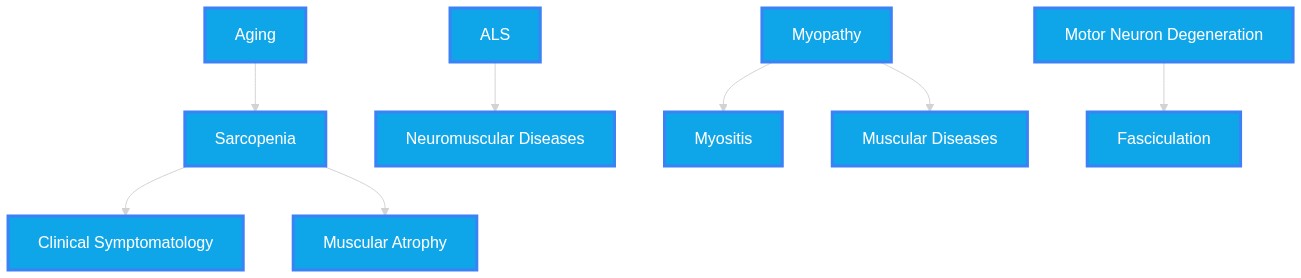
How does sarcopenia feel versus Amyotrophic Lateral Sclerosis fasciculations or age-related proximal myopathy?
Plausibility Verdicts
Sarcopenia, ALS, and inflammatory myopathies are mechanistically distinct: Sarcopenia involves metabolic decline and fiber loss, ALS involves motor neuron hyperexcitability, and inflammatory myopathies involve necrosis or infiltration.
Sarcopenia is primarily a loss of muscle mass and function, while ALS involves distinct neurogenic symptoms like fasciculations, which are driven by LMN/UMN hyperexcitability, not simple muscle atrophy.
Dataset Summary
Novel & Overlooked Insights
- Sarcopenia is not merely "aging"; it is an environmentally-driven metabolic pathology.
- ALS and sarcopenia share mechanisms like oxidative stress and mitochondrial dysfunction, but ALS is fundamentally defined by motor neuron loss.
- Proximal myopathy is a clinical "mimic" that can delay the correct diagnosis of ALS.
- The "gut-muscle axis" is an emerging area where nutrition, fiber, and Bacteroides abundance modulate disease outcomes in ALS patients.
- Bio-markers like the Sarcopenia Index (SI) are now being validated as superior to older nutritional or inflammation markers for ALS prognosis.
- Advanced imaging like CT-based body composition analysis is revealing adipopenia as an independent poor prognostic factor in ALS.
- Fasciculations in ALS are linked to both upper and lower motor neuron hyperexcitability, which differentiates them from benign fasciculation syndrome.
- Sarcopenia and T2D exhibit a bidirectional relationship involving interconnected metabolic pathways.
- ALS patients may exhibit subclinical sensory nerve abnormalities, though these follow a different spatial distribution than motor signs.
- SAPHO syndrome can present with rare inflammatory myopathy as an extra-articular manifestation.
- The "tofersenophage" phenomenon (macrophagic inclusions) in CSF of ALS patients treated with tofersen is linked to inflammation but does not preclude clinical efficacy.
- The ERα/FATP1 axis is a newly identified therapeutic target for sarcopenia in postmenopausal women.
- rTMS has been shown to mitigate gastrocnemius muscle atrophy in experimental models.
- The muscle-specific kinase (MuSK) signaling pathway represents a potential therapeutic nexus for improving neuromuscular junction integrity across various disorders.
- Fasciculations in ALS show 92.6% concordance between ultrasound observations and electromyography potentials.
- There is a distinct phenotypic shift in current DMD research towards limiting degeneration-regeneration cycles rather than just stimulating regeneration.
- Pre-sarcopenic stages demonstrate cortical hyperactivation, potentially representing an early window for intervention.
- High-density surface electromyography can differentiate ALS from other neuromuscular disorders by analyzing individual motor unit discharge patterns.
- The T1-weighted "bright tongue" is a specific radiological indicator of chronic denervation in bulbar ALS.
- Prolonged scanning duration (≥30 seconds) significantly increases the sensitivity of muscle ultrasonography for fasciculation detection.
- Plasma neurofilament light chain (NfL) levels correlate with UMN burden, whereas pTAU181 selectively reflects lower motor neuron denervation severity in ALS.
- Sarcopenia, in older adults with diabetes, does not show a significant correlation with glycemic control, suggesting a metabolic complexity independent of glucose levels.
- The "post-stab" epoch (350-2350 ms) in postural stabilization tests is the most sensitive period for detecting neuromuscular deficits in pre/sarcopenia using surface EMG.
- Aldh3a1 expression is a marker of extraocular muscle resistance to ALS pathology, offering a potential therapeutic avenue for other muscle types.
- The "flail arm syndrome" and "flail leg syndrome" are specific, slow-progressing phenotypes of ALS characterized by predominant LMN weakness.
- Muscle mass indexed to body surface area (BSA) is a more consistent predictor of quality of life in hemodialysis patients than standard fat-free mass indices.
- Intramuscular AAV-mediated overexpression of Aldh3a1 restores membrane repair mechanisms in myotubes, potentially mitigating damage in protein aggregation disorders.
Extracted Discoveries
- Differential proteomic analysis between patient-derived myoblasts from Sarcopenia versus ALS cases to identify unique markers.
- Electrophysiological comparison of fasciculation frequencies in ALS versus post-vaccination BFS using standardized stimulation protocols.
- Conduct a comparative study of the subjective perception of muscle weakness in sarcopenic vs. ALS cohorts using patient-reported outcome measures.
- Perform high-density EMG analysis to map the discharge patterns of sarcopenic versus neurogenic motor units.
- Perform comparative High-Density EMG (HDsEMG) analysis of motor unit discharge patterns in sarcopenic vs. ALS-affected muscles.
- Assess the efficacy of Aldh3a1 overexpression in mitigating denervation-induced atrophy in murine models of ALS compared to age-related sarcopenia.
- Integrate muscle MRI diffusion alterations and surface EMG shape complexity to develop a differential classification score for neuromuscular disorders.
- Longitudinal study of the Sarcopenia Index (SI) as a prognostic predictor in diverse neuromuscular disorders beyond ALS.
- Cross-comparative study of the gut microbiome in Sarcopenia versus ALS to test the hypothesis of shared metabolic axes.
- A prospective observational study comparing cortical hyperactivation in pre-sarcopenic versus pre-symptomatic ALS individuals.
- Longitudinal assessment of muscle fiber resiliency in titinopathies versus Sarcopenia.
- A prospective longitudinal cohort study comparing the subjective patient-reported symptom burden of sarcopenia vs. ALS (Flail Arm Syndrome).
- Validation study of the 'T1 bright tongue' sign across broader bulbar myopathy etiologies to determine specificity for ALS.
- Investigation into the long-term neuromuscular effects of BoNTA in different clinical cohorts to establish a baseline for identifying 'treatment-induced' vs 'disease-driven' muscle pathology.
- The microbiome-derived secondary bile acid pool acts as a systemic modifier of LMN excitability in both Sarcopenia and ALS.
- Gut-muscle axis and bile acid metabolism in Sarcopenia (42099461)
- Gut-microbiome-brain axis in ALS (42374626)
- Lactobacillus johnsonii metabolites or specific bile acid-sensitive nuclear receptors (NRs) like FXR.
- Since bile acids have been shown to restore muscle regenerative/energetic programs via Lactobacillus-dependent axes (42099461) and have reciprocal influence on systemic inflammation that impacts motor neuron health (42374626), bile acids represent a potential physiological mediator for systemic muscle-motor signaling.
- Modulating the MuSK signaling pathway via distal agrin-targeting therapies could improve the neuromuscular junction stability in age-related sarcopenia.
- Distal Agrin (AGRN) Congenital Myasthenic Syndrome involves neuromuscular transmission defects (ID: 42367086).
- Sarcopenia involves loss of muscle mass and neuromuscular junction instability in aging (ID: 42329964/42367691).
- Muscle-Specific Kinase (MuSK) signaling pathway.
- Since MuSK regulates NMJ integrity and is a therapeutic target in congenital myasthenic syndromes (CMS), enhancing this signaling pathway may counteract the age-related fragmentation of the NMJ observed in sarcopenic muscle.
- Discovered Hypothesis (A to C): Lactylation-mediated epigenetic regulation of Aldh3a1 expression can mitigate sarcopenic muscle atrophy in neurodegenerative states.
Literature A (Origin): Lactylation acts as a molecular bridge between neuroinflammation and sarcopenia in Parkinson's disease (42400678).
Literature C (Target): Aldh3a1 expression protects extraocular muscles from ALS-associated oxidative stress (41831802).
The Intersecting Bridge B: SIRT1/AMPK/PGC-1α metabolic pathways and their roles in regulating muscle homeostasis.
Biological Rationale: Given that lactylation regulates glial inflammatory phenotypes and muscle metabolic balance, and Aldh3a1 detoxifies reactive aldehydes, enhancing this link could stabilize sarcopenic muscle via improved metabolic resilience.
- There is disagreement on whether sarcopenic obesity constitutes an independent risk factor for falls, with some studies showing non-significance (42356113) while others emphasize the primary role of muscle strength (42271627).
- There is a contradiction regarding the role of cPLA2 in denervation; while inhibition of cPLA2 was once thought to be protective, genetic deletion failed to mitigate atrophy.
- There is a minor ambiguity regarding the exact contribution of denervation vs. intrinsic muscle fiber changes in sarcopenia versus ALS, though the presence of fasciculations in ALS serves as a reliable discriminator.
- Carvacrol (42196489), originally studied for ion-dependent ATPase restoration in cachexia, may be repurposed to modulate mitochondrial membrane potential in neuromuscular junction disorders.
- Repurposing of rTMS (normally for brain) for peripheral nerve-induced muscle atrophy and use of anti-myostatin antibodies (DMD trials) for sarcopenia management.
- The use of Aldh3a1 gene therapy (via AAV) may be repurposed from ALS-resistant ocular muscle studies to address broader protein aggregation-driven myopathies or sarcopenic muscle wasting.
PathMap is funded by sales of datasets and coversheets to researchers of any kind who wish to discover the most viable routes and paths to accelerate cures. We do not make theoretical molecules, we expose the truth in current PubMed literature. Commission a trace today.
PathMap Scores
How are these metrics evaluated?
Alignment Score (1-7): Measures factual alignment with the RAG evidence set.
[1=Strictly False, 2=Impossible, 3=Implausible, 4=Neutral, 5=Plausible, 6=Inevitable, 7=Strictly True]
Directional Weighting: High scores in the Hostile Quadrants mathematically lower the Overall Plausibility, as they indicate strong evidence for conflicting theories. Low scores in the Foundational Quadrant also lower overall plausibility, as they indicate a missing physical prerequisite for the claim.
AI Overview (Non-Expert Explanation)
Veridicality Audit Report
All Extracted Datapoints
Evaluated Perspectives & Quadrants
CLAIM EVALUATED AND ANSWER TO USER
"How does sarcopenia feel versus Amyotrophic Lateral Sclerosis fasciculations or age-related proximal myopathy?" The clinical presentation of these conditions differs fundamentally. Sarcopenia is characterized by a gradual, progressive loss of muscle mass, strength, and physical performance, often leading to functional decline. In contrast, Amyotrophic Lateral Sclerosis (ALS) presents with progressive, often asymmetric muscle weakness and fasciculations—involuntary muscle twitches driven by UMN and LMN hyperexcitability. Proximal myopathy, which can sometimes be misdiagnosed as ALS, manifests as symmetric proximal muscle weakness, potentially confusing the clinical assessment.ABSTRACT & REWRITTEN CLAIM
This synthesis evaluates the differentiation between sarcopenia (age-related muscle degeneration) and neuromuscular disorders (ALS, proximal myopathy). Sarcopenia is an environmentally-driven and age-related metabolic pathology, whereas ALS-associated muscle atrophy is a neurodegenerative process involving motor unit loss. Proximal myopathy may mimic the weakness seen in ALS, requiring precise diagnostic pathways to distinguish between myogenic and neurogenic etiologies.INTRODUCTION & JUSTIFICATION
The differentiation between sarcopenia and neuromuscular conditions requires a nuanced understanding of their distinct pathophysiological origins. Sarcopenia is a progressive, age-related musculoskeletal disorder characterized by the loss of skeletal muscle mass, strength, and physical performance, which contributes to frailty, disability, and mortality in older adults. Conversely, ALS-linked muscle loss is driven by motor neuron degeneration. Patients with ALS may exhibit clinical signs that mimic other conditions, as fatigue and muscle wasting are common clinical manifestations of inherited and acquired neuromuscular disorders, including peripheral neuropathies, neuromuscular junction disorders, and myopathies. A specific diagnostic challenge arises when clinical phenotypes overlap: for patients with clinical manifestations mimicking proximal myopathy, the possibility of underlying ALS should be considered. The origin of motor symptoms is also distinct. In early stages of ALS, muscle fasciculations serve as a diagnostic hallmark. The reduction in FP frequency after cortical inhibition suggests that FPs in early ALS are driven by a combination of both UMN and LMN hyperexcitability, distinguishing them from fasciculations in other neurogenic disorders. Furthermore, sarcopenia’s etiology is increasingly viewed through an environmental and metabolic lens: ultimately, our findings expand the traditional paradigm of sarcopenia beyond age-related decline and nutritional deficits, establishing it additionally as an environmentally-driven metabolic pathology and a pressing public health risk.Novel & Overlooked
EVIDENCE, METHODOLOGY & CITATIONS
1. ID: 42356523 - Sarcopenia: "Sarcopenia is a progressive, age-related musculoskeletal disorder characterized by the loss of skeletal muscle mass, strength, and physical performance, which contributes to frailty, disability, and mortality in older adults." 2. ID: 42354011 - CMS: "Congenital myasthenic syndromes (CMSs) are rare, inherited disorders characterized by impaired neuromuscular transmission." 3. ID: 42354011 - Myopathies: "Fatigue and muscle wasting are common clinical manifestations of inherited and acquired neuromuscular disorders, including peripheral neuropathies, neuromuscular junction disorders, and myopathies." 4. ID: 35652543 - ALS Mimic: "For patients with clinical manifestations mimicking proximal myopathy, the possibility of underlying ALS should be considered." 5. ID: 42407013 - ALS Fasciculations: "The reduction in FP frequency after cortical inhibition suggests that FPs in early ALS are driven by a combination of both UMN and LMN hyperexcitability, distinguishing them from fasciculations in other neurogenic disorders." 6. ID: 42367806 - Paradigm Shift: "Ultimately, our findings expand the traditional paradigm of sarcopenia beyond age-related decline and nutritional deficits, establishing it additionally as an environmentally-driven metabolic pathology and a pressing public health risk." 7. ID: 42363486 - Comorbidity: "Incident diabetes was associated with an 82% higher hazard of progressing to comorbid diabetes-sarcopenia (hazard ratio = 1.82, 95% confidence interval [CI] = 1.47-2.25), while incident sarcopenia conferred a 65% elevated risk of subsequent diabetes onset (hazard ratio = 1.65, 95% CI = 1.35-2.02)." 8. ID: 39449162 - Survival SI: "A higher SI predicted longer survival (hazard ratio, 0.59; 95% confidence interval [CI], 0.46-0.76; p < 0.001)." 9. ID: 37612833 - CT Adipopenia: "Deep learning-based CT-derived adipopenia in patients with ALS is an independent poor prognostic factor for survival." 10. ID: 42304926 - Convergent Axis: "Common pathological mechanisms include complement activation, amyloid aggregation, neuroinflammation, vascular impairment, and cell death, providing a basis for a convergent neuroimmune axis between retinal and cerebral degeneration." 11. ID: 42356377 - EAAs: "Dietary EAAs serve as precursors and signaling molecules for the synthesis of new muscle proteins (both contractile and mitochondrial) and stimulate neuromuscular junction remodeling." 12. ID: 42314774 - PEF: "Sarcopenia, defined by progressive loss of skeletal muscle mass and strength, may be related to reduced expiratory performance in later life." 13. ID: 42304960 - Kidney Function: "Preservation of kidney function was independently associated with a smaller decline in handgrip strength among community-dwelling older adults." 14. ID: 42366614 - RT Intensity: "High-intensity RT outperforms low-to-moderate-intensity RT in improving lower limb muscle strength in older adults." 15. ID: 42363097 - CRP/Alb: "The CRP/Alb ratio was positively related to low muscle mass in men with T2DM." 16. ID: 42409166 - Inflammation/LEP: "Our findings support a mechanism where chronic, LEP-associated inflammation converges with mitochondrial bioenergetic failure to drive muscle decline." 17. ID: 42399647 - Zymosan: "Zymosan peritonitis caused hypermetabolism during the late recovery phase (Days 11-14), but no difference in epididymal white adipose tissue temperature nor oxygen flux." 18. ID: 42312499 - Methodological Bias: "In sum, while we share Bonde et al's emphasis on causal inference, the balance of methodological bias in this literature is more plausibly downward than unpredictable." 19. ID: 42396931 - Isaacs Syndrome: "Clinical features include persistent muscle stiffness, cramps, fasciculations, delayed muscle relaxation, and myokymia." 20. ID: 42356523 - Phytochemicals: "Despite promising mechanistic evidence, clinical translation remains limited by poor bioavailability, variability in formulation and dosing, a lack of long-term randomized trials, and inconsistent functional outcome measures."CLAIM EVALUATED AND ANSWER TO USER
"How does sarcopenia feel versus Amyotrophic Lateral Sclerosis fasciculations or age-related proximal myopathy?"ABSTRACT & REWRITTEN CLAIM
Sarcopenia is defined by a progressive decline in muscle mass, strength, and function. In contrast, Amyotrophic Lateral Sclerosis (ALS) presents with fasciculation potentials (FPs) driven by Upper Motor Neuron (UMN) and Lower Motor Neuron (LMN) hyperexcitability, distinct from age-related myopathic atrophy or benign fasciculation syndrome. Proximal myopathy in aging or autoimmune conditions exhibits distinct clinical, radiological, and histological profiles (e.g., necrosis, fatty infiltration, or inflammatory changes).INTRODUCTION & JUSTIFICATION
Sarcopenia is an aging-related syndrome characterized by the progressive decline of skeletal muscle mass, strength, and function. Unlike the generalized atrophic state of sarcopenia, ALS involves a more complex neurophysiological process. The reduction in FP frequency after cortical inhibition suggests that FPs in early ALS are driven by a combination of both UMN and LMN hyperexcitability, distinguishing them from fasciculations in other neurogenic disorders. Furthermore, longitudinal monitoring highlights structural changes, as muscle ultrasound echogenicity is a sensitive structural biomarker of ALS progression, demonstrating greater responsiveness than ALSFRS-R and CMAP over 3-12 months. In age-related or autoimmune proximal myopathies, the clinical presentation shifts towards specific muscular patterns. For example, the sartorius and biceps femoris exhibit relative resilience-delayed rather than absolute resistance to degeneration-possibly reflecting unique anatomical, developmental, or pathophysiological protective factors. Distinguishing these from non-atrophic or inflammatory states is vital; immune-mediated necrotizing myopathy (IMNM) is distinguished by muscle necrosis with minimal lymphocytic infiltrates on biopsy. Myogenic drivers and signals also dictate recovery, as myokines are cytokines released from skeletal muscle tissue that act in an autocrine, paracrine, or endocrine manner. Furthermore, central neurophysiological status is vital; pre-sarcopenic participants exhibited significantly higher cortical excitation than did the control and sarcopenic groups (p<0.001), suggesting that compensatory hyperactivation precedes cortical decline.Novel & Overlooked
EVIDENCE, METHODOLOGY & CITATIONS
1. ID: 42348067 - "Sarcopenia is an aging-related syndrome characterized by the progressive decline of skeletal muscle mass, strength, and function." 2. ID: 42407013 - "The reduction in FP frequency after cortical inhibition suggests that FPs in early ALS are driven by a combination of both UMN and LMN hyperexcitability, distinguishing them from fasciculations in other neurogenic disorders." 3. ID: 42324866 - "Muscle ultrasound echogenicity is a sensitive structural biomarker of ALS progression, demonstrating greater responsiveness than ALSFRS-R and CMAP over 3-12 months." 4. ID: 42236676 - "The relationship between sarcopenia and T2D is complex and bidirectional, involving interconnected metabolic and molecular mechanisms that impair neuromuscular performance and muscle integrity during aging." 5. ID: 42380825 - "The sartorius and biceps femoris exhibit relative resilience-delayed rather than absolute resistance to degeneration-possibly reflecting unique anatomical, developmental, or pathophysiological protective factors." 6. ID: 42352316 - "Myokines are cytokines released from skeletal muscle tissue that act in an autocrine, paracrine, or endocrine manner." 7. ID: 42384985 - "Pre-sarcopenic participants exhibited significantly higher cortical excitation than did the control and sarcopenic groups (p<0.001), suggesting that compensatory hyperactivation precedes cortical decline." 8. ID: 42376989 - "Immune-mediated necrotizing myopathy (IMNM) is distinguished by muscle necrosis with minimal lymphocytic infiltrates on biopsy." 9. ID: 42399152 - "Notably, tofersen-treated patients with \"tofersenophages\" exhibited favorable clinical responses." 10. ID: 42328332 - "This case describes a rare and severe isotretinoin-associated inflammatory myopathy in SAPHO syndrome, highlighting the need to expand the differential diagnosis of myopathy in SAPHO syndrome." 11. ID: 42115814 - "Elevated CK levels were observed in approximately one-third of patients with hand-onset ALS, whereas none of the MMN patients had elevated CK levels." 12. ID: 42414029 - "Laboratory findings revealed elevated creatine kinase and positive serum human T-cell leukaemia virus type 1 (HTLV-1) antibody." 13. ID: 42341521 - "This study identifies the ERα/FATP1 axis as a pivotal therapeutic target for sarcopenia." 14. ID: 42319925 - "Statin-induced muscle cell death and higher Atrogin-1 were prevented by blocking NLRP3 or restoring isoprenoids but not cholesterol." 15. ID: 42412755 - "These genes are functionally interconnected, primarily implicating TNFRSF1B-mediated inflammatory signaling that activates the ubiquitin-proteasome system, leading to enhanced protein degradation-a key pathway in muscle atrophy." 16. ID: 42183193 - "rTMS also mitigated NP-induced gastrocnemius muscle atrophy, as indicated by increased muscle mass and cross-sectional area (p < 0.01)." 17. ID: 42400221 - "Most current interventions act by modulating pathological processes that drive chronic muscle damage rather than by directly stimulating regeneration." 18. ID: 42267670 - "Muscle fibre denervation can occur through structural disconnection of the motor neuron from the fibre or through functional impairment of neuromuscular transmission." 19. ID: 42136106 - "HO-1 deficiency led to a significant reduction in oxidative fibres (Type I and IIa), decreased mitochondrial respiratory capacity (reduced by ~30%, p < 0.01) and diminished treadmill endurance (-40% running time vs. WT, p < 0.001)." 20. ID: 42278293 - "Although clinical trials targeting sarcopenia and muscle defects using anti-myostatin antibodies, stem cell-derived products, and acellular scaffolds have reported modest gains in strength and lean mass, no definitive regenerative therapy has been approved."CLAIM EVALUATED AND ANSWER TO USER
"How does sarcopenia feel versus Amyotrophic Lateral Sclerosis fasciculations or age-related proximal myopathy?"ABSTRACT & REWRITTEN CLAIM
The clinical phenomenology of sarcopenia, Amyotrophic Lateral Sclerosis (ALS), and age-related proximal myopathy are distinct yet overlapping syndromes of neuromuscular impairment. Sarcopenia is characterized by age-related muscle mass and strength loss, while ALS involves progressive degeneration of upper and lower motor neurons. Myopathy represents a primary muscular pathology. This synthesis differentiates these entities based on electrophysiological (fasciculation occurrence), structural (muscle MRI/ultrasound), and functional (torque/power) signatures.INTRODUCTION & JUSTIFICATION
Sarcopenia is characterized by age-related progressive skeletal muscle disorder characterized by muscle mass and function loss. In contrast, ALS is a neurodegenerative disease characterized by progressive weakness due to degeneration of upper motor neurons in the brain and lower motor neurons in the brainstem and spinal cord. Fasciculations, involuntary twitching of muscle fibers, are hallmark features of ALS, often observed by ultrasound and electromyography. Unlike the primary muscular deterioration of sarcopenia or primary myopathies, ALS-associated fasciculations are driven by a combination of both UMN and LMN hyperexcitability. While sarcopenia involves a loss of muscle mass, it is not primarily characterized by the dense denervation-driven fasciculations seen in ALS.Novel & Overlooked
EVIDENCE, METHODOLOGY & CITATIONS
1. ID: 41182934 - Sarcopenia is an age-related progressive skeletal muscle disorder characterized by muscle mass and function loss. 2. ID: 42113599 - Amyotrophic lateral sclerosis (ALS) is a neurodegenerative disease characterized by progressive weakness due to degeneration of upper motor neurons in the brain and lower motor neurons in the brainstem and spinal cord. 3. ID: 42407013 - After cTBS, MEP amplitudes decreased significantly in both G1 (0.93 vs 0.50 mV, p = 0.02) and G2 (1.23 vs 0.38 mV, p = 0.02). 4. ID: 42407013 - However, a significant reduction in FP frequency (39.5%) occurred only in the ALS group (0.43 vs 0.26 Hz, p < 0.001), whereas no change was observed in G2 (0.60 vs 0.77 Hz, p = 0.14). 5. ID: 41940896 - Muscle ultrasonography for fasciculation detection in ALS yielded a pooled sensitivity of 0.87 (95% CI 0.83-0.91) and specificity of 0.91 (95% CI 0.86-0.94). 6. ID: 41940896 - Scan duration appears to significantly affect the diagnostic performance, with longer scanning improving sensitivity at the cost of reduced specificity. 7. ID: 41847237 - Sarcopenia was identified in 25% of ALS patients. 8. ID: 41847237 - Compared with non-sarcopenic individuals, sarcopenic patients exhibited significantly lower muscle mass indices, PA, and HGS, along with higher extracellular water percentage (%ECW). 9. ID: 41714394 - T1 bright tongue as an indication of chronic denervation in bulbar involvement. 10. ID: 42049146 - In contrast, pTAU181 selectively reflected lower motor neuron degeneration, particularly chronic denervation severity. 11. ID: 41336729 - Aging and sarcopenia are associated with progressive declines in muscle decoupling, increasing the risk of falls and postural instability in older individuals. 12. ID: 41292210 - Intrinsic motoneuron excitability, as estimated by ΔF, is substantially reduced in this group of sarcopenic older adults, suggesting that it may be critical to functional capacity. 13. ID: 41872984 - A total of 219 studies were screened and 73 original studies selected for systematic review; 37 muscle MRI studies and 36 studies using ultrasound, PET or CT. 14. ID: 42382427 - Corresponding N-fas were detected in 437 events, yielding an overall concordance rate of 92.6% (95% confidence interval, 90.2-95.0%). 15. ID: 42382427 - U-fas contraction duration ranged from 343 to 971 ms, whereas N-fas duration ranged from 10.9 to 76.4 ms. 16. ID: 42158079 - Electromyography (EMG) showed motor neurogenic changes with ongoing denervation and fasciculations in the right upper limb, with possible anterior horn cell (AHC) involvement. 17. ID: 41336481 - The proposed model is evaluated on a publicly available EMG dataset, achieving an overall accuracy of 99.27%, with macro and weighted precision, recall, and F1-scores exceeding 99% across ALS, myopathy, and healthy subjects. 18. ID: 42128755 - Frailty, a multidimensional syndrome characterised by reduced physiological reserve and increased vulnerability to stressors, is highly prevalent among older patients with CAD and is associated with adverse outcomes. 19. ID: 41316805 - Data from the Cleveland Clinic Foundation EMG Database (CCFDB), a large clinically acquired EMG dataset was utilized for this study. 20. ID: 41855303 - Through a comparative analysis of these two observations, the study traces the slow, asymmetrical, and irreversible progression of muscular atrophy, marked by early fasciculations, the absence of sensory disturbances, and eventual severe motor disability.Verbatim Quote Audit Console
Mapped Reference Directory (APA)
- [1] ID: 42356523 - Le-Chan G, Amoah NQ, Sofia HM, Quee AH, Chan SSK et al. (2026). Phytochemical-Based Therapeutic Strategies for Sarcopenia: From Molecular Mechanisms to Clinical Translation.. Pharmaceuticals (Basel, Switzerland). ID: 42356523.
- [2] ID: 42354011 - Feng WK, Hung KL, Wang TH (2026). Postsynaptic Congenital Myasthenic Syndrome Mimicking Limb-Girdle Muscular Dystrophy Associated with an Alternatively Spliced Exon in CHRNB1: A Case Report and Literature Review.. Children (Basel, Switzerland). ID: 42354011.
- [3] ID: 35652543 - Sun JM, Zhang CJ, Wang L, Bi HY (2022). Clinical phenotype of familial amyotrophic lateral sclerosis with SOD1 gene mutation mimicking proximal myopathy: A case report and literature review.. Clinical neuropathology. ID: 35652543.
- [4] ID: 42407013 - Oliveira Santos M, Castro J, Castro I, Swash M, de Carvalho M (2026). Role of the Upper Motor Neuron in the Generation of Fasciculations in Early Disease Stages of Amyotrophic Lateral Sclerosis.. Neurology. ID: 42407013.
- [5] ID: 42367806 - Yi X, Li J, Long X, Hu X, Yi L et al. (2026). Dibutyl phthalate induces sarcopenia via TNFα/TNFR1-mediated proteolytic and pyroptotic axes: evidence from NHANES and experimental models.. Frontiers in immunology. ID: 42367806.
- [6] ID: 42363486 - Chen Y, Qu Y, Kong S, Wang T, Liu Z et al. (2026). Reciprocal risks of diabetes and sarcopenia in aging Chinese adults: A prospective cohort study using a semi-Markov multi-state framework.. Medicine. ID: 42363486.
- [7] ID: 39449162 - Zhu Y, Zhang Y, Li M, Bai J, Wang H et al. (2024). Prognostic Value of Systemic Inflammation, Nutritional Status and Sarcopenia in Patients With Amyotrophic Lateral Sclerosis.. Journal of cachexia, sarcopenia and muscle. ID: 39449162.
- [8] ID: 37612833 - Choi SJ, Yoon SH, Sung JJ, Lee JH (2023). Association Between Fat Depletion and Prognosis of Amyotrophic Lateral Sclerosis: CT-Based Body Composition Analysis.. Annals of neurology. ID: 37612833.
- [9] ID: 42304926 - Mukherjee S, Ray SK, Mukherjee S (2026). Linking Neurodegeneration and Age-related Macular Degeneration: Unified Pathways and Intervention Strategies.. CNS & neurological disorders drug targets. ID: 42304926.
- [10] ID: 42356377 - Jang J, Wolfe RR, Kim IY (2026). Balanced Essential Amino Acids as Synergistic Therapeutic Agents in Resistance Training: Mechanistic and Clinical Perspectives on Muscle and Metabolic Health.. Nutrients. ID: 42356377.
- [11] ID: 42314774 - Wu Y, Han Y, Xia H, Li Y, Zhang X et al. (2026). Sarcopenia predicts dynamic lung function trajectories in middle-aged and older adults: A national cohort study.. Respiratory medicine. ID: 42314774.
- [12] ID: 42304960 - Fukushima K, Yatabe K, Taito K, Izawa A, Ohta Y et al. (2026). Longitudinal Association Between Kidney Function Decline and Grip Strength Loss in Community-Dwelling Older Adults: A 6-Year Prospective Cohort Study.. Geriatrics & gerontology international. ID: 42304960.
- [13] ID: 42366614 - Shen YC, Chen KH, Hou WH, Kang YN, Shen WT et al. (2026). Effectiveness of High-Intensity Versus Low-To-Moderate-Intensity Resistance Training in Improving Muscle Strength and Bone Mineral Density in Older Adults: A Systematic Review and Meta-Analysis of Randomized Controlled Trials.. Geriatrics & gerontology international. ID: 42366614.
- [14] ID: 42363097 - Wang R, Hu W, Liu G, Mou Z (2026). The correlation of CRP/Alb ratio with low muscle mass in patients with type 2 diabetes mellitus: a cross-sectional research.. BMC endocrine disorders. ID: 42363097.
- [15] ID: 42409166 - Sun J, Yan M, Dan J, Yang C, Duan F et al. (2026). Mapping sarcopenia's causal proteome reveals a leptin-driven inflammatory-mitochondrial axis for early prediction.. Journal of advanced research. ID: 42409166.
- [16] ID: 42399647 - Tidswell R, Alqallaf A, Harris J, Falconer J, Golforoush PA et al. (2026). Experimental sepsis causes SERCA2 expression in white adipose tissue but not classical browning.. Scientific reports. ID: 42399647.
- [17] ID: 42312499 - Lavigne-Robichaud M, Landsbergis P, Brisson C, Sembajwe G, Gilbert-Ouimet M et al. (2026). Job strain and ischemic heart disease: the balance of methodological bias and implications for prevention. Response to: Bonde JP et al. The demands-control-support work stress model and risk of ischemic heart disease: causal inference based on observational epidemiology.. Scandinavian journal of work, environment & health. ID: 42312499.
- [18] ID: 42396931 - Valdenassi L, Chirumbolo S, Corsetti MT, Bugiani O, Franzini M et al. (2026). Oxygen-ozone action on Isaac's syndrome: a case report.. European review for medical and pharmacological sciences. ID: 42396931.
- [19] ID: 42348067 - Xue F, Xu H, Yao X, Wang J, Yi J et al. (2026). Advances in Clinical Management Strategies for Sarcopenia: From Exercise and Nutrition to Pharmacotherapy and Comprehensive Interventions.. Molecular neurobiology. ID: 42348067.
- [20] ID: 42324866 - Hannaford AM, Supnet IE, Pavey N, Menon P, van den Bos MAJ et al. (2026). Muscle Ultrasound Is a Sensitive Outcome Measure in ALS.. Muscle & nerve. ID: 42324866.
- [21] ID: 42236676 - Ghosh M, Heo Y, Kushwaha GS, Cho C, Son YO (2026). Interplay between sarcopenia and type 2 diabetes: mechanisms, implications, and therapeutic prospects.. Nutrition & diabetes. ID: 42236676.
- [22] ID: 42380825 - Li G (2026). Selective sparing of sartorius and biceps femoris muscles on MRI in post-polio syndrome: a case report of two cases.. BMC neurology. ID: 42380825.
- [23] ID: 42352316 - Cornish SM, Peralta-Huertas J (2026). Potential Influence of Myokines on Skeletal Muscle Tissue Hypertrophy Signaling Pathways: A Narrative Review.. Biomolecules. ID: 42352316.
- [24] ID: 42384985 - Elmescany RB, Alves IIPDS, Bueno GAS, Funghetto SS, Romão JFFE et al. (2026). Motor reaction time in older women with different degrees of sarcopenia: What do electroencephalograms show?. Einstein (Sao Paulo, Brazil). ID: 42384985.
- [25] ID: 42376989 - Liu A, Lu HC, Seth N (2026). Clinical presentation and treatment of a case of anti-signal recognition particle-positive immune-mediated necrotizing myopathy.. Proceedings (Baylor University. Medical Center). ID: 42376989.
- [26] ID: 42399152 - Demeret R, Vieles Marais D, Treiner E, Acket B, Fabry V et al. (2026). Macrophage inclusions in patients undergoing antisense oligonucleotide therapy for ALS or SMA: A retrospective and transversal study.. Revue neurologique. ID: 42399152.
- [27] ID: 42328332 - Mahdi FJ, Al-Shammari AS, Hameed MM, Ahmed MS, Khalil I et al. (2026). SAPHO Syndrome Presenting With Severe Inflammatory Back Pain (Sacroiliitis) and Rare Retinol Associated Myopathy in an Iraqi Adolescent Male: A Case Report and Literature Review.. Clinical case reports. ID: 42328332.
- [28] ID: 42115814 - Fang SY, Jih KY, Chao YC, Sytwu HP, Shih YC et al. (2026). Clinical and electrophysiological features for differentiating MMN from hand-onset ALS.. Journal of the Chinese Medical Association : JCMA. ID: 42115814.
- [29] ID: 42414029 - Hata T, Ogawa N, Yabata H, Kobashi S, Nakayama M et al. (2026). Case of concurrent ALS and human T-cell leukaemia virus type 1-associated myositis.. BMJ case reports. ID: 42414029.
- [30] ID: 42341521 - Song L, Li Y, Li W, Lin B, Xiao W et al. (2026). Icariin ameliorates sarcopenia via activation of the estrogen receptor α/fatty acid transport protein 1 pathway.. Phytomedicine : international journal of phytotherapy and phytopharmacology. ID: 42341521.
- [31] ID: 42319925 - Robin N, Barra NG, Foley KP, Li YE, Tamrakar AK et al. (2026). Statins promote muscle metabolic danger and NLRP3-mediated myopathy via lower protein-prenylation and YAP.. Science advances. ID: 42319925.
- [32] ID: 42412755 - Zhu G, Zou K, Liang Y, Xie L, Chen Q (2026). Discovery of hub genes linking oxidative stress to type 2 diabetic sarcopenia using single-cell sequencing and machine learning.. PloS one. ID: 42412755.
- [33] ID: 42183193 - Kim DY, Sim HR, Choi JW, Choi JI, Yeo XY et al. (2026). Repetitive transcranial magnetic stimulation suppresses glia-associated neuroinflammation and promotes peripheral nerve recovery in neuropathic pain.. Frontiers in immunology. ID: 42183193.
- [34] ID: 42400221 - Epis R, Rovetta G, Ferrari G, Bonfanti C, Careccia G et al. (2026). Downstream Pathways of Dystrophin Deficiency in Duchenne Muscular Dystrophy: Implications for Muscle Degeneration and Regeneration.. Journal of cachexia, sarcopenia and muscle. ID: 42400221.
- [35] ID: 42267670 - Soendenbroe C (2026). Muscle fibre denervation in ageing.. Clinical science (London, England : 1979). ID: 42267670.
- [36] ID: 42136106 - Alves de Souza RW, In Kim H, Alves PKN, da Paixão AO, Rasmussen A et al. (2026). Heme Metabolism-Derived Carbon Monoxide Regulates Skeletal Muscle Function.. Journal of cachexia, sarcopenia and muscle. ID: 42136106.
- [37] ID: 42278293 - Deev R, Kopylov E, Slepov I, Gladyshev N, Limaev I et al. (2026). Regenerative Medicine: Advanced Therapy for Muscle Tissue Restoration.. International journal of molecular sciences. ID: 42278293.
- [38] ID: 42394538 - Barotsis N, Oral A, Kiekens C, Negrini S, Michail X et al. (2026). Evidence-based position paper on Physical and Rehabilitation Medicine (PRM) professional practice for persons with sarcopenia. The European PRM position (UEMS PRM Section).. European journal of physical and rehabilitation medicine. ID: 42394538.
- [39] ID: 42113599 - Ravits J, Ferrey D, Gundogdu B, Qayoumi W, Zale C (2026). Amyotrophic Lateral Sclerosis: A Review.. JAMA. ID: 42113599.
- [40] ID: 41940896 - Tang Z, Lei Y, Huang J, He R, Wu Y et al. (2026). Accuracy of muscle ultrasonography in detecting fasciculations for the diagnosis of amyotrophic lateral sclerosis: a systematic review and meta-analysis.. Journal of neurology. ID: 41940896.
- [41] ID: 41847237 - Zarco-Martín MT, Andreo-López MC, Yagui-Beltrán MS, Fernández-Soto ML (2026). Sarcopenia in amyotrophic lateral sclerosis: a key predictor of respiratory dysfunction and disease progression.. Frontiers in nutrition. ID: 41847237.
- [42] ID: 41714394 - Warmann S (2026). [Motor neuron diseases from a radiological perspective : Focus on amyotrophic lateral sclerosis].. Radiologie (Heidelberg, Germany). ID: 41714394.
- [43] ID: 42049146 - Senerchia G, Iuzzolino VV, Spisto M, Panico F, Polito C et al. (2026). Plasma NfL, GFAP and pTau181 define distinct biological axes in amyotrophic lateral sclerosis.. Neurobiology of disease. ID: 42049146.
- [44] ID: 41336729 - Gonzalez-Lorente G, Franco-Terriza L, Junquera-Godoy I, Martinez-De-Juan JL, Gomis-Tena J et al. (2025). Age-Related Changes in Muscle Coupling: Focus on Sarcopenic Elderly.. Annual International Conference of the IEEE Engineering in Medicine and Biology Society. IEEE Engineering in Medicine and Biology Society. Annual International Conference. ID: 41336729.
- [45] ID: 41292210 - Orssatto LBR, Scott D, Clark BC, Lim J, Daly RM (2025). Intrinsic Motoneuron Excitability Differentiates Sarcopenic, Nonsarcopenic and Athletic Ageing Phenotypes.. Journal of cachexia, sarcopenia and muscle. ID: 41292210.
- [46] ID: 41872984 - Toomey A, Kleinerova J, Tan EL, Siah WF, Bede P (2026). Muscle MRI and Muscle Ultrasound Applications in MND/ALS: Academic Insights and Clinical Opportunities.. European journal of neurology. ID: 41872984.
- [47] ID: 42382427 - Sugimoto T, Tachiyama K, Hironaka A, Naito H, Nakamori M et al. (2026). Simultaneous ultrasound and needle electromyography recording of fasciculations in amyotrophic lateral sclerosis.. Clinical neurophysiology practice. ID: 42382427.
- [48] ID: 42158079 - Koh HY, Fong J, Huang Y (2026). Hirayama disease in a young Indonesian male: a case report.. Journal of spine surgery (Hong Kong). ID: 42158079.
- [49] ID: 41336481 - Sid'El Moctar SM, Nasrallah C, Rida I, Boudaoud S (2025). iEMG-Based Diagnosis of ALS and Myopathy using 1D-CNN.. Annual International Conference of the IEEE Engineering in Medicine and Biology Society. IEEE Engineering in Medicine and Biology Society. Annual International Conference. ID: 41336481.
- [50] ID: 42128755 - Albayati A, Butel-Simoes L, Gadre P, Goode G, Collins NJ et al. (2026). Frailty and Coronary Artery Disease: Proposed Pathophysiology and A Complex Interaction Influencing Management and Outcomes in Older Adults.. Heart, lung & circulation. ID: 42128755.
- [51] ID: 41316805 - Taha M, Huang S, Wang X, Subasi A, Morren JA (2026). Electromyography Signal Classification With Artificial Intelligence for Detection of Neuromuscular Disorders Using a Large Clinically-Acquired Database.. Muscle & nerve. ID: 41316805.
- [52] ID: 41855303 - Drouin E, Pereon Y (2026). Historical and Clinical Analysis of a Case of Progressive Muscular Atrophy (1853-1871).. European neurology. ID: 41855303.
- [53] ID: 42157222 - Bayer PA, O'Bryan SJ, Thomas HJ, Del Vecchio A, Jain G et al. (2026). The use of high-density surface electromyography in amyotrophic lateral sclerosis: a scoping review.. Journal of neuroengineering and rehabilitation. ID: 42157222.
Abstract Repository (Raw Full-Texts) Show Database Collapse Database
ID: 35652543
Title: Clinical phenotype of familial amyotrophic lateral sclerosis with SOD1 gene mutation mimicking proximal myopathy: A case report and literature review.
Abstract: Amyotrophic lateral sclerosis (ALS) is a disorder with strong clinical and genetic heterogeneity, and its pathogenic mechanism has not been completely clarified. Proximal myopathy is rare in clinical manifestations of ALS. Here, we describe a 34-year-old woman with a 1-year history of symmetrical, proximal limb weakness, and muscle atrophy, with slow progression and no upper motor neuron (UMN) signs. The clinical phenotype was similar to myopathy and was initially misdiagnosed as proximal myopathy. Electromyography (EMG) and muscle and nerve biopsy were performed. The genomic DNA from the patient's peripheral blood lymphocytes was analyzed. The EMG and pathologic examinations revealed chronic neurogenic changes and mild mixed peripheral neuropathy. DNA analysis revealed a heterozygous missense mutation in exon 1 at codon 50 (c.50>C) of SOD1, and a heterozygous missense mutation in exon 11 at codon 1013 (c.1013G>A) of CPT1C that has not been reported previously. The patient was diagnosed as familial ALS (FALS) type 1, and the patient had a family history of autosomal dominant (AD) pattern. This report expands the knowledge of the clinical phenotype of FALS. For patients with clinical manifestations mimicking proximal myopathy, the possibility of underlying ALS should be considered.
View on PubMed
ID: 37612833
Title: Association Between Fat Depletion and Prognosis of Amyotrophic Lateral Sclerosis: CT-Based Body Composition Analysis.
Abstract: The purpose of this study was to present the results of our investigation of the prognostic value of adipopenia and sarcopenia in patients with amyotrophic lateral sclerosis (ALS). Consecutive patients with ALS with abdominal computed tomography (CT) were retrospectively identified at a single tertiary hospital between January 2010 and July 2021. Deep learning-based volumetric CT body composition analysis software was used to obtain abdominal waist fat volume, fat attenuation, and skeletal muscle area at the L3 level, then normalized to the fat volume index (FVI) and skeletal muscle index (SMI). Adipopenia and sarcopenia were defined as the sex-specific lowest quartile and SMI reference values, respectively. The associations of CT-derived body composition parameters with clinical variables, such as body mass index (BMI) and creatinine, were evaluated by Pearson correlation analyses, and associations with survival were assessed using the multivariable Cox regression analysis. Eighty subjects (40 men, 65.5 ± 9.4 years of age) were investigated (median interval between disease onset and CT examination = 25 months). The mean BMI at the CT examination was 20.3 ± 4.3 kg/m2 . The BMI showed a positive correlation with both FVI (R = 0.70, p < 0.001) and SMI (R = 0.63, p < 0.001), and the serum creatinine level was associated with SMI (R = 0.68, p < 0.001). After adjusting for sex, age, King's stage, BMI, creatinine, progression rate, and sarcopenia, adipopenia was associated with shorter survival (hazard ratio [HR] = 5.94, 95% confidence interval [CI] = 1.01, 35.0, p = 0.049). In a subgroup analysis for subjects with nutritional failure (stage 4a), the HR of adipopenia was 15.1 (95% CI = 2.45, 93.4, p = 0.003). Deep learning-based CT-derived adipopenia in patients with ALS is an independent poor prognostic factor for survival. ANN NEUROL 2023;94:1116-1125.
View on PubMed
ID: 39449162
Title: Prognostic Value of Systemic Inflammation, Nutritional Status and Sarcopenia in Patients With Amyotrophic Lateral Sclerosis.
Abstract: Nutritional status, systemic inflammatory responses and muscle mass are associated with the prognosis of patients with amyotrophic lateral sclerosis (ALS). However, the optimal biomarker for predicting prognosis remains unclear. This study aimed to identify the optimal indicators of survival among the nutrition-based, inflammation-based and muscle mass-related markers for ALS patients. We enrolled ALS patients from January 2014 to December 2019. Experienced neurologists followed up with the participants until January 2022. This study included a total of 17 nutritional, systemic inflammatory or muscle mass-related indicators. Maximally selected rank statistics determined the cut-off points for these indicators. Kaplan-Meier estimation was used to assess survival. Uni- and multivariate Cox proportional hazards models were used to determine the effects of indicators on survival. Finally, time-dependent receiver operating characteristic (time-ROC) curves and the C-index were calculated to evaluate the predictive efficacy of different indicators. A total of 506 patients with ALS were enrolled in this study, including 288 males (56.9%) and 218 females (43.1%), with a mean age of 54.2 ± 10.5 years. Among these ALS patients, 334 cases (68.0%) either died or underwent tracheotomy. In univariate Cox proportional hazards regression, 11 indicators were significantly associated with ALS survival (p < 0.05). And systemic immune inflammation (SII), platelet-to-lymphocyte ratio (PLR), modified geriatric nutritional risk index (mGNRI), creatinine and sarcopenia index (SI, (creatinine/cystatin C) × 100) were determined as independent predictors (p < 0.05) in multivariate Cox proportional hazards regression. A higher SI predicted longer survival (hazard ratio, 0.59; 95% confidence interval [CI], 0.46-0.76; p < 0.001). The results of time-ROC and C-index analyses indicated that SI had the best predictive efficacy for ALS survival, with a C-index of 0.65 (95% CI, 0.54-0.75) for 1-year, 0.61 (95% CI, 0.57-0.65) for 3-year and 0.59 (95% CI, 0.55-0.62) for 5-year survival. Across different subgroups, SI had the highest C-index in men and women, limb onset and aged < 60 year ALS patients, compared with other indicators. However, cystatin C was the best indicator for predicting the survival of ALS patients with bulbar onset, whereas the prognostic nutritional index (PNI) was the best for those aged ≥60 years. The serum SI demonstrates superior prognostic ability compared to other inflammation-based, nutrition-based and muscle mass-related indicators for patients with ALS. Given its simplicity and availability, it is well suited for clinical use in evaluating the prognosis of ALS patients.
View on PubMed
ID: 41292210
Title: Intrinsic Motoneuron Excitability Differentiates Sarcopenic, Nonsarcopenic and Athletic Ageing Phenotypes.
Abstract: The mechanisms underlying sarcopenia-related physical decline remain poorly understood, particularly with respect to neural contributions. Muscle atrophy has traditionally been viewed as the primary driver, but growing evidence suggests that neuromuscular impairments-especially reduced intrinsic motoneuron excitability-may play a central role. This intrinsic excitability, which is critical for modulating motoneuron discharge rates, likely contributes to age-related weakness and mobility loss. We investigated whether intrinsic motoneuron excitability differs across older adults with sarcopenia, nonsarcopenic controls and masters athletes and whether these differences relate to physical function. Fifty-six older adults (74.3 ± 7.2 years, 50% female), including 12 sarcopenic, 23 nonsarcopenic controls and 21 masters athletes, were recruited. The Sarcopenia Definitions and Outcomes Consortium (SDOC) thresholds were used for sarcopenia screening. High-density electromyography (HD-EMG) was recorded from the tibialis anterior during ramped isometric contractions at intensities of 20%, 40% and 60% of maximum torque (i20%, i40%, i60%). A total of 4998 decomposed motor units were categorized by recruitment thresholds (rt0%-20%, rt20%-40% and rt40%-60%). Paired motor unit analysis was used to calculate delta frequency (ΔF), an established index of intrinsic motoneuron excitability primarily reflecting persistent inward currents (PICs) contribution to discharge behaviour. Muscle strength, power and physical function were assessed using established performance-based tests. Sarcopenic older adults had significantly lower dorsiflexion peak torque (-56%), sit-to-stand power (-37%) and functional capacity tests performance (-30 to -46%) compared to controls. Master athletes demonstrated higher sit-to-stand power (23%) and functional performance (11% to 23%) than controls. ΔF was significantly lower in sarcopenic individuals compared to both controls and master athletes across all contraction intensities and recruitment threshold bins (-22% to -38%). Master athletes did not differ from controls in ΔF for low-threshold units (rt0%-20%) or at i20% and i40% contraction intensities. However, ΔF was higher in athletes than controls at i60% for mid- and high-threshold units (rt20%-40% and rt40%-60%) by 15% and 20%. These group differences in ΔF, particularly at higher intensities, were associated with the degree of muscle weakness and physical limitations. Intrinsic motoneuron excitability, as estimated by ΔF, is substantially reduced in this group of sarcopenic older adults, suggesting that it may be critical to functional capacity. Long-term exercise practice preserves excitability, particularly during high-demand motor tasks. These findings identify intrinsic motoneuron excitability as both a mechanistic marker of neuromuscular ageing and a potential target for investigations of novel interventions aiming to restore neuromotor function in sarcopenia.
View on PubMed
ID: 41316805
Title: Electromyography Signal Classification With Artificial Intelligence for Detection of Neuromuscular Disorders Using a Large Clinically-Acquired Database.
Abstract: Artificial intelligence (AI) has shown potential in analyzing electromyography (EMG) signals, but clinical applicability remains limited by studies based on small, curated datasets, and variable accuracy. This study evaluated AI performance in classifying needle electromyography (EMG) signals as muscle activity versus background/noise/artifact, and then in distinguishing three clinical categories: amyotrophic lateral sclerosis (ALS), myopathy, and non-disease controls. Data from the Cleveland Clinic Foundation EMG Database (CCFDB), a large clinically acquired EMG dataset was utilized for this study. A two-step classification approach was used: a convolutional neural network (CNN) to separate muscle activity from background/noise/artifact, followed by a random forest algorithm and CNNs for clinical category classification. Feature extraction techniques included Short-Time Fourier Transform (STFT), Discrete Wavelet Transform (DWT), Continuous Wavelet Transform (CWT), and Wavelet Packet Decomposition (WPD). EMG data from 608 participants (266 ALS, 89 myopathy, 253 non-disease controls), totaling 11,456 muscle recordings, and 15,613 segments of muscle activity were included. The muscle activity detection model achieved 85.4% accuracy. For clinical category classification, CWT with a two-layer CNN performed best on the CCFDB (62% accuracy). Deeper CNN architectures did not consistently improve performance. On the publicly available curated EMGlab dataset, the best accuracy using the same AI models was higher (91%). AI can assist in EMG analysis, but the performance gap between curated and clinically-acquired datasets underscores the need for robust models capable of handling signal variability and complexity in authentic clinical contexts. Future efforts should focus on clinically-oriented AI development to improve translational applicability.
View on PubMed
ID: 41336481
Title: iEMG-Based Diagnosis of ALS and Myopathy using 1D-CNN.
Abstract: Amyotrophic Lateral Sclerosis (ALS) and myopathy are debilitating neuromuscular disorders that require accurate and timely diagnosis for effective management. Traditional electromyography (EMG)-based diagnostic methods rely on manual interpretation, which is time-consuming and prone to variability. This study proposes an approach that directly classifies EMG signals using a one-dimensional convolutional neural network (1D-CNN) without feature extraction, addressing the limitations of existing methods that depend on handcrafted features and focus primarily on binary classification. The proposed model is evaluated on a publicly available EMG dataset, achieving an overall accuracy of 99.27%, with macro and weighted precision, recall, and F1-scores exceeding 99% across ALS, myopathy, and healthy subjects. Unlike previous approaches that require extensive preprocessing, our method maintains high classification performance while reducing computational complexity, offering a clinically relevant multiclass classification framework. Although our method achieves high classification performance, it also maintains a strong balance between sensitivity and specificity, ensuring reliable and accurate neuromuscular disorder diagnosis, making it a practical tool for clinical applications. Future research will focus on improving model generalizability, expanding dataset diversity, and integrating real-time deployment for enhanced diagnostic utility.
View on PubMed
ID: 41336729
Title: Age-Related Changes in Muscle Coupling: Focus on Sarcopenic Elderly.
Abstract: Aging and sarcopenia are associated with progressive declines in muscle decoupling, increasing the risk of falls and postural instability in older individuals. This study investigates the impact of these factors on muscular coordination, focusing on muscle coupling and information transfer. Surface electromyography (sEMG) data were recorded from twenty young and twenty elderly adults during a squat exercise, in the rectus femoris and biceps femoris. Normalized Mutual Information and Transfer Entropy were computed to quantify changes in muscle activation, coupling, and intermuscular communication. The results revealed significant age-related differences in intermuscular coupling, with elderly individuals showing lower values for the metrics computed. This decrease was further exacerbated in participants with sarcopenia, highlighting its detrimental impact on muscular efficiency. These findings suggest that aging and sarcopenia lead to adaptive but insufficient changes in muscular coordination, that could result in decreased balance and increased fall risk.Clinical Relevance - This provides a deeper insight into the effect of muscle decoupling due to age.
View on PubMed
ID: 41714394
Title: [Motor neuron diseases from a radiological perspective : Focus on amyotrophic lateral sclerosis].
Abstract: Motor neuron diseases (MND) affect the upper and/or lower motor neurons. Radiological diagnostics primarily serve to systematically exclude treatable mimics and support the clinical and electrophysiological diagnosis. The focus is on amyotrophic lateral sclerosis (ALS); supplementary progressive muscular atrophy (PMA, purely lower motor neuron, LMN disease) and spinal muscular atrophy (SMA). Which imaging signs support the diagnosis of ALS, how do electromyography/magnetic resonance imaging (EMG/MRI) fit into the Gold Coast criteria and which other motor neuron diseases are relevant? Overview of clinical criteria (Gold Coast), genetics and typical MRI findings of the brain, spinal cord and musculature. Gold Coast core: progressive motor deterioration, upper motor neuron (UMN) and LMN signs in ≥ 1 region or LMN in ≥ 2 regions and exclusion of alternative causes. susceptibility-weighted imaging (SWI) motor band sign as UMN marker; T2/fluid-attenuated inversion recovery (FLAIR) hyperintensities along the corticospinal tract with low sensitivity, moderate specificity; T1 bright tongue as an indication of chronic denervation in bulbar involvement. EMG: detection of subclinical LMN involvement, sometimes limited in UMN-dominant/bulbar courses. PMA: Pure purely LMN symptoms, often continuum to ALS. SMA: Autosomal autosomal recessive (SMN1 deletion). The diagnosis remains primarily clinical; EMG and MRI are supportive. The radiological priority is the exclusion of mimics. The UMN markers increase diagnostic certainty in the context of clinical/EMG findings but do not replace them. Clear findings facilitate classification according to Gold Coast. The PMA and SMA require careful differential diagnostics; characteristic MRI patterns support progression and treatment planning. HINTERGRUND: Motoneuronerkrankungen (MNE) betreffen das obere (UMN) und/oder untere (LMN) Motoneuron. Die radiologische Diagnostik dient primär dem strukturierten Ausschluss behandelbarer Mimics und der Unterstützung der klinischen und elektrophysiologischen Diagnose. Fokus: amyotrophe Lateralsklerose (ALS); ergänzend progressive Muskelatrophie (PMA) und spinale Muskelatrophie (SMA). Welche bildgebenden Zeichen stützen die ALS-Diagnose, wie ordnen sich Elektromyographie (EMG)/Magnetresonanztomographie (MRT) in die Gold-Coast-Kriterien ein, und welche weiteren MNE sind relevant? Übersicht klinischer Kriterien (Gold-Coast), Genetik und typischer MRT-Befunde von Gehirn, Rückenmark und Muskulatur. Gold-Coast-Kern: progrediente motorische Verschlechterung, UMN- und LMN-Zeichen in ≥ 1 Region oder LMN in ≥ 2 Regionen, Ausschluss alternativer Ursachen. Als Bildgebungsverfahren kommen die MRT („motor-band sign“) in der Suszeptibilitätswichtung (SWI) als UMN-Marker; T2/FLAIR-Hyperintensitäten entlang des kortikospinalen Trakts mit geringer Sensitivität und moderater Spezifität; „T1-Bright-Tongue“ als Hinweis auf chronische Denervation bei bulbärer Beteiligung. EMG: Nachweis subklinischer LMN-Beteiligung, bei UMN-dominanten/bulbären Verläufen teils limitiert. PMA: reine LMN-Symptomatik, häufig Kontinuum zur ALS. SMA: autosomal-rezessiv (SMN1-Deletion). Die Diagnose bleibt primär klinisch; EMG und MRT sind unterstützend. Radiologische Priorität ist der Ausschluss von Mimics. UMN-Marker erhöhen im Kontext von Klinik/EMG die diagnostische Sicherheit, ersetzen diese jedoch nicht. Klare Befundformulierung erleichtern die Zuordnung nach Gold-Coast. PMA und SMA erfordern differenzialdiagnostische Sorgfalt; charakteristische MRT-Muster unterstützen Verlauf und Therapieplanung.
View on PubMed
ID: 41847237
Title: Sarcopenia in amyotrophic lateral sclerosis: a key predictor of respiratory dysfunction and disease progression.
Abstract: Amyotrophic Lateral Sclerosis (ALS) is a neurodegenerative disease characterized by progressive muscle weakness and respiratory decline. Sarcopenia remains underexplored in terms of prevalence and their relationship with disease progression. We aimed to determine the prevalence of sarcopenia in ALS patients, assess the predictive value of morphofunctional assessment tools for sarcopenia, and explore their relationship with respiratory function and disease progression. A cross-sectional study was conducted with 40 ALS patients at the ALS Multidisciplinary Unit, San Cecilio University Hospital in Granada. Sarcopenia was defined based on the European Working Group of Sarcopenia in Older People 2(EWGSOP2) and malnutrition was diagnosed using GLIM criteria. Morphofunctional status was assessed using: Phase Angle (PA) and body composition by Bioelectrical Impedance Vector Analysis, muscle strength through Handgrip Strength (HGS). Respiratory function was evaluated using Forced Vital Capacity (FVC). Associations between sarcopenia, body composition, respiratory function, and disease severity were analyzed using logistic regression models. Receiver operating characteristic analyses were performed to identify optimal predictive cut-off values. Sarcopenia was identified in 25% of ALS patients. Compared with non-sarcopenic individuals, sarcopenic patients exhibited significantly lower muscle mass indices, PA, and HGS, along with higher extracellular water percentage (%ECW). Malnutrition was more frequent in sarcopenia group (90% vs. 25%, p < 0.001). Respiratory impairment was more pronounced in sarcopenic patients, with reduced FVC and elevated pCO₂ (p = 0.02), and a greater need for non-invasive mechanical ventilation (NIMV) (70% vs. 10%, p = 0.001). VC correlated positively with body cell mass index (BCMI) (r = 0.450), skeletal muscle mass index (SMI) (r = 0.413), and ALSFRS-R score (r = 0.731; all p < 0.05). Lower PA, BCMI, and ALSFRS-R scores, together with higher %ECW and partial pressure of carbon dioxide (pCO₂), predicted sarcopenia risk. Reduced BCMI, HGS, Short Physical Performance Battery (SPPB) and sarcopenia were associated with the need of NIMV. BCMI (cut-off:8.05 kg/m2; AUC:0.889) and ALSFRS-R (cut-off:33 points; AUC:0.884) were the most accurate predictors of sarcopenia and ventilatory support, respectively. This study is the first to assess sarcopenia prevalence in ALS patients using standardized diagnostic criteria. The findings highlight the relationship between sarcopenia, malnutrition, and respiratory decline. PA, BCMI, and respiratory parameters emerge as potential tools for sarcopenia and NIMV risk stratification.
View on PubMed
ID: 41855303
Title: Historical and Clinical Analysis of a Case of Progressive Muscular Atrophy (1853-1871).
Abstract: Progressive muscular atrophy (PMA) emerged in the mid-19th century as a distinct clinical entity within the evolving field of French neurology, notably through the work of François Amilcar Aran, Duchenne de Boulogne, and later Jean-Martin Charcot. During this period, uncertainties persisted regarding its nosological status, pathophysiology, and relationship to amyotrophic lateral sclerosis (ALS). Longitudinal clinical observations from this era remain rare but are essential for understanding both the natural history of motor neuron diseases and the historical construction of neurological knowledge. This article presents a historical and clinical analysis of a unique case of PMA observed for over nearly 2 decades (1853-1871) in Parisian hospitals. The case concerns Auguste-Joseph Bellinghen, whose condition was first documented in an unpublished handwritten manuscript in 1853 and later published with photographic illustrations in 1871. Through a comparative analysis of these two observations, the study traces the slow, asymmetrical, and irreversible progression of muscular atrophy, marked by early fasciculations, the absence of sensory disturbances, and eventual severe motor disability. The case is examined within its institutional, nosological, and therapeutic contexts, highlighting hospital circulation, the role of medical interns, and the empirical treatments of the time, including electrotherapy and thermal baths. Reinterpreted in light of contemporary neurology, this historical observation likely corresponds to a spinal-onset motor neuron disease closely related to ALS. Beyond its clinical significance, the case illustrates the transition from descriptive clinical medicine to anatomoclinical correlation and contributes to the historiography of neurology by illuminating how individual patient trajectories shaped medical knowledge in the 19th century. (1) Long-term historical clinical observations provide valuable insights into the natural history of PMA and motor neuron diseases. (2) The Bellinghen case illustrates the evolution of neurological semiology, particularly the early recognition of fasciculations and asymmetrical muscle wasting. (3) This case highlights the transition from Aran's initial clinical description of PMA to Charcot's anatomopathological framework linking PMA to ALS. (4) Historical medical archives offer not only scientific data but also a window into the social consequences of chronic neurological disease in the 19th century. (5) Integrating historical and clinical analysis enriches contemporary understanding of motor neuron disease nosology and medical memory.
View on PubMed
ID: 41872984
Title: Muscle MRI and Muscle Ultrasound Applications in MND/ALS: Academic Insights and Clinical Opportunities.
Abstract: There is an unmet need for the clinically relevant ALS biomarkers to facilitate an accurate diagnosis in suspected cases, monitor disease progression and evaluate response to therapy in clinical trials. While the MND/ALS literature is dominated by innovative brain studies, motor disability in ALS is primarily driven by neurogenic muscle change impacting mobility, dexterity, respiratory and bulbar function. With the intention of raising awareness of muscle-derived imaging markers in ALS, a systematic review has been conducted. Study designs, imaging methods, data interpretation frameworks, and cohort characteristics were systematically evaluated to identify innovative approaches and barriers to clinical implementation. A total of 219 studies were screened and 73 original studies selected for systematic review; 37 muscle MRI studies and 36 studies using ultrasound, PET or CT. All of the selected studies successfully captured ALS-associated muscle degeneration and their methods included the evaluation of muscle dimensions (thickness/volumes n = 34), 'acute' denervation (water content, n = 15), fasciculation counts (n = 14), 'chronic' neurogenic change (fat content, n = 21), metabolic changes (n = 4), diffusion alterations (n = 8) and echo intensity changes (n = 13). Despite the huge impact of lower motor neuron dysfunction on the patients' independence, survival and quality of life, muscle imaging is a glaringly overlooked frontier of MND/ALS research. This is a missed opportunity, as a variety of non-invasive quantitative muscle imaging techniques have been successfully used in other neurological conditions; these protocols are easy to implement on commercial MRI and ultrasound platforms and recent studies have demonstrated their ease of use and potential clinical utility.
View on PubMed
ID: 41940896
Title: Accuracy of muscle ultrasonography in detecting fasciculations for the diagnosis of amyotrophic lateral sclerosis: a systematic review and meta-analysis.
Abstract: This systematic review and meta-analysis aims to evaluate the diagnostic accuracy of muscle ultrasonography in detecting fasciculations for the diagnosis of amyotrophic lateral sclerosis (ALS). Following PRISMA-DTA guidelines, we systematically searched PubMed, Embase, Cochrane Library, Ovid Medline, Sinomed, Web of Science, CNKI and VIP for studies published up to July 8, 2025 that evaluated muscle ultrasonography to detect fasciculations for ALS diagnosis. The study protocol was registered in PROSPERO (CRD420251057866). Studies were screened using predefined inclusion and exclusion criteria and data were extracted. Risk of bias was assessed with QUADAS-2. Statistical analyses (Stata 16.0 and R 4.5.1 with the "midas," "metandi," and "mada" packages) were used to calculate pooled sensitivity (Sen), specificity (Spe), positive likelihood ratio (LR+), negative likelihood ratio (LR-), and diagnostic odds ratio (DOR). We constructed forest plots, hierarchical summary receiver operating characteristic (HSROC) curves, summary ROC (SROC) curves and calculated the area under the SROC curve (AUC). Univariate meta-regression and subgroup analyses explored sources of heterogeneity. Publication bias was assessed using Deeks' funnel plot asymmetry test. Fagan nomograms were also used to illustrate the changes from pre-test to post-test probability and to enhance clinical interpretability. Thirteen studies involving 1176 participants met the inclusion criteria. Muscle ultrasonography for fasciculation detection in ALS yielded a pooled sensitivity of 0.87 (95% CI 0.83-0.91) and specificity of 0.91 (95% CI 0.86-0.94). The pooled LR+ was 9.81 (95% CI 6.25-15.40) and LR- was 0.14 (95% CI 0.10-0.19), with a DOR of 70.03 (95% CI 41.72-117.56). The area under the SROC curve was 0.94 (95% CI 0.91-0.95). Meta-regression identified scan duration as a primary factor influencing diagnostic accuracy, with scan durations ≥ 30 s associated with higher sensitivity but relatively lower specificity. Deeks' funnel plot showed no significant asymmetry (p = 0.61), indicating no notable publication bias. Fagan nomograms showed that, at a pre-test probability of 30%, the post-test probability increased to 81% after a positive MUS result and decreased to 6% after a negative result. Muscle ultrasonography demonstrates good pooled diagnostic accuracy for detecting fasciculations in ALS and may serve as a useful adjunct to electrodiagnostic evaluation. Scan duration appears to significantly affect the diagnostic performance, with longer scanning improving sensitivity at the cost of reduced specificity. We speculate that prolonged scanning may be more useful in clinical scenarios where fasciculations are subtle or atypical, whereas shorter scanning may be sufficient when fasciculations are already readily apparent. Nevertheless, further large-scale prospective studies are needed to validate standardized scanning protocols and to better define the clinical role of MUS in ALS diagnostic pathways.
View on PubMed
ID: 42049146
Title: Plasma NfL, GFAP and pTau181 define distinct biological axes in amyotrophic lateral sclerosis.
Abstract: Amyotrophic lateral sclerosis is biologically heterogeneous, and blood biomarkers may reflect distinct pathological mechanisms. We investigated whether plasma neurofilament light chain (NfL), phosphorylated tau at threonine 181 (pTAU181), and glial fibrillary acidic protein (GFAP) capture complementary biological domains in amyotrophic lateral sclerosis. Plasma biomarkers were measured using a fully automated chemiluminescent immunoassay platform in patients with amyotrophic lateral sclerosis and control groups. Upper motor neuron burden was quantified using transcranial magnetic stimulation and the Penn Upper Motor Neuron Score. Lower motor neuron involvement was assessed by electromyography and Medical Research Council strength scores. Associations were tested using multivariable models adjusted for age, sex, disease progression rate, and phenotype. Latent profile analysis was applied to identify biomarker-defined subgroups. NfL levels increased with greater upper motor neuron burden across both neurophysiological and clinical measures. In contrast, pTAU181 selectively reflected lower motor neuron degeneration, particularly chronic denervation severity. GFAP levels were strongly associated with age and showed no relationship with motor neuron involvement. After adjustment for age and other covariates, higher GFAP levels were independently associated with behavioural lability. Biomarker levels did not differ across cognitive classes. Latent profile analysis identified three biologically distinct clusters characterized by selective pTAU181 elevation, progressive NfL increase, or prominent glial activation. Cluster membership independently predicted disease aggressiveness. These findings demonstrate that plasma NfL, pTAU181, and GFAP capture complementary biological processes in amyotrophic lateral sclerosis and support combined biomarker profiling for mechanistically informed patient stratification.
View on PubMed
ID: 42113599
Title: Amyotrophic Lateral Sclerosis: A Review.
Abstract: Amyotrophic lateral sclerosis (ALS) is a neurodegenerative disease characterized by progressive weakness due to degeneration of upper motor neurons in the brain and lower motor neurons in the brainstem and spinal cord. It affects approximately 25 000 individuals in the United States. Amyotrophic lateral sclerosis is characterized by progressive painless muscle weakness that typically begins in a focal region of the body, such as limb muscle weakness causing hand weakness or foot drop (65%), cranial muscle weakness causing speech or swallowing problems (20%-25%), or axial muscle weakness causing bent posture (5%-10%), and spreads to other body regions over time. The disease usually manifests with dysfunction indicative of both upper motor neurons (causing muscle stiffness and spasticity) and lower motor neurons (causing weakness, fasciculations, atrophy, and flaccidity). After onset, weakness spreads through the musculature and typically causes death due to respiratory muscle weakness. Among people with ALS, approximately 85% have sporadic ALS, which is not associated with known environmental or genetic factors, and 15% have familial ALS. Amyotrophic lateral sclerosis is diagnosed based on clinical features, which can be supported by results of electromyography. More than 60 genes have been associated with ALS, and most are autosomal dominant. Pathogenic variants in chromosome 9 open reading frame 72 (C9orf72) are found in 40% of all familial ALS cases, and pathogenic variants in superoxide dismutase 1 (SOD1) are found in 20% of patients with familial ALS. Patients with ALS survive a mean of 3 to 5 years after diagnosis, and there are currently no curative therapies. Clinical care primarily focuses on symptom management and quality of life. Three US Food and Drug Administration (FDA)-approved disease-modifying therapies are available in the United States. Riluzole and edaravone are oral medications that slow ALS progression by up to 2 to 4 months, and tofersen is an intrathecally administered gene therapy for patients with SOD1 gene variants. Specialized multidisciplinary teams, comprising neurologists, nurses, therapists, dietitians, and social workers, are associated with improved survival (4-7 months) and quality of life. Amyotrophic lateral sclerosis is a progressive and fatal neurodegenerative disorder of upper and lower motor neurons. No curative therapies exist. Two oral medications, riluzole and edaravone, are approved by the FDA and modestly decrease disease progression in sporadic ALS. Tofersen, an intrathecally administered gene-based therapy, is also FDA approved and slows disease progression in patients with SOD1 pathogenic gene variants.
View on PubMed
ID: 42115814
Title: Clinical and electrophysiological features for differentiating MMN from hand-onset ALS.
Abstract: Multifocal motor neuropathy (MMN) and amyotrophic lateral sclerosis (ALS) can be difficult to differentiate, particularly at early disease stages for patients with hand-onset weakness and without upper motor neuron (UMN) signs. This study aimed to identify clinical and electrophysiological features that may facilitate early differentiation between MMN and ALS. We retrospectively analyzed the clinical, laboratory, and electrophysiological characteristics of patients diagnosed with MMN and ALS who underwent an identical nerve conduction study protocol comprising extended motor stimulation. A total of 125 patients (74 men and 51 women) were included, consisting of eight patients with MMN and 117 patients with ALS, including 42 with hand-onset ALS. The patients with MMN had a significantly younger mean age at symptom onset than those with ALS (43.1 vs 58.7 years, p = 0.004). The patients with ALS had greater muscle weakness, more frequent muscle atrophy and fasciculation, UMN signs, and body weight loss. Compared with both the overall ALS and hand-onset ALS groups, the MMN group had significantly lower serum creatine kinase (CK) levels and higher serum IgM levels. Elevated CK levels were observed in approximately one-third of patients with hand-onset ALS, whereas none of the MMN patients had elevated CK levels. Conduction blocks (CB) on nerve conduction studies were more common in the MMN group (87.5%) than in the overall ALS (19.7%, p < 0.001) and hand-onset ALS groups (31.0%, p = 0.005). MMN patients more frequently exhibited definite CBs involving multiple nerves (85.7%) compared with the overall ALS (17.4%, p = 0.002) and hand-onset ALS groups (7.7%, p = 0.001). Our findings suggest that a combination of clinical features, serum CK and IgM levels, and electrophysiological evidence of CB provides valuable clues for distinguishing MMN from ALS.
View on PubMed
ID: 42128755
Title: Frailty and Coronary Artery Disease: Proposed Pathophysiology and A Complex Interaction Influencing Management and Outcomes in Older Adults.
Abstract: Coronary artery disease (CAD) and frailty frequently coexist in older adults and represent a growing clinical challenge in the context of an ageing population. Frailty, a multidimensional syndrome characterised by reduced physiological reserve and increased vulnerability to stressors, is highly prevalent among older patients with CAD and is associated with adverse outcomes. This review examines the complex interplay between frailty and CAD, highlighting shared pathophysiological mechanisms, and further explores the impact of frailty on clinical presentation, risk stratification and therapeutic decision-making in CAD. A range of frailty assessment tools are discussed, although no single tool has been universally adopted in cardiovascular practice. The presence of frailty influences the utilisation and outcomes of pharmacological therapies, invasive strategies, and cardiac rehabilitation, often contributing to treatment disparities. Incorporating frailty assessment into routine cardiovascular care may improve individualised management and shared decision-making. Future research should prioritise frailty inclusive clinical trials and integrated cardiogeriatric approaches to optimise outcomes in this vulnerable population.
View on PubMed
ID: 42136106
Title: Heme Metabolism-Derived Carbon Monoxide Regulates Skeletal Muscle Function.
Abstract: Heme oxygenases, HO-1 (Hmox1) and HO-2 (Hmox2), regulate skeletal muscle homeostasis by degrading heme and generating carbon monoxide (CO), a bioactive signalling molecule. Although HO-1 is known to influence muscle fibre composition and mitochondrial function, the role of HO-2 in activity-dependent neuromuscular plasticity remains poorly understood. This study aimed to define the distinct contributions of each isoform and test whether CO could restore muscle function in HO-deficient states. We generated Hmox1/2 double-knockout mice (Hmox1/2-/-) and compared their skeletal muscle phenotype with that of single HO-1 or HO-2 knockouts and wild-type (WT) controls under sedentary and exercised conditions. We evaluated endurance capacity using treadmill running (n = 8-12 per group), assessed fibre-type distribution and neuromuscular junction (NMJ) morphology via immunohistochemistry and measured mitochondrial function using high-resolution respirometry. Primary neuronal cultures were analysed using multielectrode array recordings to assess firing dynamics. Inhaled CO was administered to test its capacity to rescue muscle phenotype and performance. HO-1 deficiency led to a significant reduction in oxidative fibres (Type I and IIa), decreased mitochondrial respiratory capacity (reduced by ~30%, p < 0.01) and diminished treadmill endurance (-40% running time vs. WT, p < 0.001). Hmox2 deficiency was associated with NMJ remodelling, increased acetylcholine receptor expression, reduced Sox2 transcription and heightened burst firing. The double deletion of HO-1/HO-2 produced an additive phenotype characterized by severe mitochondrial dysfunction, increased glycolytic fibre content and NMJ remodelling. We identify CO, a by-product of HO-1, as a crucial modulator of skeletal muscle adaptation, capable of compensating for HO deficiency. Treatment with CO in Hmox1/2-/- mice restored fibre-type distribution toward oxidative fibres (increased by 25%, p < 0.01), improved mitochondrial respiratory parameters and doubled endurance performance (p < 0.001). CO also normalized mitochondrial protein expression and modulated key metabolic pathways, including nucleotide metabolism, the TCA cycle and redox balance. HO-1 and HO-2 have distinct roles in regulating muscle phenotype and metabolic adaptation. HO-1 modulates mitochondrial content and muscle plasticity, whereas Hmox2 regulates, in part, activity-dependent neuromuscular plasticity and responsiveness to exercise. Exogenous CO effectively restores mitochondrial and functional deficits in HO-deficient muscle, mimicking endurance exercise adaptations. These findings support the therapeutic potential of CO in conditions of muscle disuse, aging or disease where exercise is limited or not feasible.
View on PubMed
ID: 42157222
Title: The use of high-density surface electromyography in amyotrophic lateral sclerosis: a scoping review.
Abstract: Amyotrophic lateral sclerosis (ALS) is characterised by progressive degeneration of motor neurons, resulting in muscle weakness and atrophy. This neuronal loss is partially compensated for by the collateral sprouting of surviving motor neurons, leading to the formation of enlarged motor units (MUs). These MU adaptations, together with hyperexcitability and altered descending messages from the brain, lead to altered characteristics of the MU action potential shape and discharge pattern, that can be captured using high-density surface electromyography (HDsEMG). The aim of this review is to survey all available literature, investigating how HDsEMG has been used in ALS, and highlight differences in methods and outcomes to allow comparison between studies. A systematic literature search was conducted using four databases (PubMed, Scopus, IEEE Xplore, and Academic Search Ultimate) to identify studies employing HDsEMG in individuals diagnosed with ALS. Eligible studies were reviewed to examine experimental protocols, hardware and software configurations and reported outcome measures. Out of 168 identified articles, 26 were included in this review. High heterogeneity was observed in recording methods, analysis, and reporting strategies. Based on measurable features of MU behaviour and morphology, the outcomes reported in the studies were grouped into five main categories: fasciculations, MU properties, MU discharge characteristics, multiple discharges and number of MUs. HDsEMG represents a promising non-invasive technique that allows for repeated, longitudinal measurements as well as the detection of multiple MUs and their individual analysis, the potential of which has not been fully explored. HDsEMG has a strong potential for clinical use in ALS, but its application should first be based on a clear understanding of disease pathophysiology. The findings of this review highlight the urgent need for a consensus on standardised protocols and reporting practices for the application of HDsEMG in ALS research, along with the development of methods that can sensitively indicate disease-specific physiological changes to improve comparability, reproducibility. This understanding will improve how HDsEMG findings are interpreted and support the translation of HDsEMG into a diagnostic tool.
View on PubMed
ID: 42158079
Title: Hirayama disease in a young Indonesian male: a case report.
Abstract: Hirayama disease (HD) is a rare, self-limiting lower motor neuron disorder predominantly affecting young males in Asia. It is caused by dynamic compression of the lower cervical spinal cord during neck flexion, resulting in ischemic injury to the anterior horn cells. A 15-year-old Indonesian male presented with a 6-month history of progressive right upper limb weakness and muscle wasting without sensory deficits or spasticity. Electromyography (EMG) showed motor neurogenic changes with ongoing denervation and fasciculations in the right upper limb, with possible anterior horn cell (AHC) involvement. Cervical magnetic resonance imaging (MRI) in the neutral position appeared normal initially. However, a repeat dynamic MRI cervical spine demonstrated anterior displacement of the posterior dural sac and dilatation of the posterior epidural venous plexus from C3-6 with neck flexion, confirming the diagnosis of HD. The patient was managed conservatively with a hard cervical collar and physiotherapy. At 8 months' follow-up, symptoms continued to be stable with no further progression. Although rare, HD should be considered in adolescents presenting with unilateral distal upper limb weakness. It can often be underdiagnosed due to normal findings on neutral MRI cervical spine. As such, flexion imaging is essential for detecting the hallmark signs like anterior dural displacement and posterior epidural venous engorgement. With early recognition, conservative management with a cervical collar can halt disease progression and preserve neurological function.
View on PubMed
ID: 42183193
Title: Repetitive transcranial magnetic stimulation suppresses glia-associated neuroinflammation and promotes peripheral nerve recovery in neuropathic pain.
Abstract: Neuropathic pain (NP) is a chronic condition caused by peripheral nerve damage and is characterized by persistent neuroinflammation and limited treatment options. Repetitive transcranial magnetic stimulation (rTMS) has been reported to modulate neuroinflammation in the brain. However, it remains unclear whether rTMS also influences inflammatory responses in the spinal cord and peripheral nerve structures. A rat NP model was established by unilateral sciatic nerve ligation, and the effects of rTMS were evaluated through behavioral testing and molecular, histological, and ultrastructural analyses of the spinal cord and sciatic nerve. NP induced thermal hyperalgesia and mechanical allodynia, whereas rTMS significantly alleviated these pain-related behaviors (p < 0.05). In the spinal cord, NP increased the expression of pro-inflammatory markers including CD40, CD86, ionized calcium-binding adapter molecule-1 (Iba-1), and transient receptor potential cation channel subfamily V member 1 (TRPV1) (p < 0.05 for TRPV1; p < 0.01 for the others). rTMS significantly attenuated the increases in CD86, Iba-1, and TRPV1 (p < 0.01 for Iba-1; p < 0.05 for the others), while CD40 showed a decreasing trend without statistical significance. In the sciatic nerve, NP also elevated glial and inflammatory markers (Iba-1, TRPV1, S100, and glial fibrillary acidic protein (GFAP), which were significantly reduced following rTMS treatment (p < 0.01 for S100; p < 0.05 for the others). Immunostaining confirmed a reduction in both the number and activation state of Iba-1(+) and GFAP(+) cells in the rTMS-treated group. Ultrastructural analysis demonstrated improved myelin integrity in the sciatic nerve after rTMS, including increased myelin thickness, higher myelinated axon density, and a reduced G-ratio. rTMS also mitigated NP-induced gastrocnemius muscle atrophy, as indicated by increased muscle mass and cross-sectional area (p < 0.01). rTMS was associated with changes in ERK and Akt signaling pathways that were reduced under NP conditions. rTMS alleviates NP by suppressing glia-associated neuroinflammation in both the spinal cord and sciatic nerve and by promoting structural recovery of peripheral nerves. These findings support rTMS as a promising non-invasive therapeutic strategy for NP.
View on PubMed
ID: 42236676
Title: Interplay between sarcopenia and type 2 diabetes: mechanisms, implications, and therapeutic prospects.
Abstract: Sarcopenia, characterized by the progressive loss of skeletal muscle mass and function, is both a significant risk factor for and a potential consequence of type 2 diabetes mellitus (T2D). The relationship between sarcopenia and T2D is complex and bidirectional, involving interconnected metabolic and molecular mechanisms that impair neuromuscular performance and muscle integrity during aging. The key pathways linking these conditions include insulin resistance, chronic low-grade inflammation, oxidative stress, and accumulation of advanced glycation end products. This review aims to critically examine the interplay between sarcopenia and T2D, with a focus on underlying pathophysiological mechanisms, nutritional determinants, and clinical implications. Dysregulated glucose metabolism, alterations in myostatin signaling, and activation of the ubiquitin-proteasome system are major contributors to muscle atrophy in this context. Furthermore, we highlight the role of targeted interventions, including resistance exercise, nutritional optimization, and emerging pharmacological strategies, in mitigating muscle loss and improving metabolic outcomes. A comprehensive understanding of these interconnected pathways is essential for developing integrated therapeutic approaches to improve the clinical outcomes and quality of life of affected individuals.
View on PubMed
ID: 42267670
Title: Muscle fibre denervation in ageing.
Abstract: Muscle fibre denervation describes the loss of effective neural input from a motor neuron to one or more muscle fibres. In ageing, denervation is increasingly recognised as an important contributor to progressive declines in muscle strength and functional capacity, yet it remains heterogeneous and difficult to define in humans. This ambiguity reflects both biological complexity and current methodological limitations. The purpose of the present review is to synthesise current human evidence for muscle fibre denervation in ageing, clarify key conceptual distinctions, and evaluate methodological approaches used to assess denervation in humans. Muscle fibre denervation can occur through structural disconnection of the motor neuron from the fibre or through functional impairment of neuromuscular transmission. Evidence for denervation in ageing is derived from histological, molecular, electrophysiological, and circulating biomarker approaches, each capturing distinct and only partially overlapping aspects of neuromuscular integrity. Importantly, no single measure provides a comprehensive assessment of denervation. Experimental models of disuse in humans reveal a functional denervation phenotype, characterised by molecular and electrophysiological changes that partially resemble those observed with ageing. Physical activity appears to mitigate against aspects of muscle fibre denervation; however, the mechanisms underlying these effects remain incompletely understood. Collectively, the available evidence indicates that denervation in ageing is a multifaceted and dynamic process that requires multimodal, longitudinal approaches to define, detect, and ultimately target denervation-related mechanisms to preserve neuromuscular function across the human lifespan.
View on PubMed
ID: 42278293
Title: Regenerative Medicine: Advanced Therapy for Muscle Tissue Restoration.
Abstract: Skeletal muscle loss resulting from traumatic injury, sarcopenia, and myopathies remains a major clinical challenge due to the limited regenerative capacity of adult muscle tissue. This review systematically examines advanced biomedical therapeutic approaches to restoring muscle mass and function, including gene therapy, microRNA, cell-based strategies, and tissue engineering. Key mechanisms of muscle histogenesis and regeneration are discussed, with emphasis on the roles of satellite cells, growth factors (IGF-1, VEGF), and transcriptional regulators. Preclinical studies demonstrate that viral and non-viral delivery of myogenic factors can enhance muscle repair, reduce fibrosis, and improve functional outcomes. However, translation to clinical practice is hindered by challenges such as immune responses, inadequate reinnervation, and the complexity of replicating native tissue architecture. Emerging strategies combining gene delivery with rehabilitation, immunomodulation, or exosome therapy show synergistic effects. Although clinical trials targeting sarcopenia and muscle defects using anti-myostatin antibodies, stem cell-derived products, and acellular scaffolds have reported modest gains in strength and lean mass, no definitive regenerative therapy has been approved. While significant progress has been made, achieving full structural and functional muscle regeneration will require combinatorial approaches that address vascularization, innervation, and the inflammatory microenvironment.
View on PubMed
ID: 42304926
Title: Linking Neurodegeneration and Age-related Macular Degeneration: Unified Pathways and Intervention Strategies.
Abstract: Age-related macular degeneration (AMD) is caused by the degeneration of photoreceptors and retinal pigment epithelium (RPE) along with drusen deposition and is the leading cause of vision loss in older adults. Both these structures within the central nervous system (CNS) utilize common neuro-inflammatory mechanisms because the retina is an outgrowth of the brain. Like the brain, the eye has its own physical characteristics and surface molecules as well as a tendency towards specific immune reactions. Numerous distinct neurodegenerative diseases like Alzheimer's disease (AD), Parkinson's disease (PD), Amyotrophic lateral sclerosis (ALS), Huntington's disease (HD), and Frontotemporal dementia (FTD) that impact the brain present as eye symptoms, and the conventional diagnosis of these neurodegenerative disorders (NDs) is often preceded by ocular symptoms. Furthermore, several eye-specific disorders have characteristics in common with other CNS disorders. NDs and AMD share common key features, such as tau and amyloid-β deposits, oxidative stress response, chronic inflammation, and dysregulation of microglia and müller glia. Common pathological mechanisms include complement activation, amyloid aggregation, neuroinflammation, vascular impairment, and cell death, providing a basis for a convergent neuroimmune axis between retinal and cerebral degeneration. Comparing these age-related diseases will facilitate the identification of shared risk factors, convergent molecular pathways, and potential cross-applicable therapeutic strategies, such as anti-inflammatory, anti-complementary, anti-apoptotic, and anti-VEGF-based approaches. This knowledge may enhance understanding of neurodegenerative diseases, help identify early biomarker development for diagnosis, and enable the design of targeted therapeutic strategies.
View on PubMed
ID: 42304960
Title: Longitudinal Association Between Kidney Function Decline and Grip Strength Loss in Community-Dwelling Older Adults: A 6-Year Prospective Cohort Study.
Abstract: Age-related functional decline in muscle strength is a major determinant of disability in older adults. Although kidney dysfunction has been implicated in sarcopenia, longitudinal evidence linking changes in kidney function with muscle strength decline in community-dwelling older adults remains limited. This study, part of the Kusatsu Cohort Study, aimed to examine whether 6-year changes in estimated glomerular filtration rate (eGFR) were associated with changes in handgrip strength and skeletal muscle mass index (SMI). A total of 279 residents in Kusatsu Town, Gunma Prefecture, aged ≥ 65 years participated in municipal checkups in 2019, 2021, 2023, and 2025. Handgrip strength, SMI, and eGFR (uncorrected for body surface area) were assessed. Six-year changes (Δgrip, ΔSMI, ΔeGFR) were calculated. Associations were examined using Pearson correlation and multivariable linear regression. ROC analysis evaluated the discriminatory ability of ΔeGFR for grip-strength decline. Grip strength declined significantly over 6 years (28.5 ± 8.8-24.0 ± 7.6 kg, p < 0.001), whereas SMI remained stable (6.3 ± 1.0 to 6.2 ± 1.0 kg/m2, p = 0.10). Δgrip correlated positively with ΔeGFR (r = 0.30, p < 0.001). In multivariable analysis, ΔeGFR independently predicted Δgrip (β = 0.14, p = 0.03), along with sex and baseline grip strength. ROC analysis showed moderate discrimination (AUC 0.664), with an optimal ΔeGFR cutoff of -0.263 over 6 years (-4.4%/year). Preservation of kidney function was independently associated with a smaller decline in handgrip strength among community-dwelling older adults. These findings highlight kidney-muscle crosstalk as a key mechanism of functional aging and support the use of eGFR decline as a biomarker for early detection of strength deterioration.
View on PubMed
ID: 42312499
Title: Job strain and ischemic heart disease: the balance of methodological bias and implications for prevention. Response to: Bonde JP et al. The demands-control-support work stress model and risk of ischemic heart disease: causal inference based on observational epidemiology.
Abstract: We read with interest Bonde et al's (1) recent review. We agree with their premise: strengthening causal inference is an important objective for occupational epidemiology. However, we believe the conclusion that "at most, any true effect [of job strain on ischemic heart disease (IHD)] appears to be small" is not supported by a valid appraisal of the available evidence. The pooled relative risk estimate (RRE) of 1.14 is most likely underestimated, as common limitations in the available literature tend to bias results toward the null. The authors acknowledge underestimation sources: nondifferential exposure misclassification, overadjustment for cardiometabolic risk factors, and healthy-worker survivor selection (1). Additional sources of underestimation are not discussed. Dichotomizing exposure by combining active and passive exposures into a single "non-high-strain" category may attenuate risk estimates by increasing heterogeneity in the reference group. Indeed, workers with passive exposure may also be at increased IHD risk (2). The pooled RRE may further be attenuated by sex: women develop IHD at older ages partly due to pre-menopausal estrogen cardioprotection, thus working-age follow-up captures fewer events, reducing pooled estimates and precision (3). Sources of overestimation raised also warrant closer scrutiny. For instance, lower estimates in job-exposure matrix (JEM) studies are interpreted as evidence of upward bias in self-reported studies. However, even when exposure values are imputed within subgroups defined by sex and age, JEM do not fully capture individual-level variability in exposure within occupational categories (4). The resulting non-differential misclassification likely attenuates estimates, a limitation the authors acknowledge but do not take into account in their conclusion. The supporting reference for overestimation relies on a 4-item measure of perceived stress (5), limiting its relevance to job strain. An additional source of overestimation is negative affectivity, in which adverse health perceptions inflate individual-level exposure reports. However, this mechanism is not supported in prospective studies with control for anger, hostility, and cynicism (6, 7). Finally, the authors raise concerns about a health-reporting bias: workers with prodromal IHD symptoms may over-report perceived job strain, inflating observed associations. In prospective studies excluding early incident IHD events, associations were not attenuated and, if anything, marginally strengthened (6, 8), providing no support for reverse causation as a source of overestimation. More broadly, methodological characteristics are presented as isolated binary indicators rather than as interdependent dimensions. This hinders the overall appraisal of study quality. These methodological considerations have implications for burden estimation. There has been considerable debate about whether the population attributable fraction (PAF) of 3.4% that the IPD-Work Consortium reported for job strain and IHD (8) was an underestimate when accounting for exposure misclassification, alternative referent group definitions, and other sources of attenuation identified in the literature (9, 10). A subsequent prospective cohort study designed to address several of the sources of underestimation discussed here estimated that 18.2% of incident IHD were attributable to job strain exposure (11). In sum, while we share Bonde et al's emphasis on causal inference, the balance of methodological bias in this literature is more plausibly downward than unpredictable. Given the substantial burden of IHD, debates about the precise magnitude should not delay the development and evaluation of workplace interventions to reduce job strain and improve cardiovascular health. References 1. Bonde JP, Skaaby S, Flachs EM, Dollard M, Keyes K, Rosengren A et al. The demands-control-support work stress model and risk of ischemic heart disease: causal inference based on observational epidemiology. Scand J Work Environ Health 2026 Apr. [Epub ahead of print]. https://doi.org/10.5271/sjweh.4299. 2. Xu S, Huang Y, Xiao J, Zhu W, Wang L, Tang H et al. The association between job strain and coronary heart disease: a meta-analysis of prospective cohort studies. Ann Med 2015;47(6):512-8. https://doi.org/10.3109/07853890.2015.1075658. 3. Zahiriharsini A, Gilbert-Ouimet M, Hervieux V, Trudel X, Matteau L, Jalbert L et al. Incorporating sex and gender considerations in research on psychosocial work exposures and cardiovascular diseases: A systematic review of 55 prospective studies. Neurosci Biobehav Rev 2024 Dec;167:105916. https://doi.org/10.1016/j.neubiorev.2024.105916. 4. Schwartz JE, Pieper CF, Karasek RA. A procedure for linking psychosocial job characteristics data to health surveys. Am J Public Health 1988 Aug;78(8):904-9. https://doi.org/10.2105/AJPH.78.8.904. 5. Metcalfe C, Davey Smith G, Macleod J, Heslop P, Hart C. Self-reported stress and subsequent hospital admissions as a result of hypertension, varicose veins and haemorrhoids. J Public Health Med 2003 Mar;25(1):62-8. https://doi.org/10.1093/pubmed/fdg013. 6. Lavigne-Robichaud M, Trudel X, Talbot D, Milot A, Gilbert-Ouimet M, Vézina M et al. Psychosocial stressors at work and coronary heart disease risk in men and women: 18-year prospective cohort study of combined exposures. Circ Cardiovasc Qual Outcomes 2023 Oct;16(10):e009700. https://doi.org/10.1161/CIRCOUTCOMES.122.009700. 7. Tiwa Diffo E, Lavigne-Robichaud M, Milot A, Brisson C, Gilbert-Ouimet M, Vézina M et al. Psychosocial stressors at work and atrial fibrillation incidence: An 18-year prospective study. J Am Heart Assoc 2024 Aug;13(16):e032414. https://doi.org/10.1161/JAHA.123.032414. 8. Kivimäki M, Nyberg ST, Batty GD, Fransson EI, Heikkilä K, Alfredsson L et al.; IPD-Work Consortium. Job strain as a risk factor for coronary heart disease: a collaborative meta-analysis of individual participant data. Lancet 2012 Oct;380(9852):1491-7. https://doi.org/10.1016/S0140-6736(12)60994-5. 9. Choi BK, Schnall P, Landsbergis P, Dobson M, Ko S, Gómez-Ortiz V et al. Recommendations for individual participant data meta-analyses on work stressors and health outcomes: comments on IPD-Work Consortium papers. Scand J Work Environ Health 2015 May;41(3):299-311. https://doi.org/10.5271/sjweh.3484. 10. Kivimäki M, Singh-Manoux A, Virtanen M, Ferrie JE, Batty GD, Rugulies R; IPD-Work consortium. IPD-Work consortium: pre-defined meta-analyses of individual-participant data strengthen evidence base for a link between psychosocial factors and health. Scand J Work Environ Health 2015 May;41(3):312-21. https://doi.org/10.5271/sjweh.3485. 11. Lavigne-Robichaud M, Trudel X, Talbot D, Milot A, Pena-Gralle AP, Mésidor M et al. Coronary heart disease attributable to psychosocial stressors at work. JACC Adv 2025 Oct;4(10 Pt 2):102160. https://doi.org/10.1016/j.jacadv.2025.102160.
View on PubMed
ID: 42314774
Title: Sarcopenia predicts dynamic lung function trajectories in middle-aged and older adults: A national cohort study.
Abstract: Sarcopenia, defined by progressive loss of skeletal muscle mass and strength, may be related to reduced expiratory performance in later life. However, evidence linking relative muscle strength (RMS) to peak expiratory flow (PEF) and PEF-based respiratory performance in Asian populations remains limited. This study examined cross-sectional and longitudinal associations between RMS and PEF-based outcomes and explored nonlinear and subgroup variations. Data were obtained from the China Health and Retirement Longitudinal Study (CHARLS). RMS was computed as maximal handgrip strength divided by appendicular skeletal muscle mass (ASM). The primary respiratory measures were peak expiratory flow (PEF), PEF% predicted, low PEF% predicted (<80%), and severe low PEF% predicted (<60%). PEF% predicted was calculated using sex-, age-, and height-specific adult reference equations from Zhong. Multivariable regression models examined associations between RMS and PEF-based outcomes; longitudinal models estimated four-year changes and incident low/severe low PEF% predicted. Each one standard deviation (1-SD) higher RMS was associated with higher PEF% predicted (β = 2.92, 95% CI 2.31-3.53) and higher absolute PEF (β = 10.29, 95% CI 7.92-12.66). Nonlinear analyses suggested that the association plateaued at RMS values around 1.8-2.0. Longitudinally, the third RMS quartile showed the strongest association with slower PEF decline (β = 3.12 units/year less decline vs Q1). Associations were generally more evident in males and smokers, with endpoint-specific subgroup differences for diabetes or stroke. Higher RMS was also correlated with lower CRP and more favorable metabolic profiles, suggesting possible inflammatory and metabolic pathways. Higher RMS was associated with better PEF-based expiratory performance and lower odds of low PEF% predicted in middle-aged and older adults. These findings support RMS as a simple functional marker related to PEF performance during aging, while recognizing that PEF does not replace spirometry-based assessment of obstructive or restrictive lung disease.
View on PubMed
ID: 42319925
Title: Statins promote muscle metabolic danger and NLRP3-mediated myopathy via lower protein-prenylation and YAP.
Abstract: Statin intolerance and side effects such as low-level myopathy limit statin use and the dose for optimal cholesterol lowering. We found that priming the NLRP3 inflammasome with bacterial components like lipopolysaccharide lowered the dose of statins that caused side effects in muscle cells. We then built models of low-level statin myopathy and found that muscle cell-autonomous statin-induced myopathy occurs through the NLRP3 inflammasome in vitro and in mice. Statin-induced muscle cell death and higher Atrogin-1 were prevented by blocking NLRP3 or restoring isoprenoids but not cholesterol. Statins reduced glycolysis in muscle cells, which required lower protein prenylation. Statins lowered YAP effector genes and promoted nuclear accumulation of FOXO. Activating YAP, restoring isoprenoids, or blocking NLRP3 mitigated nuclear FOXO accumulation, statin-induced muscle atrophy, and statin-mediated lowering of protein synthesis. These results define a statin-induced myopathy pathway where metabolic danger engages the NLRP3 inflammasome and YAP via lower prenylation independent of cholesterol.
View on PubMed
ID: 42324866
Title: Muscle Ultrasound Is a Sensitive Outcome Measure in ALS.
Abstract: Muscle ultrasound is a potential outcome measure in amyotrophic lateral sclerosis (ALS), although prospective, multicenter longitudinal studies are lacking. This study aimed to evaluate muscle ultrasound as an outcome in ALS and compare its sensitivity with clinical and neurophysiological metrics. In this prospective two-center cohort study, adults with ALS underwent baseline and follow-up assessments at least 3 months apart. Clinical measures included the ALS Functional Rating Scale-Revised (ALSFRS-R) and Medical Research Council sum scores. Median nerve abductor pollicis brevis and ulnar nerve first dorsal interosseous compound motor action potential (CMAP) amplitudes were recorded. Muscle ultrasound of 11 bulbar and limb muscles was performed using harmonized protocols, with offline analysis of muscle thickness and echogenicity. Longitudinal change and effect sizes were calculated. Twenty-two patients were included (median age 59.3 years, follow-up 9.6 months, disease duration 23.1 months). ALSFRS-R declined by -3.0 points (-0.7% per month; effect size 0.84). Median nerve CMAP amplitude decreased by -1.6 mV (-1.2% per month; effect size 0.77). Muscle echogenicity increased by 0.8 units (+6.0% per month), yielding the largest effect size (1.09), with increases across multiple muscles. Responsiveness improved with onset-specific muscle selection, with biceps brachii (effect size 1.12) and gastrocnemius (1.18) showing the strongest changes. Muscle thickness and fasciculation frequency did not change. Muscle ultrasound echogenicity is a sensitive structural biomarker of ALS progression, demonstrating greater responsiveness than ALSFRS-R and CMAP over 3-12 months. Its accessibility and sensitivity support its utility as an outcome measure in clinical trials.
View on PubMed
ID: 42328332
Title: SAPHO Syndrome Presenting With Severe Inflammatory Back Pain (Sacroiliitis) and Rare Retinol Associated Myopathy in an Iraqi Adolescent Male: A Case Report and Literature Review.
Abstract: SAPHO syndrome is a rare autoinflammatory disorder characterized by synovitis, acne, pustulosis, hyperostosis, and osteitis. Although musculoskeletal and dermatologic manifestations are well recognized, extra-articular involvement remains uncommon, particularly muscular inflammation. We report the case of a 17-year-old male who presented with severe inflammatory low back pain and extensive nodulocystic acne for which he took escalating doses of isotretinoin. Clinical examination demonstrated positive sacroiliac stress tests, proximal muscle myopathy, and dermatologic evaluation confirmed acne conglobata. Laboratory testing revealed markedly elevated inflammatory markers. Magnetic resonance imaging of the sacroiliac joints showed bilateral asymmetric active sacroiliitis, fulfilling clinical criteria for Axial Spondyloarthritis. The infectious and autoimmune workup was negative. The patient responded favorably to isotretinoin withdrawal and immunosuppressive therapy, with sustained remission following steroid withdrawal. This case describes a rare and severe isotretinoin-associated inflammatory myopathy in SAPHO syndrome, highlighting the need to expand the differential diagnosis of myopathy in SAPHO syndrome. It is imperative to exercise caution when prescribing isotretinoin to patients with SAPHO syndrome.
View on PubMed
ID: 42341521
Title: Icariin ameliorates sarcopenia via activation of the estrogen receptor α/fatty acid transport protein 1 pathway.
Abstract: Sarcopenia is a prevalent disorder among postmenopausal women, representing a debilitating condition with limited treatment options. Icariin (ICA), a prenylated flavonol glycoside, is commonly used in conditions associated with estrogen deficiency; however, its efficacy and mechanism in postmenopausal sarcopenia remain undefined. This study aimed to evaluate the therapeutic effect of ICA on postmenopausal sarcopenia and to elucidate its underlying mechanism, with a focus on the estrogen receptor α/fatty acid transport protein 1 (ERα/FATP1) pathway. An integrated approach was employed, combining in vivo pharmacological evaluation, multi-omics analyses, and in vitro mechanistic validation. The in vivo therapeutic effect of oral ICA was assessed by evaluating muscle function, histology, and senescence markers. Human muscle transcriptome datasets and mouse single-cell RNA sequencing data were analyzed. In vitro validation was performed in D-galactose-induced senescent C2C12 myoblasts. Target engagement was confirmed by molecular docking, cellular thermal shift assay, and surface plasmon resonance, and mechanistic validation was performed via FATP1 knockdown. Oral administration of ICA significantly improved muscle mass, function, and fiber cross-sectional area, while attenuating lipid deposition and cellular senescence. Single-cell RNA sequencing revealed a diminished myoblast pool with downregulated ERα in aged muscle. This finding aligns with human transcriptome data, linking reduced ERα/FATP1 signaling and dysregulated fatty acid metabolism to sarcopenia. Metabolomic analysis identified FATP1 as a critical transporter of eicosapentaenoic acid and docosapentaenoic acid, which activated the protein kinase B/ mammalian target of rapamycin pathway to promote myogenesis. Importantly, ICA functioned as a dual-target agonist, directly binding to and upregulating both ERα and FATP1, thereby elevating eicosapentaenoic/ docosapentaenoic acid levels and reactivating the protein kinase B/ mammalian target of rapamycin/ myogenic differentiation 1 axis. The specificity of this pathway was confirmed, as FATP1 knockdown completely abrogated the protective effects of ICA. This study identifies the ERα/FATP1 axis as a pivotal therapeutic target for sarcopenia. ICA, acting as a first-in-class dual agonist of this pathway, represents a promising candidate for sarcopenia treatment by synchronously modulating estrogen signaling and fatty acid metabolism.
View on PubMed
ID: 42348067
Title: Advances in Clinical Management Strategies for Sarcopenia: From Exercise and Nutrition to Pharmacotherapy and Comprehensive Interventions.
Abstract: Sarcopenia is an aging-related syndrome characterized by the progressive decline of skeletal muscle mass, strength, and function. With the accelerating global aging population, sarcopenia has emerged as a serious public health issue. It significantly impairs the quality of life in older adults and elevates the risks of falls, fractures, adverse comorbidity outcomes, and mortality. This review aims to systematically summarize recent advances in the clinical management of sarcopenia, focusing on evaluating evidence-based support for various intervention strategies. Exercise intervention remains the cornerstone of treatment, and multiple modalities-such as high-intensity resistance training, low-load blood flow restriction training, multicomponent training, neuromuscular electrical stimulation, and telerehabilitation-have been proven effective in improving muscle mass and function. Nutritional support serves as a core strategy, wherein adequate protein intake (1.2-1.5 g/kg daily) and essential amino acids are critical. Specific nutrients, including β-hydroxy-β-methylbutyrate, leucine-rich whey protein, vitamin D, and composite formulations targeting the "gut-muscle axis," demonstrate synergistic or independent muscle-protective effects in both preclinical and clinical studies. Although no pharmacotherapy is yet globally approved, several targeted drugs show potential for increasing muscle mass in clinical trials. These include agents acting on the myostatin/activin signaling pathway (e.g., Bimagrumab), androgen receptors (e.g., LPCN 1148), metabolic and endocrine pathways (e.g., active vitamin D, metformin), as well as anti-inflammatory and immunomodulatory approaches (e.g., probiotics, anti-TNF-α agents). However, their functional benefits and long-term safety require further validation. Furthermore, comprehensive intervention and management strategies-particularly combined exercise and nutrition, multi-domain lifestyle interventions, individualized treatment based on screening and stratification, and prehabilitation programs for specific clinical populations such as those with chronic kidney disease, heart failure, or cancer-have been established as effective pathways to achieve optimal clinical outcomes. Despite notable progress, the field continues to face challenges including disease heterogeneity, inconsistent diagnostic criteria, poor long-term adherence to interventions, and inadequate functional translation of drug therapies. Future research should prioritize advancing precision medicine, optimizing personalized regimens, exploring novel biomarkers, and integrating and disseminating effective interventions into community and clinical practice to comprehensively improve the clinical management of sarcopenia.
View on PubMed
ID: 42352316
Title: Potential Influence of Myokines on Skeletal Muscle Tissue Hypertrophy Signaling Pathways: A Narrative Review.
Abstract: Sarcopenia is defined as the age-related loss of skeletal muscle strength, power, and size. Understanding the fundamental mechanisms whereby sarcopenia occurs is an area of research that has received much attention due to the aging population. Skeletal muscle tissue is used for locomotion and acts as a major site aiding the regulation of metabolism. Myokines are cytokines released from skeletal muscle tissue that act in an autocrine, paracrine, or endocrine manner. Myokines have been termed the 'exercise factor' or 'work factor' that scientists have long thought communicate between skeletal muscle and various physiological systems, including muscle-to-muscle cross-talk. One area of research that has been underexplored is the effect that myokines may have in an autocrine manner on skeletal muscle tissue itself. Although the myokine role in skeletal muscle hypertrophy and atrophy has been somewhat elucidated in rodent models, relatively little research has been performed in human models to understand the role myokines have on anabolic and catabolic metabolism in an autocrine manner. This review will provide an overview of myokine function within a biological context, some molecular pathways involved in skeletal muscle anabolism, a mechanistic understanding of myokine autocrine action, key evidence in relation to skeletal muscle satellite cell interaction with myokines, how myokines may be involved in skeletal muscle regeneration, and an outline of some key myokines that have the potential to act in an anabolic fashion within skeletal muscle. The review will then emphasize some important areas of research that are needed to understand the role of myokines in maintaining or improving skeletal muscle mass within an aging context.
View on PubMed
ID: 42354011
Title: Postsynaptic Congenital Myasthenic Syndrome Mimicking Limb-Girdle Muscular Dystrophy Associated with an Alternatively Spliced Exon in CHRNB1: A Case Report and Literature Review.
Abstract: Fatigue and muscle wasting are common clinical manifestations of inherited and acquired neuromuscular disorders, including peripheral neuropathies, neuromuscular junction disorders, and myopathies. These conditions encompass a wide disease spectrum with variable prognoses, making accurate diagnosis essential for appropriate management. Congenital myasthenic syndromes (CMSs) are rare, inherited disorders characterized by impaired neuromuscular transmission. Although symptoms often begin in infancy or early childhood, later onset during adolescence or adulthood is increasingly recognized. Clinical phenotypes vary according to the underlying molecular defect, but fatigable weakness predominantly affecting axial and proximal limb muscles is a hallmark feature. We report an adolescent male who developed progressive proximal muscle weakness and wasting over several years, resulting in significant functional impairment. Initial evaluation suggested limb-girdle muscular dystrophy. However, comprehensive investigations, including whole-exome sequencing, identified a heterozygous CHRNB1 mutation consistent with postsynaptic CMS. Targeted pharmacological therapy led to clinical improvement. This case highlights the importance of considering CMS in patients presenting with limb-girdle weakness and underscores the value of genetic testing in establishing an accurate diagnosis and guiding treatment.
View on PubMed
ID: 42356377
Title: Balanced Essential Amino Acids as Synergistic Therapeutic Agents in Resistance Training: Mechanistic and Clinical Perspectives on Muscle and Metabolic Health.
Abstract: Declines of skeletal muscle mass and functions are implicated in the progression of various clinical conditions such as cancers, obesity, insulin resistance, diabetes, and osteoporosis. While no effective and safe drugs against muscle wasting, such as sarcopenia and disease-associated cachexia, have been discovered, it is well documented that dietary essential amino acids (EAAs) or high-quality protein work synergistically to enhance the anabolic effect of resistance exercise training (RT), leading to gains in muscle mass, strength, and muscle quality. Dietary EAAs serve as precursors and signaling molecules for the synthesis of new muscle proteins (both contractile and mitochondrial) and stimulate neuromuscular junction remodeling. Furthermore, EAAs consumed in the post-absorptive state improve endurance capacity via stimulation of mitochondrial biogenesis (independent of PGC1-α) and mitochondrial dynamics (mitochondrial protein synthesis and fission). Here, we discuss (1) traditional molecular mechanisms regulating the muscle proteome through constant turnover (synthesis and breakdown), (2) novel mechanisms by which dietary supplementation of EAAs during RT simultaneously improves muscle strength and endurance, (3) stable isotope tracer methodologies that enable understanding of the dynamic muscle proteome and accurate assessment of functional muscle mass, and finally, (4) clinical implications of combined EAA and RT interventions in the context of muscle and metabolic dysfunction, including sarcopenia, cachexia, obesity, and chronic disease. Collectively, current evidence underscores the potential of balanced EAAs, particularly when combined with resistance training, as a safe, effective, and translationally relevant nutritional strategy to preserve and enhance muscle and metabolic health across healthy and clinical populations.
View on PubMed
ID: 42356523
Title: Phytochemical-Based Therapeutic Strategies for Sarcopenia: From Molecular Mechanisms to Clinical Translation.
Abstract: Sarcopenia is a progressive, age-related musculoskeletal disorder characterized by the loss of skeletal muscle mass, strength, and physical performance, which contributes to frailty, disability, and mortality in older adults. Although resistance exercise and optimized protein intake remain first-line interventions, effective pharmacological therapies are limited, highlighting the need for novel adjunctive strategies. Increasing interest has focused on phytochemicals, plant-derived bioactive compounds with antioxidant, anti-inflammatory, and metabolic regulatory properties that may target multiple mechanisms underlying muscle aging. This review summarizes the molecular and translational potential of phytochemicals in sarcopenia management. Experimental and emerging clinical evidence indicates that flavonoids, polyphenols, alkaloids, and terpenoids modulate key pathways involved in sarcopenia pathogenesis, including PI3K/Akt/mTOR-mediated anabolic signaling, AMPK-SIRT3-PGC-1α-dependent mitochondrial biogenesis, NF-κB-driven inflammation, oxidative stress responses, autophagy, and satellite cell function. Through these pleiotropic effects, phytochemicals may attenuate the anabolic resistance, mitochondrial dysfunction, chronic inflammation, and impaired muscle regeneration associated with aging. Despite promising mechanistic evidence, clinical translation remains limited by poor bioavailability, variability in formulation and dosing, a lack of long-term randomized trials, and inconsistent functional outcome measures. Current evidence suggests that phytochemicals are most effective when integrated with resistance exercise and nutritional support rather than used as stand-alone therapies. Overall, phytochemicals represent promising complementary candidates for sarcopenia prevention and management. Future studies should prioritize standardized formulations, biomarker-guided approaches, and rigorously designed clinical trials focused on clinically meaningful functional outcomes to establish their efficacy, safety, and translational relevance in aging populations.
View on PubMed
ID: 42363097
Title: The correlation of CRP/Alb ratio with low muscle mass in patients with type 2 diabetes mellitus: a cross-sectional research.
Abstract: Sarcopenia is a prominent age-related condition with low muscle mass, yet its underlying pathogenesis remains unclear. Type 2 diabetes mellitus (T2DM) is a well-recognized risk factor for this disorder. Recent data indicates that low muscle mass or sarcopenia is closely linked to high C-reactive protein-to-albumin (CRP/Alb) ratio in patients with esophageal, gastric and colorectal cancers. Therefore, this study aimed to investigate the association between the CRP/Alb ratio and low muscle mass in a T2DM population. This study included 1009 participants (549 males and 460 females) diagnosed with T2DM. Dual energy X-ray absorptiometry was utilized to measure the skeletal muscle index (SMI). Low muscle mass was identified based on the diagnostic criteria established by the Asian Working Group for Sarcopenia (AWGS). Our findings revealed that low muscle mass was present in 110 male patients (20.04%) and 62 female patients (13.48%). In univariate logistic regression analysis, the C-reactive protein -to-Albumin ratio (CRP/Alb) was significantly associated with low muscle mass in men with T2DM (Odds Ratio (OR) = 1.084 [95%CI = 1.014 ~ 1.158], p = 0.017). The association remained significant after adjusting for age, triglycerides (TG), high-density lipoprotein cholesterol (HDL-C), diastolic blood pressure (DBP) and body mass index (BMI) in the multiple logistic regression model (OR = 1.142 [95%CI = 1.028 ~ 1.269], p = 0.013). No significant association between CRP/Alb ratio and the risk of low muscle mass was observed in the female participants (OR = 0.975 [95%CI = 0.868 ~ 1.095], p = 0.672). In multiple linear regression analyses, SMI was positively associated with Alb, BMI, total cholesterol (TC) and HbA1c in males, but negatively related to associated with age. In females, SMI was positively associated with BMI and smoking duration. The CRP/Alb ratio was positively related to low muscle mass in men with T2DM. Not applicable.
View on PubMed
ID: 42363486
Title: Reciprocal risks of diabetes and sarcopenia in aging Chinese adults: A prospective cohort study using a semi-Markov multi-state framework.
Abstract: Type 2 diabetes mellitus and sarcopenia are increasingly recognized as interrelated syndromes sharing pathophysiological pathways, yet empirical evidence for their reciprocal, time-dependent relationship in aging populations remains limited. Conventional analytical approaches fail to capture the dynamic, trajectory-based nature of their coprogression because of restrictive assumptions regarding state transitions and sojourn time. We conducted a prospective cohort study using harmonized data from 2 nationally representative Chinese longitudinal surveys: the China Health and Retirement Longitudinal Study and the Chinese Longitudinal Healthy Longevity Survey, with follow-up spanning 2008-2018. A semi-Markov multi-state model was employed to estimate sojourn-time-dependent transition hazards across 5 clinically defined states: diabetes-free/sarcopenia-free, diabetes-only, sarcopenia-only, comorbid diabetes-sarcopenia, and death (absorbing state). All models adjusted for time-varying sociodemographic, lifestyle, and functional covariates and accounted for competing risks. Population attributable fractions were derived via counterfactual simulation. The semi-Markov model demonstrated superior fit over the Markov specification (global ΔAkaike information criterion = 316.4), confirming strong sojourn-time dependence in transition risks. Incident diabetes was associated with an 82% higher hazard of progressing to comorbid diabetes-sarcopenia (hazard ratio = 1.82, 95% confidence interval [CI] = 1.47-2.25), while incident sarcopenia conferred a 65% elevated risk of subsequent diabetes onset (hazard ratio = 1.65, 95% CI = 1.35-2.02). These bidirectional associations remained robust across multiple sensitivity analyses. Counterfactual modeling revealed that 38.2% (95% CI = 31.5%-44.1%) of new comorbid cases could be prevented by blocking diabetes→sarcopenia progression, and 32.6% (26.8%-38.0%) by interrupting sarcopenia→diabetes progression. Strikingly, 58.9% (53.4%-64.1%) of all 5-year mortality was attributable to entry into any chronic disease state. These findings suggest that diabetes and sarcopenia are dynamically and bidirectionally associated in aging Chinese adults. Integrated assessment of glycemic status and muscle health may help identify older adults at elevated risk of comorbidity and mortality. Further interventional studies are needed to determine whether dual-domain prevention strategies can modify these trajectories.
View on PubMed
ID: 42366614
Title: Effectiveness of High-Intensity Versus Low-To-Moderate-Intensity Resistance Training in Improving Muscle Strength and Bone Mineral Density in Older Adults: A Systematic Review and Meta-Analysis of Randomized Controlled Trials.
Abstract: Sarcopenia and osteoporosis are common age-related conditions that lead to frailty, functional decline, and increased fracture risk. Resistance training (RT) improves muscle strength and bone mineral density (BMD), but the optimal training intensity remains unclear. This systematic review and meta-analysis synthesized evidence from randomized controlled trials evaluating high-intensity (≥ 70% one-repetition maximum) versus low-to-moderate-intensity (< 70% one-repetition maximum) RT in older adults (age ≥ 50 years). The review included 18 studies (1283 participants). The primary outcomes were lower limb muscle strength (leg press and leg extension), lumbar spine BMD, and femoral neck BMD. The secondary outcomes were fall incidence and adverse events. Standardized mean differences (SMDs) and risk ratios (RRs) were pooled using a random-effects model. High-intensity RT significantly outperformed low-to-moderate-intensity RT in improving leg press (SMD: 0.95; 95% confidence interval [CI]: 0.48-1.43) and leg extension (SMD: 0.63; 95% CI: 0.09-1.17). No significant between-regimen difference was observed in lumbar spine BMD (SMD: 0.28; 95% CI: -0.02 to 0.58), femoral neck BMD (SMD: 0.13; 95% CI: -0.08 to 0.33), fall incidence (RR: 2.68; 95% CI: 0.65-11.11), or adverse events (RR: 2.42; 95% CI: 0.66-8.88). High-intensity RT outperforms low-to-moderate-intensity RT in improving lower limb muscle strength in older adults. The modalities appear similarly effective in maintaining BMD. No significant between-regimen differences were observed in fall incidence or adverse events, suggesting similar safety profiles. Further randomized controlled trials with well-defined populations and standardized RT protocols are required to validate these findings. International Prospective Register of Systematic Reviews Database: CRD420251076841.
View on PubMed
ID: 42367806
Title: Dibutyl phthalate induces sarcopenia via TNFα/TNFR1-mediated proteolytic and pyroptotic axes: evidence from NHANES and experimental models.
Abstract: Environmental exposure to plasticizer dibutyl phthalate (DBP) is increasingly implicated in skeletal muscle decline, yet the effects and underlying mechanisms remain elusive. This study investigates the impact of DBP on skeletal muscle using a cross-scale integration of epidemiological modeling, computational toxicology, and experimental validations. Mixture modeling of 3,514 NHANES adults (2011-2018) demonstrated that combined phthalate exposure negatively correlated with skeletal muscle mass not only in aged but also in young populations. DBP metabolite monobutyl phthalate (MBP) emerged as the predominant toxic driver, mediated by inflammation and oxidative stress (Uric acid to High-density lipoprotein cholesterol Ratio, 20.8%). Phenotypically, in vitro/in vivo models showed that DBP exposure impairs myogenic differentiation, drives transition from oxidative-glycolytic type IIA fibers toward glycolytic type IIB fibers, and depletes regenerative Pax7+ satellite cells, accompanied by myofiber atrophy and lipid infiltration, mirroring environmentally-induced myosteatosis. Mechanistically, systems-level analyses and molecular docking suggest a predictive model wherein DBP/MBP could act as pseudo-ligands that dock into the active pocket of the primary trigger TNFα, which specifically upregulates TNFR1 (but not TNFR2), driving dual pathological axes: a proteostatic collapse (ubiquitin-proteasome overactivation and autophagy) and GSDMD-dependent pyroptosis. Pharmacological intervention with Morroniside successfully inhibited TNFα-driven dual axes, restoring homeostasis and alleviating DBP-induced atrophy. Ultimately, our findings expand the traditional paradigm of sarcopenia beyond age-related decline and nutritional deficits, establishing it additionally as an environmentally-driven metabolic pathology and a pressing public health risk. Furthermore, we redefine phthalate toxicity from generalized endocrine disruption to a targeted, receptor-mediated event driven by the TNFα/TNFR1 axis, culminating in environmental sarcopenia.
View on PubMed
ID: 42376989
Title: Clinical presentation and treatment of a case of anti-signal recognition particle-positive immune-mediated necrotizing myopathy.
Abstract: Inflammatory myopathies present with proximal muscle weakness and elevated creatine kinase levels. Immune-mediated necrotizing myopathy (IMNM) is distinguished by muscle necrosis with minimal lymphocytic infiltrates on biopsy. Those with IMNM may have the signal recognition particle (SRP) antibody, hydroxy-3-methylglutaryl-CoA reductase (HMGCR) antibody, or neither. We present a case of anti-SRP-positive IMNM in a patient with chronic proximal muscle weakness and dysphagia, which improved with empiric intravenous immunoglobulin. Muscle biopsy showed major histocompatibility complex-I positivity, confirming immune-mediated necrotizing myopathy. Ongoing steroid treatment with physical rehabilitation and neurology follow-up is planned. Although corticosteroids remain standard first-line therapy, early intravenous immunoglobulin or rituximab should be considered in statin-naive anti-HMGCR and anti-SRP disease. Cardiac screening is recommended given the frequency of extramuscular cardiac involvement in IMNM. Statin-naive anti-HMGCR and anti-SRP subgroups of patients with immune-mediated necrotizing myopathy tend to have severe clinical presentations with poor response to steroid treatment. Administration of intravenous immunoglobulin should be considered early in their disease course.Patients with immune-mediated necrotizing myopathy should undergo cardiac screening with baseline electrocardiogram and echocardiogram to detect any abnormalities early.
View on PubMed
ID: 42380825
Title: Selective sparing of sartorius and biceps femoris muscles on MRI in post-polio syndrome: a case report of two cases.
Abstract: Post-polio syndrome (PPS) is characterized by progressive muscle weakness and atrophy decades after acute poliomyelitis. While muscle involvement is typically asymmetric and patchy, specific patterns of selective muscle sparing have not been well characterized. We report two male patients (ages 36 and 69 years) with a remote history of paralytic poliomyelitis who presented with progressive lower limb weakness and atrophy, fulfilling the March of Dimes diagnostic criteria for PPS. Detailed clinical examination revealed asymmetric motor deficits with right-sided predominance. Comprehensive electrophysiological studies demonstrated chronic neurogenic changes without evidence of active denervation or upper motor neuron involvement. Muscle MRI of the thighs revealed a progressive pattern of selective muscle sparing: Patient 1 demonstrated unilateral preservation of the sartorius and biceps femoris in the newly affected left thigh, with end-stage fatty obliteration of these muscles in the previously affected right thigh; Patient 2 demonstrated bilateral preservation of these muscles, representing an earlier stage of the same pathophysiological process. This observation suggests that post-polio muscular degeneration follows a hierarchic and progressive pattern. The sartorius and biceps femoris exhibit relative resilience-delayed rather than absolute resistance to degeneration-possibly reflecting unique anatomical, developmental, or pathophysiological protective factors. This MRI pattern may serve as a dynamic imaging clue to support PPS diagnosis and stage assessment, though validation in larger cohorts is required.
View on PubMed
ID: 42382427
Title: Simultaneous ultrasound and needle electromyography recording of fasciculations in amyotrophic lateral sclerosis.
Abstract: Fasciculations can be detected using both muscle ultrasonography and needle electromyography, yet the correspondence between ultrasonographically observed fasciculations (U-fas) and needle electromyography-detected fasciculation potentials (N-fas) has not been clarified. This study investigated their correspondence using fully synchronized recordings. Adult patients showing fasciculation-like contractions on muscle ultrasonography were enrolled; all were subsequently diagnosed with amyotrophic lateral sclerosis. Ultrasound and needle electromyography were recorded simultaneously in up to three muscles per patient, with a recording duration of 3 min per muscle. For each ultrasonographically observed fasciculation, the presence of a corresponding electromyographic event and contraction duration assessed by M-mode imaging were evaluated. Ten patients with amyotrophic lateral sclerosis were included. A total of 472 focused U-fas events were analyzed. Corresponding N-fas were detected in 437 events, yielding an overall concordance rate of 92.6% (95% confidence interval, 90.2-95.0%). U-fas contraction duration ranged from 343 to 971 ms, whereas N-fas duration ranged from 10.9 to 76.4 ms. The number of phases of N-fas observed during U-fas events ranged from 1 to 10. Most ultrasonographically observed fasciculations corresponded to electromyography-detected events on simultaneous recording. Ultrasonographically detected fasciculations may serve as a supplementary indicator of lower motor neuron involvement in amyotrophic lateral sclerosis.
View on PubMed
ID: 42384985
Title: Motor reaction time in older women with different degrees of sarcopenia: What do electroencephalograms show?
Abstract: This study aimed to analyze cortical activity during simple motor reaction time tasks in older women with different degrees of sarcopenia. This cross-sectional, observational, analytical study included 59 women classified into control, pre-sarcopenia, and sarcopenia groups according to European Working Group on Sarcopenia in Older People criteria. Motor reaction time was assessed through standardized visual stimuli with simultaneous electroencephalography. All participants received identical instructions and completed a practice block. The trials were verified by blinded raters. Electroencephalogram alpha (8-12 Hz) and beta (12-28 Hz) power ratios were analyzed as markers of cortical excitation using a false discovery rate correction (q=0.05). Pre-sarcopenic participants exhibited significantly higher cortical excitation than did the control and sarcopenic groups (p<0.001), suggesting that compensatory hyperactivation precedes cortical decline. Sarcopenia involves central neurophysiological changes in addition to muscle atrophy. The pre-sarcopenic stage represents an optimal window for neuromotor intervention given its increased cortical responsiveness.
View on PubMed
ID: 42394538
Title: Evidence-based position paper on Physical and Rehabilitation Medicine (PRM) professional practice for persons with sarcopenia. The European PRM position (UEMS PRM Section).
Abstract: Sarcopenia is a progressive and generalized disorder of skeletal muscles associated with accelerated loss of muscle mass and function. Individuals suffering from sarcopenia need rehabilitation services due to its significant impact on their functional abilities. The aim of this evidence-based position paper (EBPP) is to improve Physical and Rehabilitation Medicine (PRM) physicians' professional practice in sarcopenia. A systematic review of the literature and a consensus procedure by means of a Delphi method process have been performed involving the delegates of all European countries represented in the UEMS PRM Section. The systematic literature review is reported together with the 25 main recommendations resulting from the Delphi procedure. It is recommended that PRM physicians play a significant role in taking preventive measures for sarcopenia in older individuals and in developing an Individual Rehabilitation Project for maintaining and improving functioning and reducing disability in individuals with sarcopenia. This EBPP represents the official position of the European Union through the UEMS PRM Section and designates the professional role of PRM physicians in persons with sarcopenia.
View on PubMed
ID: 42396931
Title: Oxygen-ozone action on Isaac's syndrome: a case report.
Abstract: Isaac's syndrome, or neuromyotonia, is a rare autoimmune neuromuscular disorder characterized by continuous muscle fiber activity due to peripheral nerve hyperexcitability. Clinical features include persistent muscle stiffness, cramps, fasciculations, delayed muscle relaxation, and myokymia. These symptoms are often associated with autoantibodies targeting voltage-gated potassium channels (VGKCs) or related proteins such as CASPR2. Conventional treatment typically involves immunosuppressive agents and symptomatic medications, but therapeutic responses can be incomplete or transient. We report the case of a 43-year-old woman with a long-standing diagnosis of Isaac's syndrome who experienced limited benefit from prolonged immunosuppressive and symptomatic therapies. The patient presented with disabling motor symptoms, pain, and reduced quality of life. She was treated with major autohemotherapy using an oxygen-ozone (O₂-O₃) protocol. Within two months, notable clinical and electrophysiological improvements were observed, including the resolution of neuromyotonia and significant gains in daily functional abilities. These improvements, assessed via the Barthel Index, remained stable over a three-year follow-up period, indicating sustained autonomy and pain control. The patient also carried MTHFR C677T and A1298C polymorphisms, which may have contributed to the autoimmune disease and influenced treatment response. This case highlights the potential role of oxygen-ozone therapy as a complementary non-pharmacological approach in refractory autoimmune neuromuscular disorders. The sustained clinical benefit observed suggests that ozone therapy may contribute to immune modulation, redox balance, and restoration of mitochondrial function. Further studies are warranted to evaluate personalized ozone-based protocols in the management of immune-mediated neuromuscular conditions.
View on PubMed
ID: 42399152
Title: Macrophage inclusions in patients undergoing antisense oligonucleotide therapy for ALS or SMA: A retrospective and transversal study.
Abstract: Intrathecal antisense oligonucleotides (ASOs) have revolutionized the management of genetic motor neuron diseases. Nusinersen is approved for spinal muscular atrophy (SMA) caused by SMN1 mutations, and tofersen for amyotrophic lateral sclerosis (ALS) linked to SOD1 mutations. Since their approval, some studies reported the presence of macrophagic inclusions in cerebrospinal fluid (CSF) of patients treated with ASOs, first in nusinersen-treated patients and more recently in those receiving tofersen. These findings remain poorly characterized, and their clinical significance is unclear. We first conducted a retrospective study in 21 patients (132 CSF samples): six treated with tofersen (every 4 weeks) and 15 with nusinersen (every 4 months). CSF samples were analyzed for macrophagic inclusions, their time of onset, and persistence over time. To assess clinical and inflammatory correlates of macrophagic inclusions, we then performed an analysis of CSF inflammatory biomarkers and serum ferritin and neurofilament light chain tests in 18 of these patients still under treatment. In tofersen-treated patients, macrophagic inclusions were consistently observed and persisted over time, except in one case. In nusinersen-treated patients, inclusions were rare and transient. An inflammatory CSF profile was associated with the presence of inclusions, but their cellular nature remained undetermined. Notably, tofersen-treated patients with "tofersenophages" exhibited favorable clinical responses. Macrophagic inclusions appear more frequent in the CSF of tofersen-treated patients than previously reported. While their origin remains unclear, they seem linked to CSF inflammation without precluding a beneficial therapeutic response.
View on PubMed
ID: 42399647
Title: Experimental sepsis causes SERCA2 expression in white adipose tissue but not classical browning.
Abstract: Sepsis causes muscle wasting and cachexia but mechanisms remain unclear. Cachexia in cancer and burn injury is partly attributed to 'browning'; where white adipose tissue (WAT) develops a catabolic, thermogenic brown adipose tissue-like phenotype. We hypothesised that sepsis-induced muscle wasting is caused by browning. 58 male Wistar rats were randomised to sham (n = 17) or experimental sepsis induced by intraperitoneal zymosan (n = 41). Tibialis anterior mass was measured on Days 3 and 14. Browning was sought using whole body and WAT respirometry, RNA-sequencing, immunoblot, thermal imaging and multi-photon microscopy of WAT. Fourteen-day mortality in rats receiving zymosan was 17%. In survivors, body mass loss peaked at day 3 and persisted to day 14 with associated tibialis anterior muscle mass loss. Zymosan peritonitis caused hypermetabolism during the late recovery phase (Days 11-14), but no difference in epididymal white adipose tissue temperature nor oxygen flux. At Day 14 transcriptomics showed inflammation but no increase in uncoupling protein (UCP)-1 at transcript or protein levels. SERCA2 protein was however increased fourfold in retroperitoneal WAT at day 14 (p = 0.016). Rats recovering from zymosan peritonitis developed muscle wasting and cachexia associated with WAT inflammation and whole-body hypermetabolism. No evidence of browning was seen at functional, transcriptomic or protein levels, therefore our data do not support the hypothesis of classical browning as a driver of sepsis-induced muscle wasting and cachexia. SERCA2 protein expression was however increased in retroperitoneal WAT at day 14.
View on PubMed
ID: 42400221
Title: Downstream Pathways of Dystrophin Deficiency in Duchenne Muscular Dystrophy: Implications for Muscle Degeneration and Regeneration.
Abstract: Duchenne muscular dystrophy (DMD) is the most common and severe form of muscular dystrophy, primarily affecting skeletal muscle and leading to premature death. Although the loss of dystrophin has long been recognised as the primary cause of the disease, no definitive cure is currently available. As a consequence, therapeutic efforts have largely focused on mitigating disease progression rather than correcting the primary genetic defect. In this context, extensive research focuses on secondary pathological mechanisms, downstream cellular and molecular alterations triggered by dystrophin deficiency, that contribute to disease progression, particularly by affecting muscle degeneration and regeneration. While therapeutic strategies have traditionally aimed to enhance muscle regeneration, accumulating evidence indicates that limiting chronic degeneration and the associated degeneration-regeneration cycles may represent a more effective approach to preserve muscle integrity. Here, we examine the published evidence to delineate this shift in therapeutic perspective. This narrative review summarises preclinical and clinical strategies for DMD. We considered over 100 published articles, 85% from the last 15 years and analysing 40 different approaches, grouping them based on pathways targeted. For each study, therapeutic efficacy was assessed by focusing on the impact on promoting muscle regeneration versus limiting degeneration, based on morphological features, including muscle architecture, inflammation and fibrosis, as well as functional outcomes. Our analysis revealed pathway-specific benefits in skeletal muscle. Among calcium- and mitochondrial-targeted interventions, 94.4% preserved muscle morphology and slowed down muscle regeneration. Myofibre stability approaches were evenly split, with 50% promoting regeneration and 50% delaying muscle wasting. Satellite cell-targeted therapies affecting proliferation and fusion enhanced muscle regeneration in most cases, while anti-inflammatory strategies slowed muscle degeneration in 63.6% and promoted new myofibre formation in 36.4% of cases. Oxidative stress modulation preserved muscle structure in 85.7% of cases, while boosting muscle regeneration in the remaining therapies. Emerging evidence indicates a shift in DMD therapeutic focus, from strategies aimed primarily at enhancing muscle regeneration to approaches that limit repeated degeneration-regeneration cycles. Most current interventions act by modulating pathological processes that drive chronic muscle damage rather than by directly stimulating regeneration. Importantly, targeting multiple disease-relevant pathways within skeletal muscle has shown beneficial effects in preclinical models, supporting the concept that coordinated and temporally controlled modulation of key biological processes may represent an effective strategy to stabilise muscle tissue and delay disease progression.
View on PubMed
ID: 42407013
Title: Role of the Upper Motor Neuron in the Generation of Fasciculations in Early Disease Stages of Amyotrophic Lateral Sclerosis.
Abstract: The origin of fasciculation potentials (FPs) in the early stages of amyotrophic lateral sclerosis (ALS) remains a subject of debate. We investigated the role of the motor cortex in FP generation by comparing resting FP frequency in the first dorsal interosseous (FDI) muscle before and after motor cortex inhibition induced by continuous theta-burst stimulation (cTBS). We studied patients with early-stage ALS (G1) and a disease-control group (G2) comprising individuals with chronic lower motor neuron (LMN) disorders or benign fasciculation syndrome without upper motor neuron (UMN) involvement. Inclusion required a right FDI strength of MRC grade 4+ or 5. At baseline, we recorded FP frequency and amplitude in the right FDI (3 replicates) and the motor evoked potential (MEP) amplitude. These measures were repeated immediately after cTBS-induced corticomotor inhibition. Statistical significance was set at p < 0.05. Twenty-two patients with ALS (14 men; median age 65.5 years; 72.7% spinal onset) were included, with a median disease duration of 6.4 months and a mean ALSFRS-R score of 44. The control group (G2) consisted of 11 participants. Notably, 50% of the ALS cohort showed no neurogenic features on needle EMG of the right FDI at enrollment. Baseline peripheral and cortical amplitudes and left hemisphere motor thresholds were comparable between groups. After cTBS, MEP amplitudes decreased significantly in both G1 (0.93 vs 0.50 mV, p = 0.02) and G2 (1.23 vs 0.38 mV, p = 0.02). However, a significant reduction in FP frequency (39.5%) occurred only in the ALS group (0.43 vs 0.26 Hz, p < 0.001), whereas no change was observed in G2 (0.60 vs 0.77 Hz, p = 0.14). Patients with ALS with a normal FDI EMG demonstrated an even greater reduction in FP frequency (54.5%). FP amplitudes remained stable across both groups after cTBS. Our findings indicate that in early ALS, LMN excitability is significantly modulated by descending corticospinal input. The reduction in FP frequency after cortical inhibition suggests that FPs in early ALS are driven by a combination of both UMN and LMN hyperexcitability, distinguishing them from fasciculations in other neurogenic disorders.
View on PubMed
ID: 42409166
Title: Mapping sarcopenia's causal proteome reveals a leptin-driven inflammatory-mitochondrial axis for early prediction.
Abstract: Sarcopenia, the age-related loss of muscle mass and function, is a major barrier to healthy aging. However, its molecular origins remain obscure, and current clinical tools lack the sensitivity needed to detect risk before significant decline occurs. We sought to map the causal proteome of sarcopenia to clarify its pathogenesis and derive a blood-based signature capable of predicting disease onset years in advance. Our approach integrated multi-omics with causal inference. We first screened muscle transcriptomes to guide a proteome-wide Mendelian randomization (MR) analysis, leveraging cis-pQTLs and UK Biobank GWAS data to isolate causal proteins. Concurrently, we analyzed 2,920 plasma proteins in the UK Biobank to pinpoint markers associated with future sarcopenia risk. We then combined these causal and prospective datasets to train a machine learning predictor. We identified 39 circulating proteins with causal effects on muscle mass or strength, implicating specific growth (HBEGF), inflammatory (TLR2), and metabolic (MDH1) pathways. By integrating these causal drivers with prospective biomarkers, our machine learning model predicted incident sarcopenia up to six years prior to diagnosis (AUC = 0.738). Notably, the model distinguished true sarcopenia from simple muscle weakness. Network analysis placed Leptin (LEP) at the core of this signature, linking systemic metabolic signals to downstream inflammatory effectors. Our findings support a mechanism where chronic, LEP-associated inflammation converges with mitochondrial bioenergetic failure to drive muscle decline. This study provides proof-of-concept for a plasma proteomic tool for early risk stratification and establishes a new framework of high-confidence targets for therapeutic development.
View on PubMed
ID: 42412755
Title: Discovery of hub genes linking oxidative stress to type 2 diabetic sarcopenia using single-cell sequencing and machine learning.
Abstract: Type 2 diabetes mellitus (T2DM) and sarcopenia demonstrate a significant comorbidity, particularly in the elderly, yet the molecular mechanisms linking them, especially through oxidative stress, remain incompletely understood. This study aimed to identify oxidative stress-related hub genes involved in T2DM-associated sarcopenia (T2DS) by integrating single-cell RNA sequencing (scRNA-seq) and bulk RNA-seq data with machine learning. We analyzed scRNA-seq datasets (GSE244515, GSE268953) to characterize cellular heterogeneity and bulk RNA-seq datasets (GSE202295, GSE226151) for differential expression. Cell type annotation revealed key involvement of neuromuscular junctions and myofibers. Functional enrichment analyses highlighted pathways like the proteasome, TNF signaling, and ubiquitin-mediated proteolysis. From an initial set of oxidative stress-related genes, a comprehensive machine learning framework comprising 127 algorithm combinations was employed. The Lasso+Stepglm[both] model identified 12 candidate genes. Subsequent Protein-Protein Interaction (PPI) network analysis refined this to seven core hub genes: TNFRSF1B, PSMA2, UBE2D1, UBE2N, HSP90AA1, RAD23A, and DNAJB1. These genes are functionally interconnected, primarily implicating TNFRSF1B-mediated inflammatory signaling that activates the ubiquitin-proteasome system, leading to enhanced protein degradation-a key pathway in muscle atrophy. ROC curve analysis confirmed the strong diagnostic value of these hub genes across training, test, and external validation sets. Our findings systematically reveal novel oxidative stress-related hub genes and mechanisms in T2DS, providing potential biomarkers and therapeutic targets for this debilitating condition.
View on PubMed
ID: 42414029
Title: Case of concurrent ALS and human T-cell leukaemia virus type 1-associated myositis.
Abstract: A woman in her late 70s presented with progressive limb weakness, muscle atrophy and hyper-reflexia. Laboratory findings revealed elevated creatine kinase and positive serum human T-cell leukaemia virus type 1 (HTLV-1) antibody. Clinical and electrophysiological findings met revised El Escorial criteria for amyotrophic lateral sclerosis (ALS), but muscle MRI showed inflammatory changes. Muscle biopsy revealed both neurogenic and inflammatory features. While methylprednisolone showed no benefit, intravenous immunoglobulin therapy produced transient improvement in weakness with normalisation of creatine kinase levels. The patient died from respiratory failure 3 years after symptom onset. Autopsy confirmed typical ALS-TDP pathology with phosphorylated TDP-43 inclusions in motor neurons. HTLV-1 Tax-positive lymphocytes infiltrated skeletal muscles but not the central nervous system, establishing dual pathology of ALS-TDP with HTLV-1-associated myositis. The improvement most likely reflected treatment of the HTLV-1-associated myositis rather than the underlying motor neuron disease. This case highlights the importance of evaluating treatable conditions in HTLV-1-seropositive ALS patients.
View on PubMed
Investigator Profile