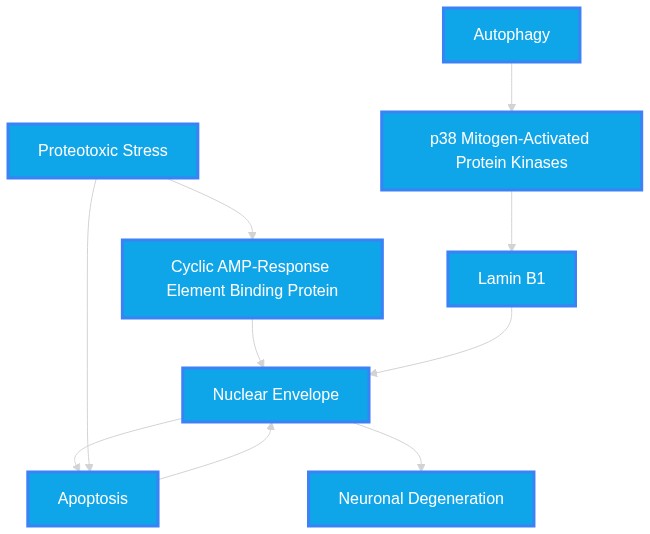
What is Karyoptosis and how does it align with past and present neurodegenerative disease research? Does Karyoptosis provide a new context in which a new class of repurposed therapeutics is formed?
Plausibility Verdicts
Karyoptosis is a distinct RCD marked by nuclear rupture. It is present in AD/FTD and is a potential therapeutic target.
Karyoptosis is a novel, distinct RCD characterized by nuclear rupture driven by loss of INM integrity. It aligns with neurodegeneration by providing a mechanism for cell death where apoptosis is insufficient, and it offers potential for repurposed therapeutics by targeting the CREB3 cleavage and p38 signaling pathways.
Dataset Summary
Novel & Overlooked Insights
- Karyoptosis is distinct from apoptosis, autophagy, and necroptosis, possessing its own unique biochemical signature.
- The p38 kinase signaling pathway regulates nuclear lamina stability, specifically controlling LaminB1, which highlights a druggable kinase target for preventing karyoptosis.
- The "explosive" nature of nuclear rupture in karyoptosis contrasts with the controlled fragmentation seen in classical apoptosis.
- Evidence suggests that autophagy inhibition can directly trigger this specific form of regulated cell death.
- Nucleolar stress and the mislocalization of proteins like nucleolin are emerging indicators of the nuclear instability that leads to karyoptosis in neurodegeneration.
- There is a clear distinction between caspase-dependent death and the caspase-independent pathways that characterize AIF-mediated nuclear changes.
- The study of CREB3 cleavage in cancer biology provides a template for developing therapeutics aimed at neuroprotection.
- Nuclear envelope integrity is a shared mechanosensitive hub for both healthy function and pathological degeneration.
- The existence of "hybrid" cell death phenotypes, involving both apoptotic and necrotic features, necessitates a more granular classification system for neuronal loss.
- Karyoptosis is fundamentally distinct from apoptosis, autophagy, necroptosis, and pyroptosis, necessitating a reclassification of cellular death phenotypes in neurodegenerative tissues.
- Nuclear waste clearance is a newly identified survival mechanism; when it fails, neurons accumulate waste, suggesting that therapeutic restoration of lysosomal exocytosis of nuclear debris is a viable neuroprotective strategy.
- The "BBB senescence unit," involving astrocytes and microglia, creates a self-sustaining inflammatory loop via the SPP1-CD44 axis that may drive Karyoptosis-related neurodegeneration.
- DMPK, classically associated with muscle dystrophy, is an essential nuclear envelope protein whose depletion causes nuclear fragmentation, highlighting an unexpected connection between neuromuscular and neurodegenerative pathology.
- The use of AI-guided medicinal chemistry (e.g., ChiTaRS 8.0/ChiTaH) allows for identifying novel chimeric RNAs in AD, which may serve as biomarkers for detecting pre-apoptotic nuclear distress.
- Pharmacological agents currently used for other purposes (e.g., statins, lithium, TUDCA) are being retrospectively identified as modulators of autophagy and protein aggregation, but their effects on nuclear envelope maintenance remain largely uncharacterized.
- Karyoptosis is specifically distinguished from established cell death pathways like apoptosis and pyroptosis.
- The nuclear envelope acts as a "mechanosensitive signaling hub" rather than a simple cellular barrier.
- The tension between tightly packed DNA and the nuclear lamina/anchoring proteins defines the boundary of cell viability.
- CREB3-FL acts as an inner nuclear membrane anchor that, when cleaved by S1P/S2P, triggers nuclear collapse.
- Karyoptosis provides an explanation for neuronal death in neurodegenerative diseases that is not fully accounted for by apoptosis.
- UVB radiation serves as an exogenous trigger for karyoptosis by inducing CREB3 cleavage.
- The transition from a structural anchor to a cleaved signaling fragment (CREB3-CF) is a key pathological checkpoint.
- The role of p38 kinase in regulating LaminB1 provides a potential drug-targetable interface.
Extracted Discoveries
- Assess the effect of p38 kinase inhibitors on LaminB1 stabilization in induced pluripotent stem cell (iPSC)-derived neurons from ALS/FTD patients.
- Evaluate the impact of stabilizing CREB3-FL tethering at the INM as a means to prevent nuclear rupture in models of proteotoxic stress.
- Assess the effect of p38 kinase inhibitors on LaminB1 stabilization in human iPSC-derived neurons subjected to proteotoxic stress.
- Evaluate whether APP overexpression specifically mitigates karyoptosis as opposed to classical apoptosis in AD models.
- Quantify the inhibition of karyoptosis in ALS/FTD neuron models using small molecule p38 kinase inhibitors.
- Assess if stabilizing CREB3-FL at the inner nuclear membrane prevents cell death under ER stress conditions.
- Compare the efficacy of S1P/S2P inhibitors in reducing karyoptosis-mediated neuronal loss versus traditional anti-apoptotic compounds.
- Comparative longitudinal study of karyoptotic markers versus apoptotic markers in patient-derived FTD and AD cortical tissue to determine the temporal precedence of each cell death type.
- Screening of FDA-approved compounds for their ability to influence the p38 kinase-LaminB1 axis as a strategy for repurposing neuroprotective agents.
- Comparative proteomic analysis of nuclear rupture markers (e.g., CREB3-CF) in CSF from pre-symptomatic versus advanced-stage AD patients.
- Investigation into whether existing drugs known to impact nuclear lamina (e.g., specific kinase inhibitors) decrease nuclear waste accumulation in vivo.
- Longitudinal analysis of CREB3 cleavage fragment accumulation in cerebrospinal fluid as a potential biomarker for FTD/AD progression.
- Comprehensive proteomic profiling of the nuclear envelope in post-mortem AD patient brains to correlate CREB3/LaminB1 loss with cognitive decline severity.
- Inhibition of specific S1P/S2P protease activity may prevent neurodegeneration in ALS/FTD by preserving CREB3-FL mediated nuclear anchoring.
- CREB3/S1P/S2P cleavage mechanism in karyoptosis (38480902, 41303380).
- Neurodegeneration in ALS/FTD involving nuclear envelope instability (42350373, 36001963).
- CREB3 (Cyclic AMP-responsive element-binding protein 3).
- Since CREB3 cleavage at the INM triggers nuclear rupture (karyoptosis) and these pathologies involve nuclear envelope instability, stabilizing the CREB3 tether via S1P/S2P protease inhibition represents a novel mechanism to prevent the terminal phase of neuronal death.
- Inhibitors of Cdk5-mediated lamin phosphorylation may function as potent karyoptosis preventatives in AD and ALS.
- Cdk5-induced lamin phosphorylation as a driver of neuronal death (ID 21389115).
- Karyoptosis as a form of regulated cell death induced by lamina instability (ID 42350373, 39625813).
- Lamin B1 stability and nuclear envelope integrity.
- Since Cdk5 induces lamina dispersion by phosphorylating LaminB1, and karyoptosis is fundamentally driven by lamina destabilization, blocking Cdk5-mediated phosphorylation is a logical, previously unlinked strategy to prevent karyoptosis.
- Inhibitors of S1P/S2P or p38 kinase may mitigate neuronal loss in FTD by preventing CREB3-mediated karyoptosis.
- ID 38480902: CREB3 cleavage leads to karyoptosis; cancer therapy potential.
- ID 42350373: FTD/AD patients show karyoptotic features linked to p38-mediated LaminB1 instability.
- Nuclear Membrane Integrity and Proteotoxic Stress Response Signaling.
- Since both cancer cell death and neurodegeneration rely on ER stress signaling that destabilizes the nuclear membrane, agents that prevent premature cleavage of anchoring proteins like CREB3 (a known regulator of karyoptosis) could be repurposed from oncology to neurology to preserve neuronal nuclear integrity.
- There is a distinction in the literature between caspase-dependent death (often labeled apoptosis) and caspase-independent, necrotic-like, or karyoptotic pathways, which creates potential diagnostic confusion in older literature that relies solely on nuclear morphology (e.g., chromatin condensation) to define 'apoptosis' without identifying the specific molecular mediator.
- There is a minor semantic conflict regarding whether DNA fragmentation always indicates apoptosis. ID 9596416 argues that DNA fragmentation in AD indicates metabolic disturbance and higher susceptibility rather than clear evidence of apoptosis, whereas other papers (e.g., ID 9714816) treat nuclear fragmentation as a late stage of apoptotic pathways.
- None identified; the literature is consistent in characterizing karyoptosis as a novel RCD distinct from other known cell death modalities.
- The use of p38 kinase inhibitors (originally investigated for various inflammatory pathways) and S1P/S2P protease modulators represents a strong candidate for repurposing in neurodegenerative disease to stabilize the nuclear envelope.
- The literature suggests p38 kinase inhibitors and potential autophagy enhancers (like VPA or CBZ) are strong candidates for repurposing. These drugs have established safety profiles and are shown to affect nuclear-related cellular death mechanisms, positioning them as potential therapeutic candidates to stabilize the nuclear lamina or improve nuclear waste clearance.
- The primary repurposed potential lies in targeting the p38 kinase pathway and S1P/S2P mediated proteolysis. Drugs originally designed to inhibit these pathways in cancer to induce/regulate cell death can be repurposed to modulate or inhibit karyoptotic cell death in neurodegenerative contexts.
PathMap is funded by sales of datasets and coversheets to researchers of any kind who wish to discover the most viable routes and paths to accelerate cures. We do not make theoretical molecules, we expose the truth in current PubMed literature. Commission a trace today.
PathMap Scores
How are these metrics evaluated?
Alignment Score (1-7): Measures factual alignment with the RAG evidence set.
[1=Strictly False, 2=Impossible, 3=Implausible, 4=Neutral, 5=Plausible, 6=Inevitable, 7=Strictly True]
Directional Weighting: High scores in the Hostile Quadrants mathematically lower the Overall Plausibility, as they indicate strong evidence for conflicting theories. Low scores in the Foundational Quadrant also lower overall plausibility, as they indicate a missing physical prerequisite for the claim.
AI Overview (Non-Expert Explanation)
Veridicality Audit Report
All Extracted Datapoints
Evaluated Perspectives & Quadrants
Verbatim Quote Audit Console
Mapped Reference Directory (APA)
Abstract Repository (Raw Full-Texts) Show Database
Investigator Profile