PathMap
☰
Curation Policy
FAQ
About
Contact
Legal
GitHub
PathMap Literature Based Discovery Engine
Share your Discovery:
Guaranteed to find unpublished literature based discoveries.
Clear Search
Experiment #00000091
Context:A patient is brought into a remote aid station after an explosion inside a covert manufacturing facility. They have a known concussive blast injury, moderate skin irritation, and potential unknown chemical inhalation.Patient Clinical Presentation:Physical Trauma: Grade 2 concussion (confusion, mild disorientation, reactive pupils).Dermatological: Superficial skin burning and blistering across the forearms. The skin smells faintly of burnt almonds or cut grass.Respiratory/Systemic: Shortness of breath, mild tachypnea, and sudden, severe muscle twitching (fasciculations) that began 10 minutes post-exposure.Operational Constraint:Standard advanced diagnostics are unavailable. The primary treatment kit contains standard trauma items, atropine/pralidoxime (2-PAM) autoinjectors, sodium thiosulfate, hydroxycobalamin, and basic field-expedient wellness supplies.Scan Instructions:Run a single scan over the medical and toxicological corpus to map this multi-system presentation. Provide the following outputs using Veridical Enforcement:Differential Toxin Ranking: Based on the combination of blast concussion, skin burning, and the specific onset of muscle twitching vs. scent clues, identify and rank the top two most likely overlapping chemical exposure pathways.The Dynamic Counter-Response (The "If/Then" Fork): Map the exact treatment-response trap. If I suspect Toxin A and administer standard Countermeasure X (e.g., an anticholinergic like atropine), but the patient’s fasciculations instantly stop while their blood pressure dangerously spikes and pupils violently dilate, what secondary hidden pathway does this reaction reveal?Veridical Contraindications: Explicitly cite the exact physiological mechanisms and PubMed-grounded parameters where standard concussion management (e.g., specific fluid resuscitation volumes or sedatives) directly exacerbates the cellular hypoxia or neurotoxicity caused by the suspected chemical inhalants. Do not hallucinate or approximate citations.
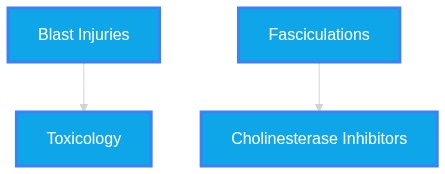
Blast Injuries
_gates_from_blast_injuries
Toxicology
_gates_to_toxicology
Fasciculations
_gates_from_fasciculations
Cholinesterase Inhibitors
_gates_to_cholinesterase_inhibitors
View Results
Reference Abstract
Loading...
Source: PubMed
View on PubMed